Independent public comparison
We asked U-Haul and Penske to quote the smallest suitable box truck for a one-way move from Los Angeles to San Diego. We are not affiliated with either company. This records the public journeys on 27 September 2026; prices and availability can change.
The Los Angeles to San Diego truck test
Move a studio or one-bedroom home from Los Angeles 90001 to San Diego 92101, collecting on 18 October 2026.
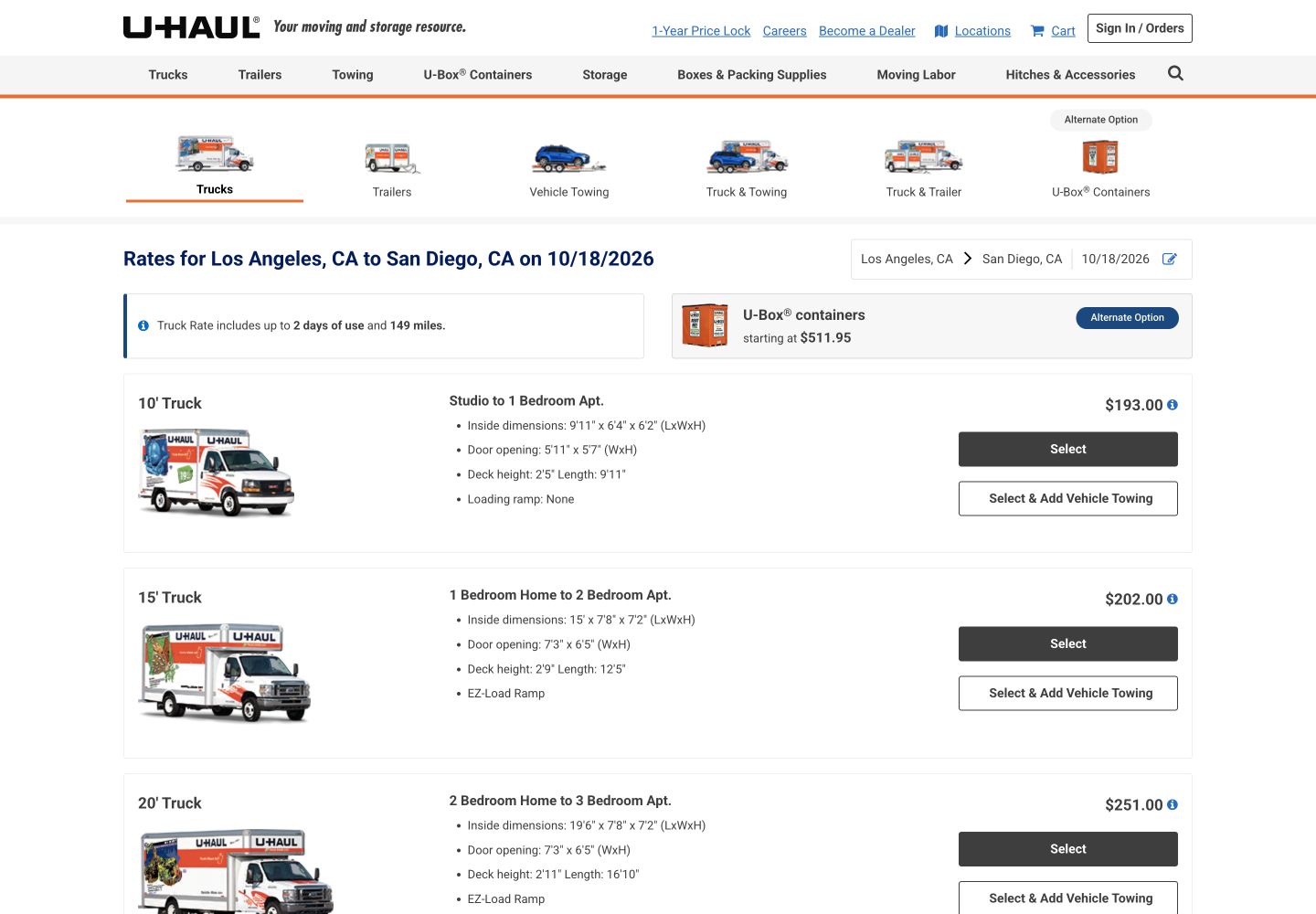
10-foot truck at $193, including up to two days and 149 miles.
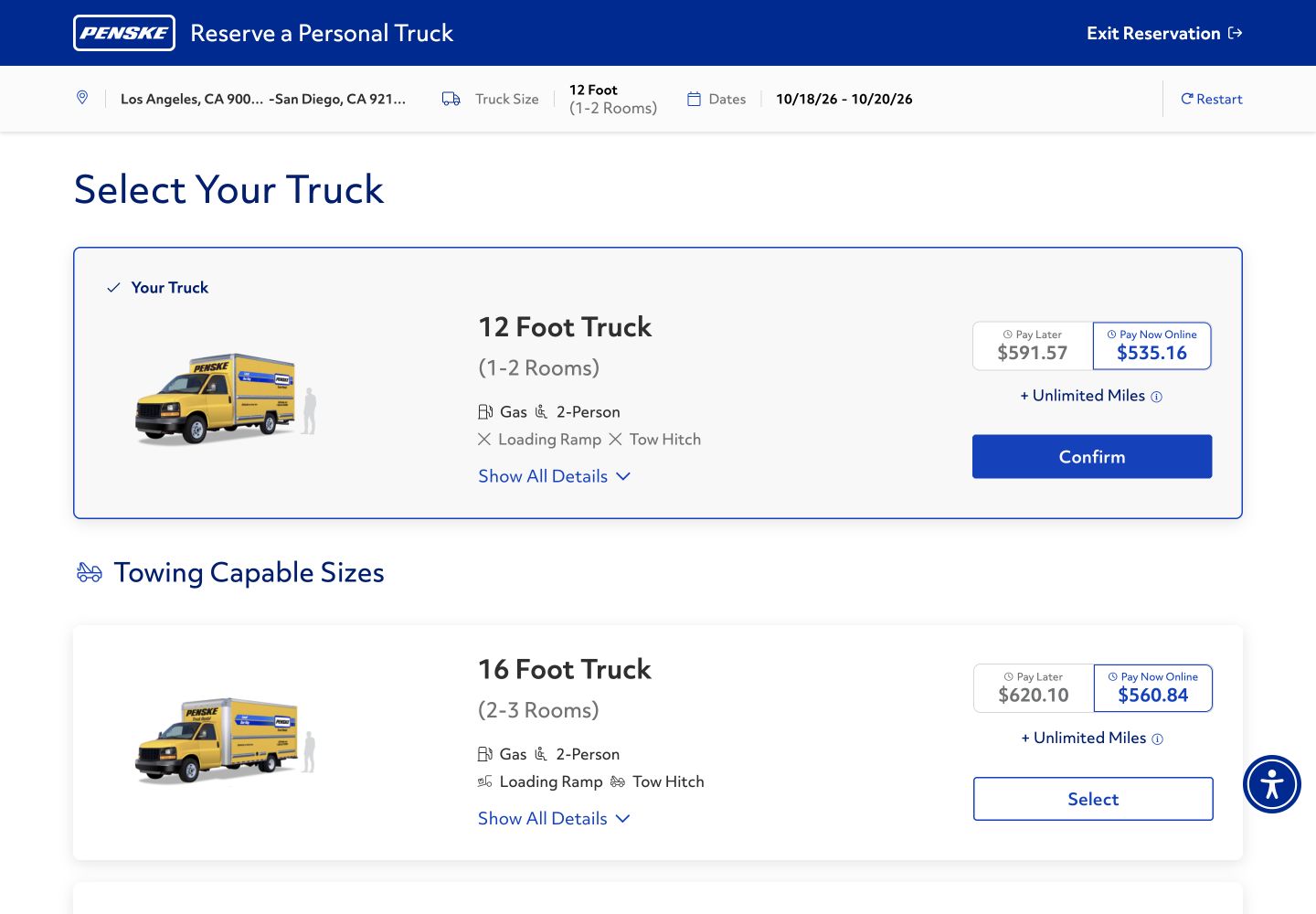
12-foot truck at $591.57 pay later or $535.16 pay now, including unlimited miles.
United States, unsigned-in desktop Chrome session, prices in US dollars.
The first truck and rate commitment, before identity, payment or reservation submission.
Attempt to continue without a required pickup time, then select one and confirm that progress is restored.
The 30-second result
U-Haul made the practical choice far cheaper and easier to size. Penske made the payment trade-off more visible.
U-Haul wins this quote journey. Its 10-foot truck matched the studio-to-one-bedroom brief at $193 and showed the included two days and 149 miles beside the result. Penske’s smallest truck was larger and included unlimited miles, but its $591.57 pay-later total was more than three times U-Haul’s quote. Penske clearly separated pay-later and pay-now prices, although the cheaper $535.16 option was selected by default even though it would charge the full amount at confirmation. U-Haul’s main caveat was a $32 Safemove option already selected when the journey reached protection.
Both preserved the route, date and household-size brief
U-Haul translated the same route into a compact result summary: Los Angeles to San Diego on 18 October, with the allowance attached to the rate. Penske retained the route, selected 12-foot size and a two-day window from 18 to 20 October in a persistent header. Both reduced the need to remember what had been entered.
U-Haul explained fit; Penske explained capability
U-Haul labelled the 10-foot truck for a studio to one-bedroom apartment and listed internal dimensions, door opening and deck height. The next sizes rose gradually to $202 for 15 feet, $251 for 20 feet and $300 for 26 feet. That made the smallest sufficient vehicle easy to identify without opening every card.
Penske described its 12-foot truck as suitable for one to two rooms and exposed two-person seating, petrol fuel and the absence of a loading ramp or tow hitch. A 16-foot truck rose to $620.10 pay later or $560.84 pay now. Those capability cues were useful, but the price gap dominated this particular short route.
Round winner / U-Haul
The rate was lower and the household-size guidance made the minimum suitable truck easier to recognise.
Optional protection and early payment changed the apparent deal
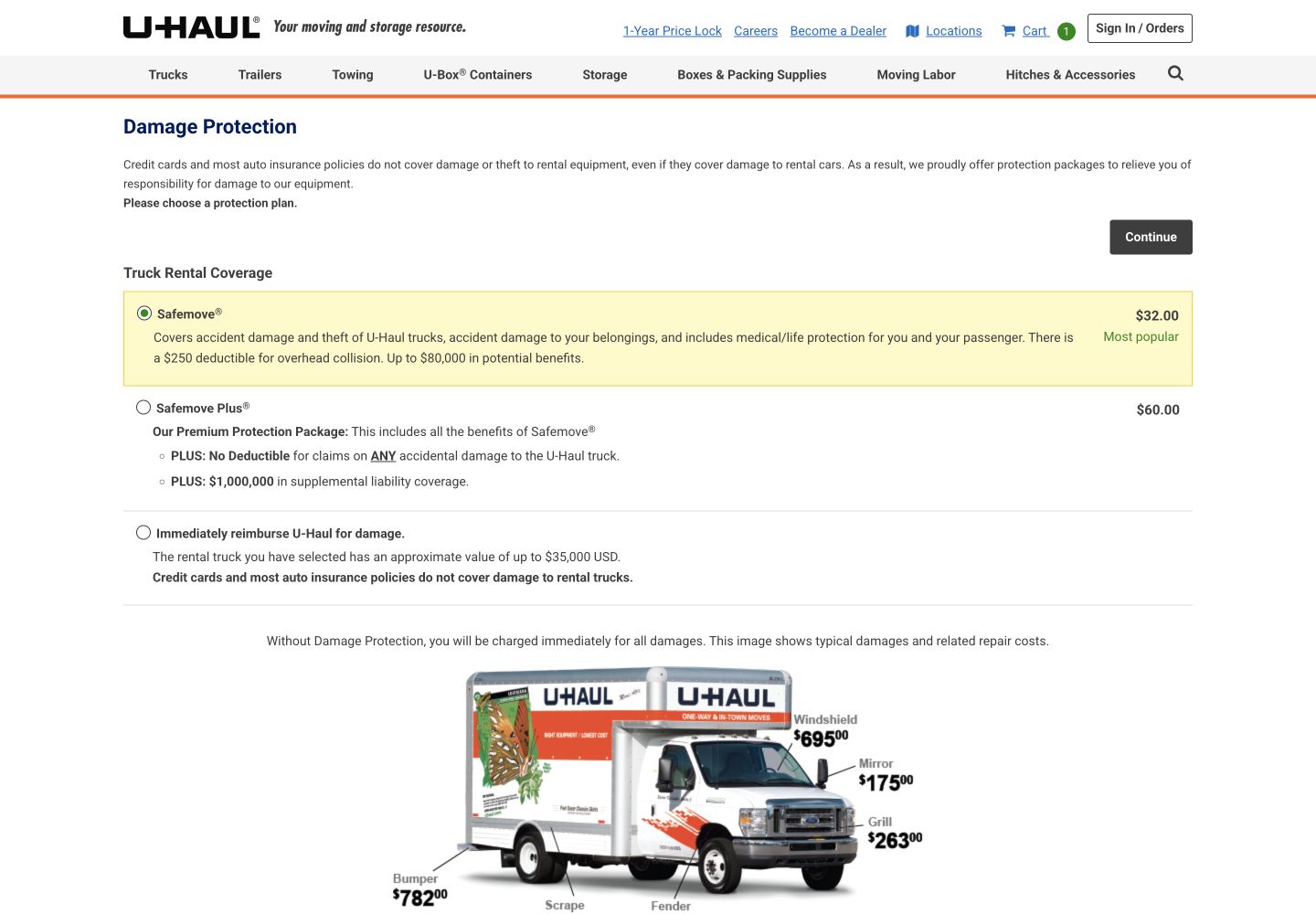
U-Haul’s headline $193 was not the final decision. The next step presented Safemove at $32 and Safemove Plus at $60, with Safemove already selected. Optional protection can be valuable, but a preselection makes the customer notice and reverse a cost rather than choose it deliberately.
Penske’s choice was financial rather than protective: pay $591.57 later or $535.16 now. The $56.41 saving was prominent, as was the fact that pay-now would be charged in full at confirmation. Selecting the committed option by default risks turning a comparison screen into an accidental purchase decision.
U-Haul named the missing pickup time but left focus behind
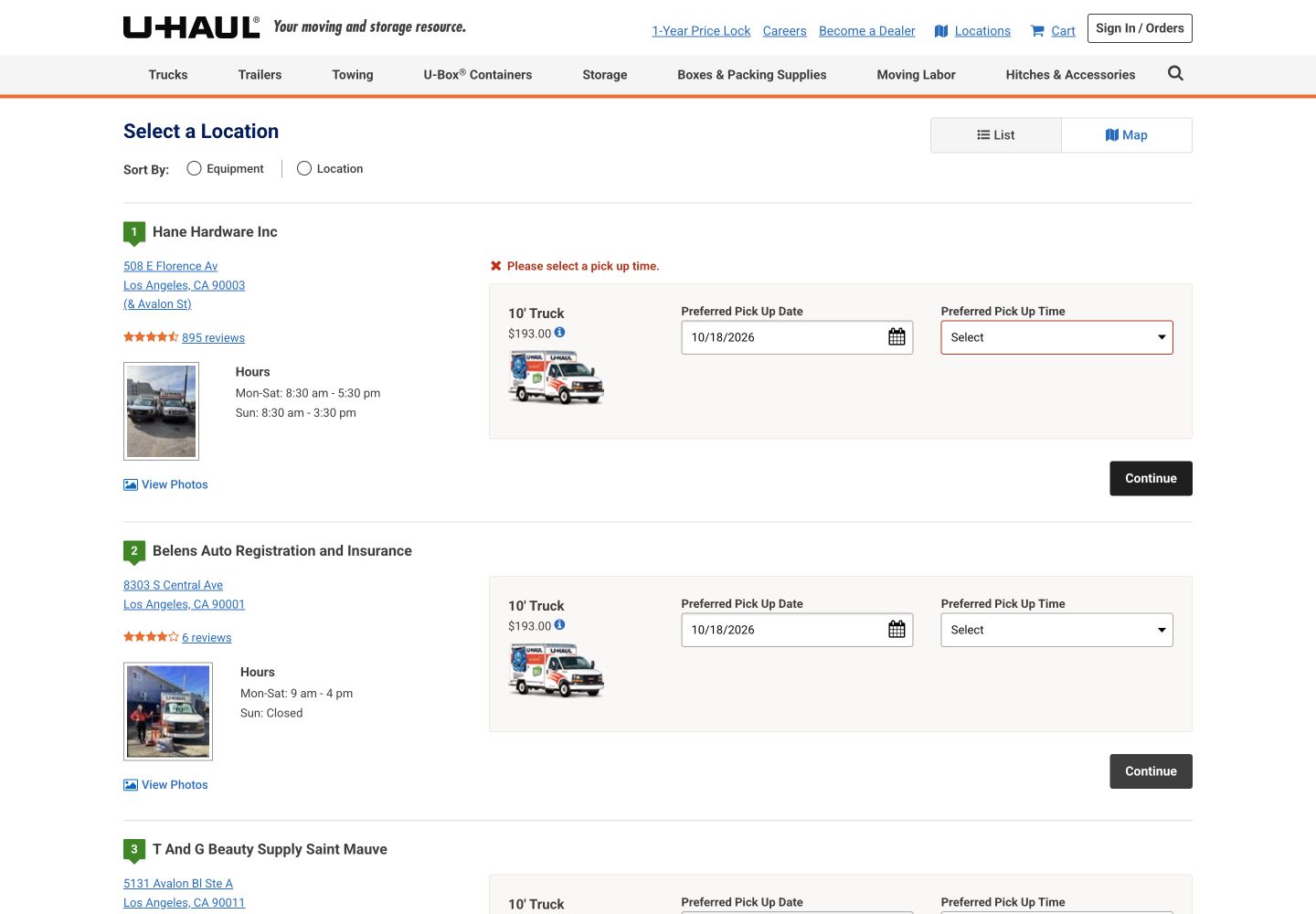
Continuing without a pickup time produced “Please select a pick up time.” The message appeared beside the required choice and selecting 9am restored progress without losing the truck or locations. Keyboard focus, however, remained on Continue rather than moving to the missing control, adding work for keyboard and assistive-technology users.
Both loaded well; both missed the good phone interaction threshold
These p75 phone Chrome UX Report records cover U-Haul’s public truck-rental page and Penske’s public quote start page from 29 August to 25 September 2026. They do not measure the dynamic rate, location or protection screens above. Both pages were stable and loaded inside the good threshold; interaction response needs improvement on both.
The configured mobile PageSpeed runs scored U-Haul 94 for accessibility and 69 for best practices, and Penske 97 and 73. U-Haul’s automated findings included contrast and links distinguishable only by colour. Penske’s included an unnamed interactive control. Both runs also named console problems, image delivery, caching and render-blocking work. These are investigation leads, not proof of WCAG conformance.
All ten Nielsen usability heuristics
Keep route, allowance and total together.
Both preserved the brief; U-Haul paired the allowance with the price most effectively.
Size trucks by homes and rooms.
Both converted feet into household capacity, reducing specialist knowledge.
Leave optional costs unselected.
U-Haul preselected protection; Penske preselected the paid-now rate.
Use one commitment pattern.
Price cards should make “charged now” as prominent as the saving.
Require a time before Continue.
U-Haul could disable or annotate the action until a pickup time is selected.
Expose what the rate includes.
U-Haul showed 149 miles; Penske showed unlimited miles on the cards.
Support commitment comparison.
Penske’s side-by-side pay options made the trade-off quick to scan.
Keep the core move ahead of add-ons.
U-Haul introduced an alternate container and protection around the truck decision.
Focus the missing field.
U-Haul’s message was specific but keyboard focus stayed on Continue.
Explain comparability.
Mileage, days, fuel, ramp and towing details all materially affect the apparent price.
What we would change first
Make protection an active choice.
What
Start with no optional coverage selected and compare protections neutrally.
Where
The protection step after truck and location selection.
Why
The observed $32 option was already included in the interface state.
Measure
Protection selection, reversals, support contacts and reservation completion.
Default to the reversible pay-later rate.
What
Leave pay-now unselected until the customer explicitly accepts immediate charging.
Where
Every truck card on the quote results page.
Why
The cheaper selected rate carried a materially different commitment.
Measure
Rate switches, confirmation reversals, payment complaints and completed reservations.
Show the effective trip cost in one place.
What
Keep days, included miles, excess mileage, payment timing and selected options beside the total.
Where
Truck results and the sticky quote summary.
Why
The two headline prices included different vehicle sizes and mileage terms.
Measure
Quote edits, total-detail opens and progression to customer details.
Bring phone interaction response below 200ms.
What
Profile route entry and result-card interactions; reduce blocking and legacy script work.
Where
The tested public start templates and reused quote components.
Why
Both exact pages missed the good p75 INP threshold.
Measure
Template-level p75 INP alongside successful quote starts.
What this public comparison cannot see
The trucks differed in size and mileage allowance. We did not enter identity, licence or payment details, submit a reservation, collect a truck, buy fuel or test cancellation. U-Haul progressed one step farther into protection; no claim is made about Penske’s later extras or final form.
We cannot say which journey converts better or which final rental costs less after fuel and optional products. GA4 could measure quote completion and option reversals, Search Console could show the moving needs that bring people into each journey, and Microsoft Clarity could reveal truck changes and validation recovery before confirmed reservations.