Independent public comparison
We asked Hertz and Enterprise to price the same 24-hour rental from Los Angeles International Airport for an unsigned-in driver aged 25 or over. We are not affiliated with either company. This records the public journeys on 27 September 2026; rates and availability can change.
The LAX rental test
Find a compact or economy car at LAX from noon on 20 October to noon on 21 October 2026, inspect extras and continue to the reservation form.
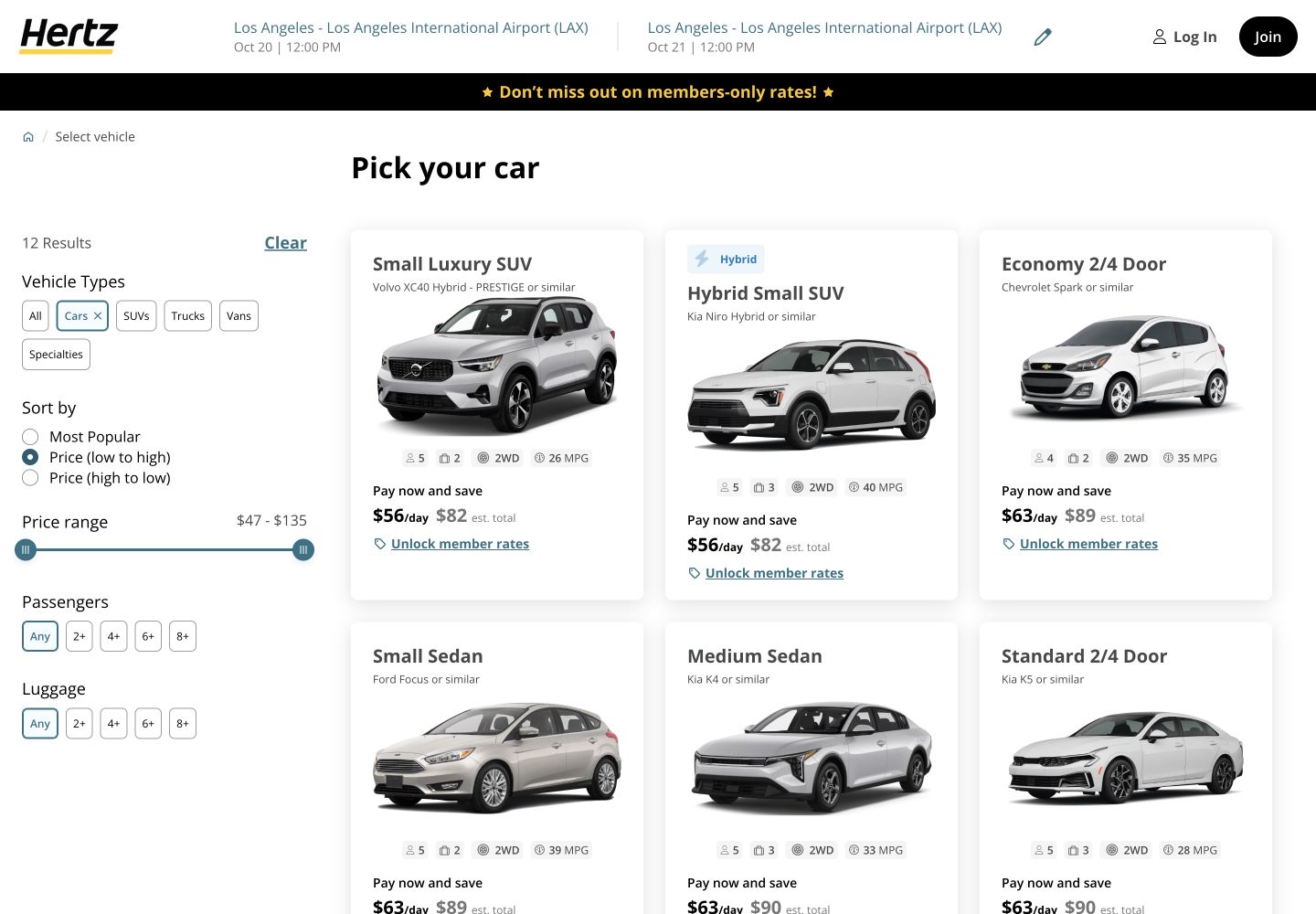
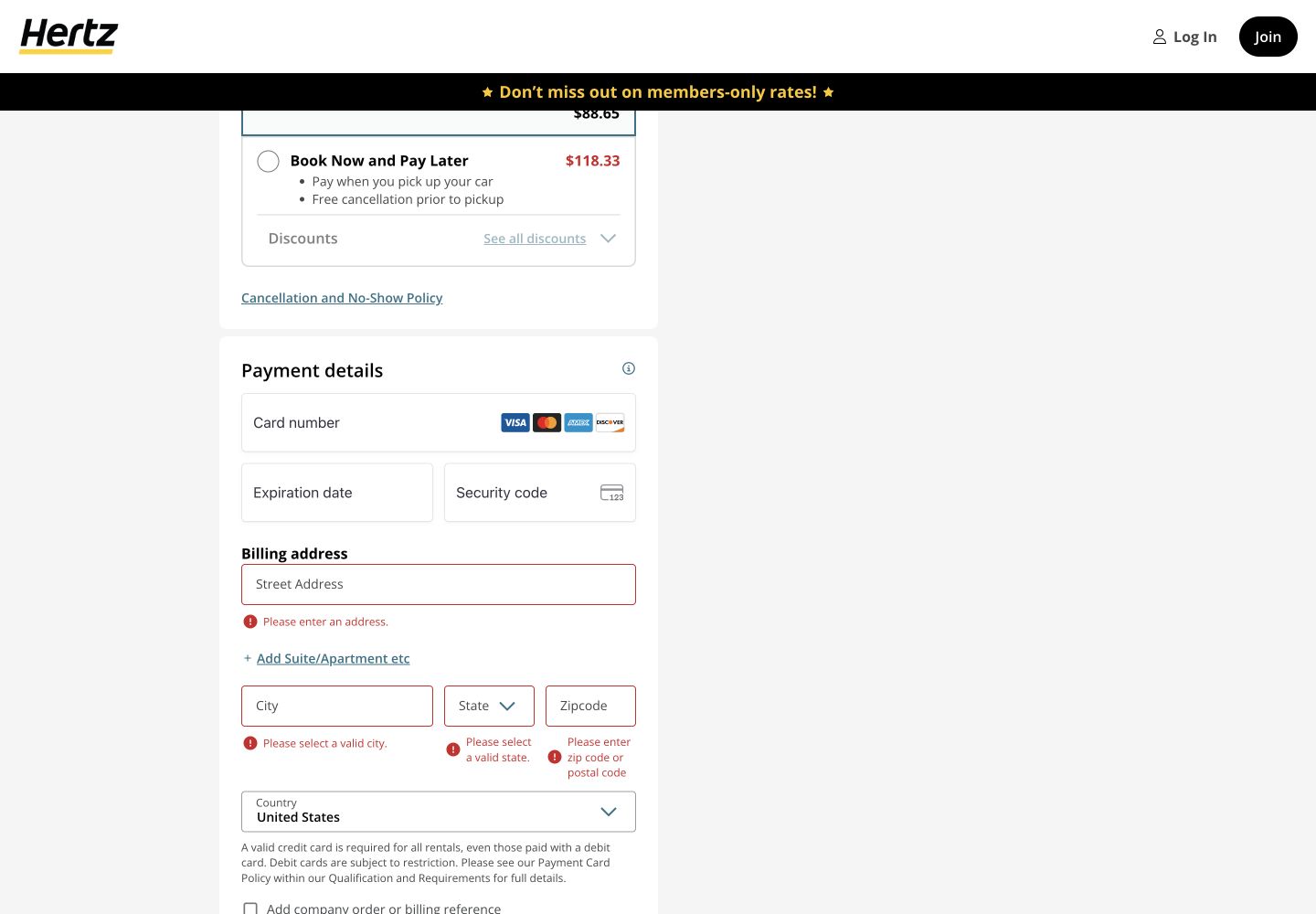
Chevrolet Spark and Ford Focus from $63/day. The selected car reached $88.65 pay now or $118.33 pay later.
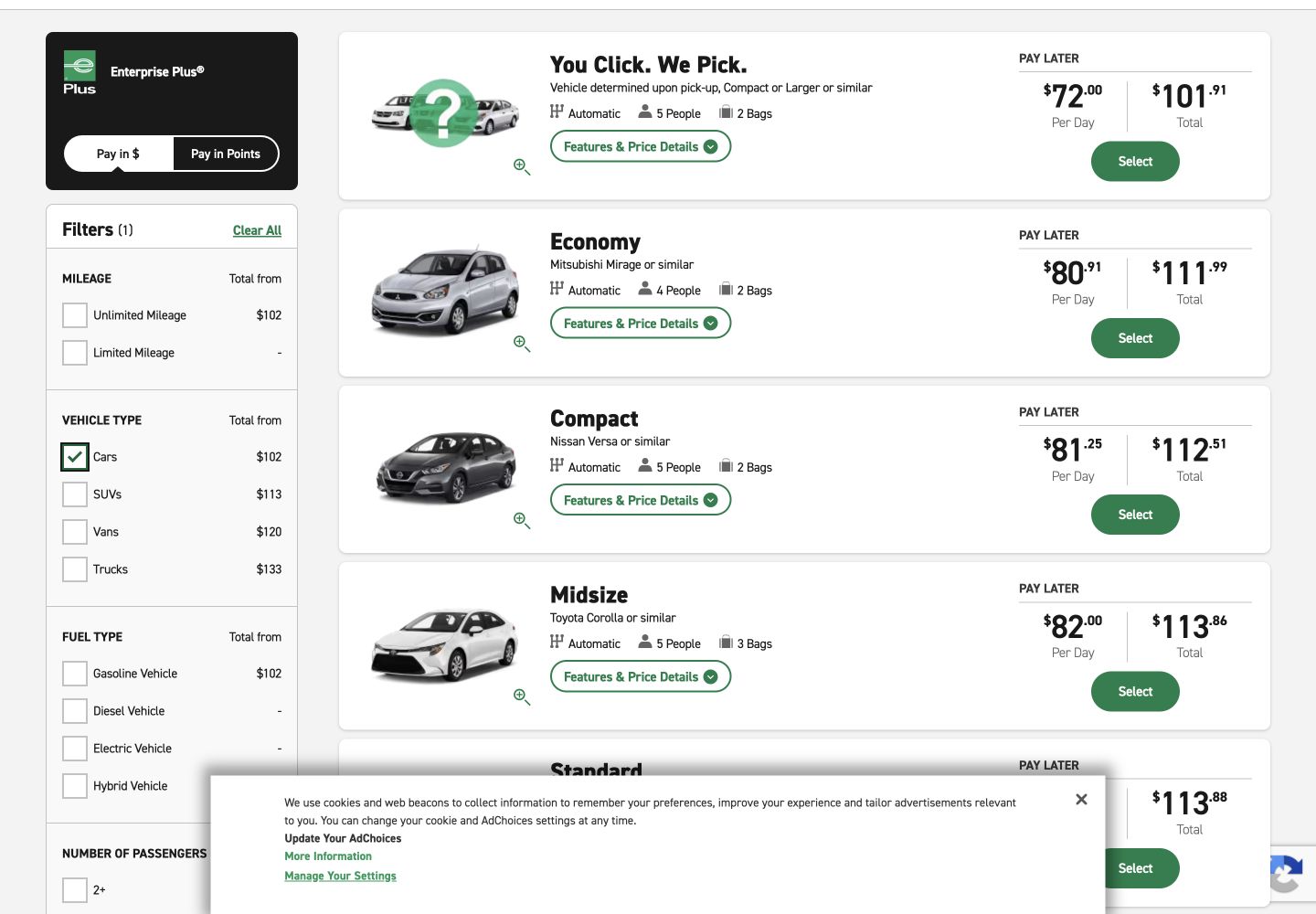
Nissan Versa compact at $81.25 time-and-distance and $112.51 total, payable at pickup.
One driver aged 25 or over, no account or loyalty status, prices in US dollars.
The empty reservation submission. We entered no identity, licence or payment data and made no booking.
Desktop Chrome fieldwork plus configured phone CrUX and mobile PageSpeed checks on the exact public start pages.
The 30-second result
Enterprise made the comparable pay-later deal easier to understand. Hertz made the lowest headline total conditional.
Enterprise wins this journey for clearer progress, a persistent total and a line-by-line tax and fee breakdown. Its $112.51 compact was also $5.82 below Hertz’s comparable $118.33 pay-later total. Hertz offered a materially lower $88.65 pay-now option, but the journey layered protection, toll and fuel decisions before a reservation form with a 28-minute timer. Enterprise’s win is qualified: SMS was set to “Yes” and email specials were preselected, which should be fixed before celebrating the rest of the flow.
Both found cars, but neither filter state was fully trustworthy
Hertz first warned that its LAX return location had moved to 5251 West 98th Street and explained the shuttle connection. The results page showed 39 vehicles. Selecting Cars and sorting low to high reduced that to 12, yet SUV cards still appeared while the SUV checkbox was visibly clear. A filter that contradicts its own results makes the customer re-check every card.
Enterprise initially returned 74 vehicles. Its Cars filter and low-to-high sort produced 33, beginning with “You Click. We Pick.” at $101.91 total, an Economy Mirage at $111.99 and the Compact Versa at $112.51. The selected “vehicle class” control on the start page had not constrained the initial result set, but the result cards themselves were easier to compare.
Round winner / Enterprise
The shorter rate hierarchy and consistent car cards reduced scanning, even though the start-page class choice did not visibly narrow the initial set.
Hertz had the cheapest commitment; Enterprise had the clearer comparable total
Hertz quoted the selected car at $88.65 if paid now and $118.33 if paid later. The cheaper figure is real, but it is not comparable to Enterprise’s “Pay at Pickup” offer without explaining the commitment. Enterprise’s $112.51 review total broke out $81.25 for time and distance, $9.14 concession recovery, $9 facility charge, $2.84 tourism assessment, $1.02 licence recovery and $9.26 sales tax.
Hertz made protection a high-friction decision
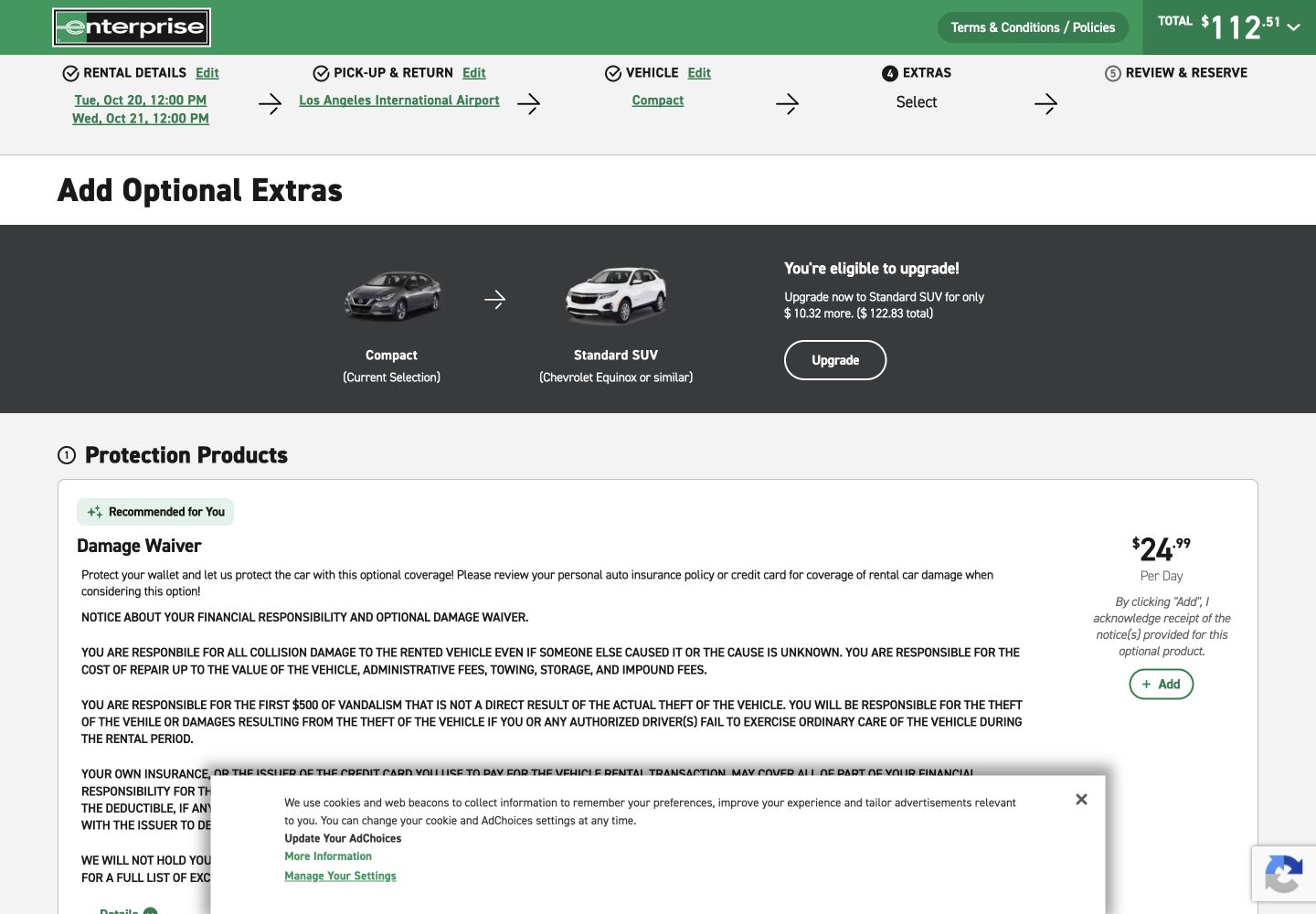
Hertz presented Complete protection at $49.57/day, Standard at $45.47 and Basic at $34.43. Rejecting protection required an explicit acknowledgement; selecting “I accept risk” before checking it produced “You must agree…” but left keyboard focus on the action button. Later extras included tolling at $15.99/day and a $70.08 fuel option. Each choice was understandable on its own, but the number and framing of consecutive upsells increased decision load.
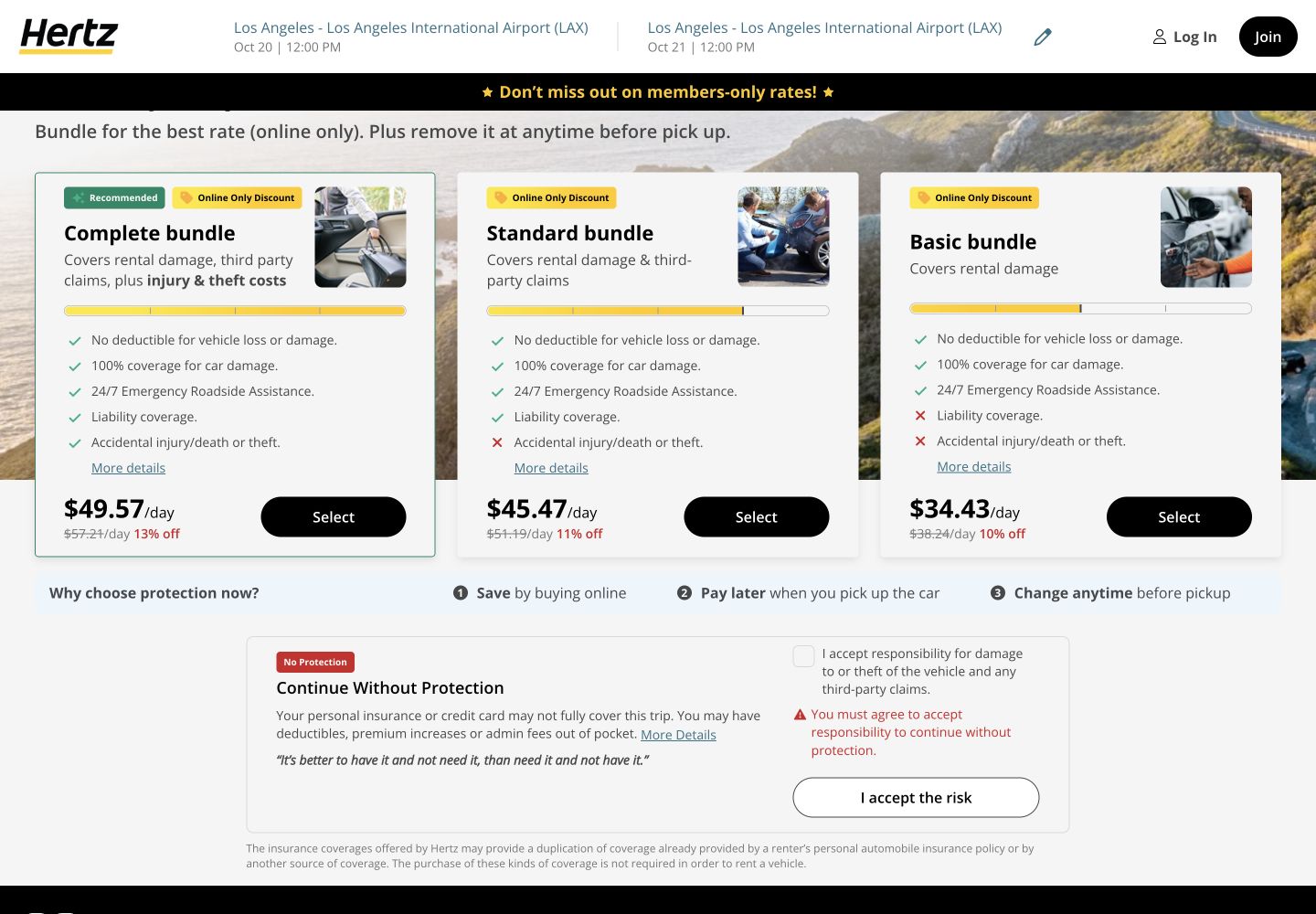
Enterprise offered a $10.32 standard-SUV upgrade, protections and equipment, but let the customer continue with none. Its damage-waiver notice was long, all capitals in places and contained “RESPONBILE” and “VEHILE”, which weakens trust precisely where legal and financial wording needs care.
The reservation forms exposed two different recovery problems
Submitting Hertz’s empty form produced inline errors for the missing personal and payment fields, but focus stayed on Book Now and there was no summary. Choosing Pay Later removed the card fields while leaving the “Payment details” heading behind. The screen also displayed a 28-minute rate timer, increasing pressure while the customer was resolving form issues.
Enterprise relied on native required-field validation. The first empty field received browser attention, but the controls still reported aria-invalid="false" and there was no page-level error summary. More seriously, SMS was set to “Yes” and “Enterprise Email Specials” was checked before consent. Reservation and marketing choices should be separate, unambiguous and off by default.
Enterprise loaded faster; Hertz reacted much more slowly
These p75 phone Chrome UX Report records cover the exact public airport start pages from 29 August to 25 September 2026. They are field results for those URLs, not measurements of the vehicle, extras or reservation screens above. Hertz’s 578ms INP deserves first investigation; Enterprise’s 0.15 CLS points to visible movement on its location template.
The configured mobile PageSpeed runs scored Hertz 86 for accessibility and 96 for best practices, and Enterprise 93 and 69. Hertz’s automated findings included heading order, missing image alternatives, unnamed links and disabled zoom. Enterprise’s included an unnamed button, positive tabindex and visible-label/name mismatches, alongside console errors and a named layout-shift culprit. These are diagnostic leads, not proof of WCAG conformance.
All ten Nielsen usability heuristics
Keep rate consequences visible.
Enterprise persisted the total; Hertz clearly contrasted pay now and pay later but added a countdown.
Use the traveller’s terms.
Vehicle, luggage and mileage information was useful; dense waiver language was not.
Declining must be neutral.
Hertz required a risk acknowledgement; Enterprise allowed extras to be skipped.
Make filters tell the truth.
Hertz showed SUV cards under a Cars-only state; Enterprise’s class choice did not constrain the initial set.
Separate consent from reservation.
Enterprise preselected marketing choices instead of asking deliberately.
Repeat the complete price.
Enterprise’s review kept taxes, policies and total together.
Support fast comparison.
Both offered sort and filter controls; Enterprise’s first cards were easier to scan.
Reduce decision stacking.
Hertz placed protection, toll and fuel decisions in sequence before identity.
Move focus to the problem.
Hertz left focus on submit; Enterprise’s native validation lacked an error summary.
Proofread consequential copy.
Enterprise’s damage-waiver notice contained visible spelling errors.
What we would change first
Turn marketing consent off by default.
What
Default SMS and email marketing to unselected, with separate plain-language choices.
Where
The final contact section.
Why
Consent should not be bundled into a reservation.
Measure
Valid opt-in rate, complaint rate and completed reservations.
Investigate the 578ms phone INP.
What
Profile long tasks around search, filters and rate choices; reduce main-thread and unused-script work.
Where
The airport start template and reused booking components.
Why
Exact-page p75 INP is poor, and PageSpeed named unused JavaScript and execution work.
Measure
Template-level p75 INP beside search completion.
Focus the first invalid control and add a summary.
What
Link concise error messages to controls, move focus and announce the summary.
Where
Protection acknowledgement and Book Now validation.
Why
The observed errors were visible but inefficient to recover from.
Measure
Recovery time, repeat submits and keyboard completion.
Stabilise the moving components.
What
Reserve image, banner and module dimensions and fix the element named by the lab run.
Where
The LAX public location page and shared shell.
Why
Exact-page phone CLS was 0.15.
Measure
p75 CLS and misclicks during search starts.
What this public comparison cannot see
We did not enter identity, licence or payment data, reserve a car, collect it or test cancellation. Inventory, taxes, eligibility and prices can change. The selected cars were comparable classes, not guaranteed identical models.
We cannot say which journey converts better. Connected analytics and session evidence could quantify filter corrections, extra acceptance, validation loops, consent choices and completed rentals.