Independent public comparison
We asked Currys and John Lewis to sell the same black Sony WH-1000XM5 headphones for delivery or collection in central London, then continued as a guest to payment. We are not affiliated with either retailer. This records the public journeys on 27 September 2026; prices and availability can change.
The London headphones test
Buy black Sony WH-1000XM5 headphones, compare delivery and collection in central London, and reach payment as a guest.
£229 with free standard delivery, optional cover and a guest checkout that reached payment.
£229.99 with free delivery or collection, a two-year guarantee and a guest checkout that reached payment.
United Kingdom, unsigned-in desktop Chrome at 1440 × 1000 pixels, postcode SW1A 2AA, prices in pounds sterling.
The payment step on both sites. No payment details were entered and no order was placed.
The same colour and model, one unit, current fulfilment choices, guest checkout and the price disclosed before payment.
The 30-second result
John Lewis made fulfilment and payment choices easier to inspect. Currys was 99p cheaper but added more interruptions.
John Lewis wins this task narrowly. It showed free delivery and collection, preserved the chosen product through a clear guest route and offered a broad set of payment methods. Currys reached the same safe boundary for £229, but the journey inserted a protection-plan decision, defaulted an email-marketing checkbox on and initially described a delivery option as selected even though Continue still required a choice. John Lewis also used an opt-out marketing pattern, so neither retailer should treat the winner as permission to leave consent unchanged.
Both found the exact headphones; John Lewis made the service promise stronger
Currys listed the black WH-1000XM5 at £229, supported by 2,889 reviews and free standard delivery for orders over £40. John Lewis listed the same colour and model at £229.99 with free standard delivery, free collection and a two-year guarantee. The 99p Currys saving is real but too small to decide the journey on its own.
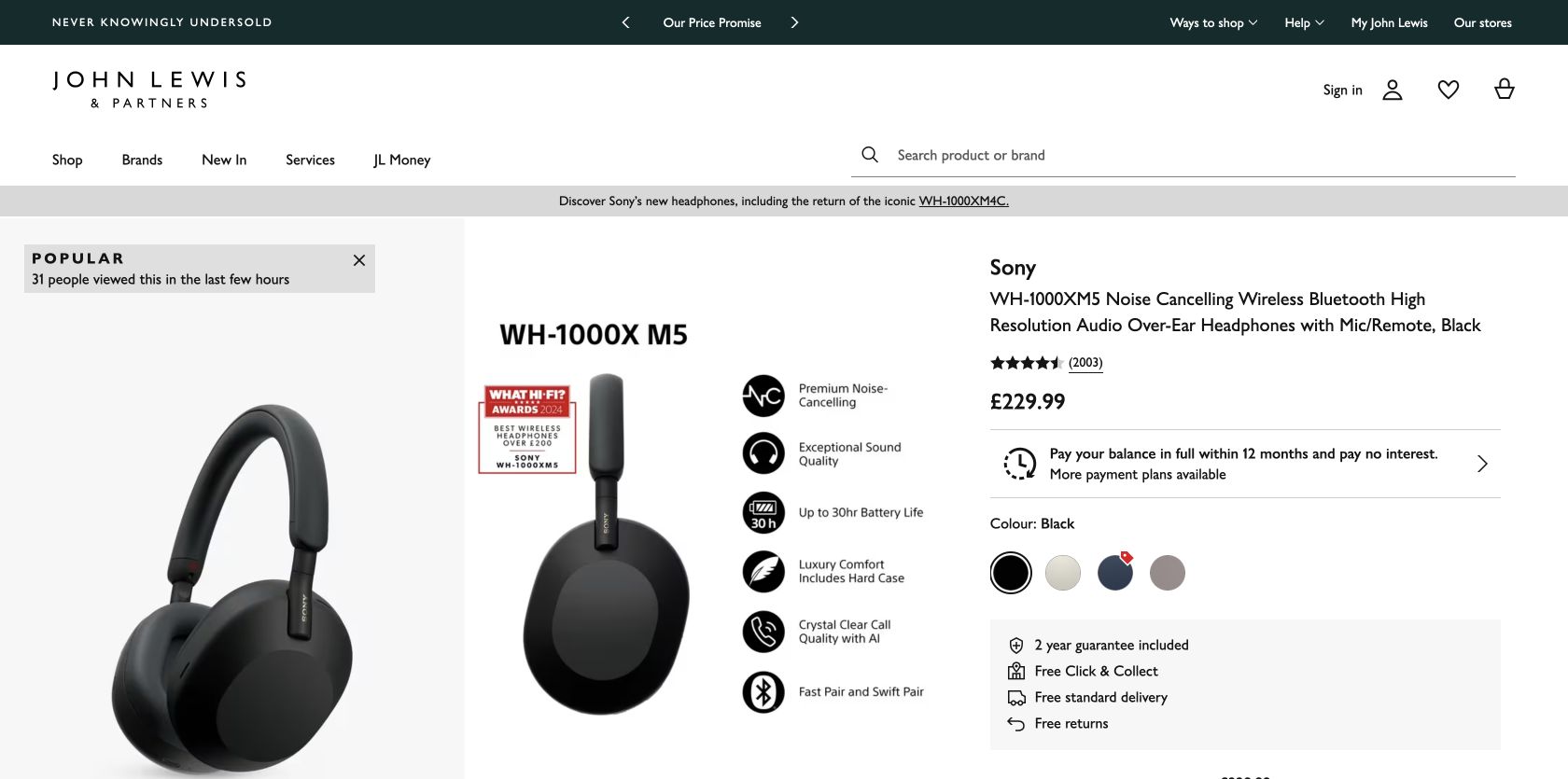
Round winner / John Lewis
The 99p premium bought a clearer guarantee and more visible fulfilment choice.
Optional protection stayed optional, but both made shoppers decline it explicitly
Currys offered Care & Repair for £2 a month, £45 for three years or £60 for five years. After Add to basket, an interruption required a choice before continuing; “Continue without Care & Repair” was available and no plan was preselected. John Lewis similarly opened a Protect Plus panel offering three years for £25, with a route to continue without it.
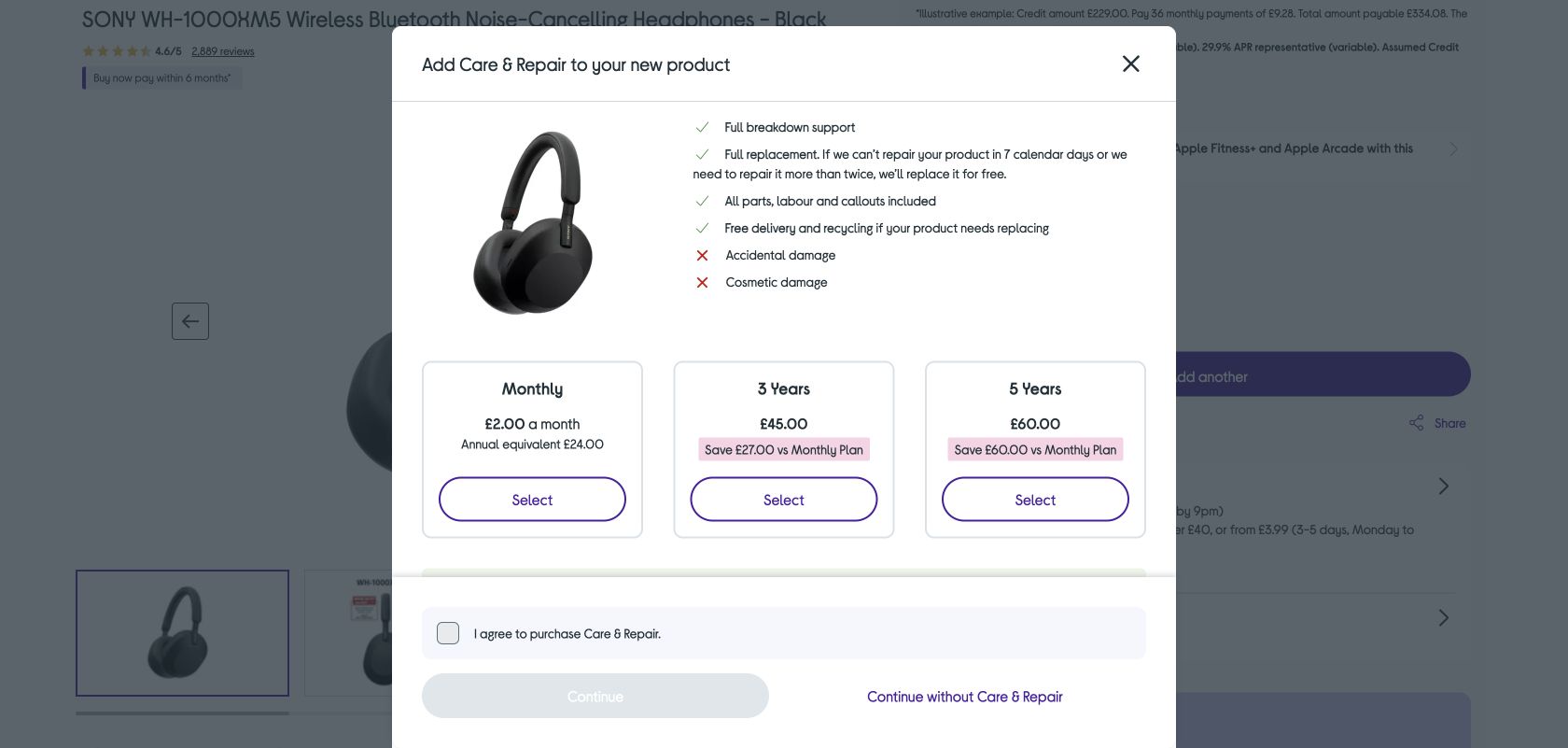
Neither site silently added cover, which is the important protection against bill shock. The remaining cost is interruption: a customer who has already chosen Add to basket must process a second decision before seeing the basket. The decline action should be visually equal, and experiments should measure whether the panel improves informed uptake rather than merely increasing accidental attachment.
John Lewis made collection concrete; Currys exposed a delivery-state contradiction
Currys showed a £229 basket total and a clear guest route. After contact details and a central London address were entered, its delivery step displayed “Book a slot” as selected. Continue nevertheless asked for a delivery selection. Choosing the free three-to-five-working-day option recovered the journey and reached payment, but the initial checked state did not match the system’s validation state.
John Lewis showed a £229.99 basket and guest checkout. The radio control itself did not respond in our first attempt, while clicking its visible “Guest checkout” label did. Collection search for SW1A 2AA returned several named London locations, distances and availability. Waitrose Victoria Street was 0.58 miles away, free and available from 3pm the next day.
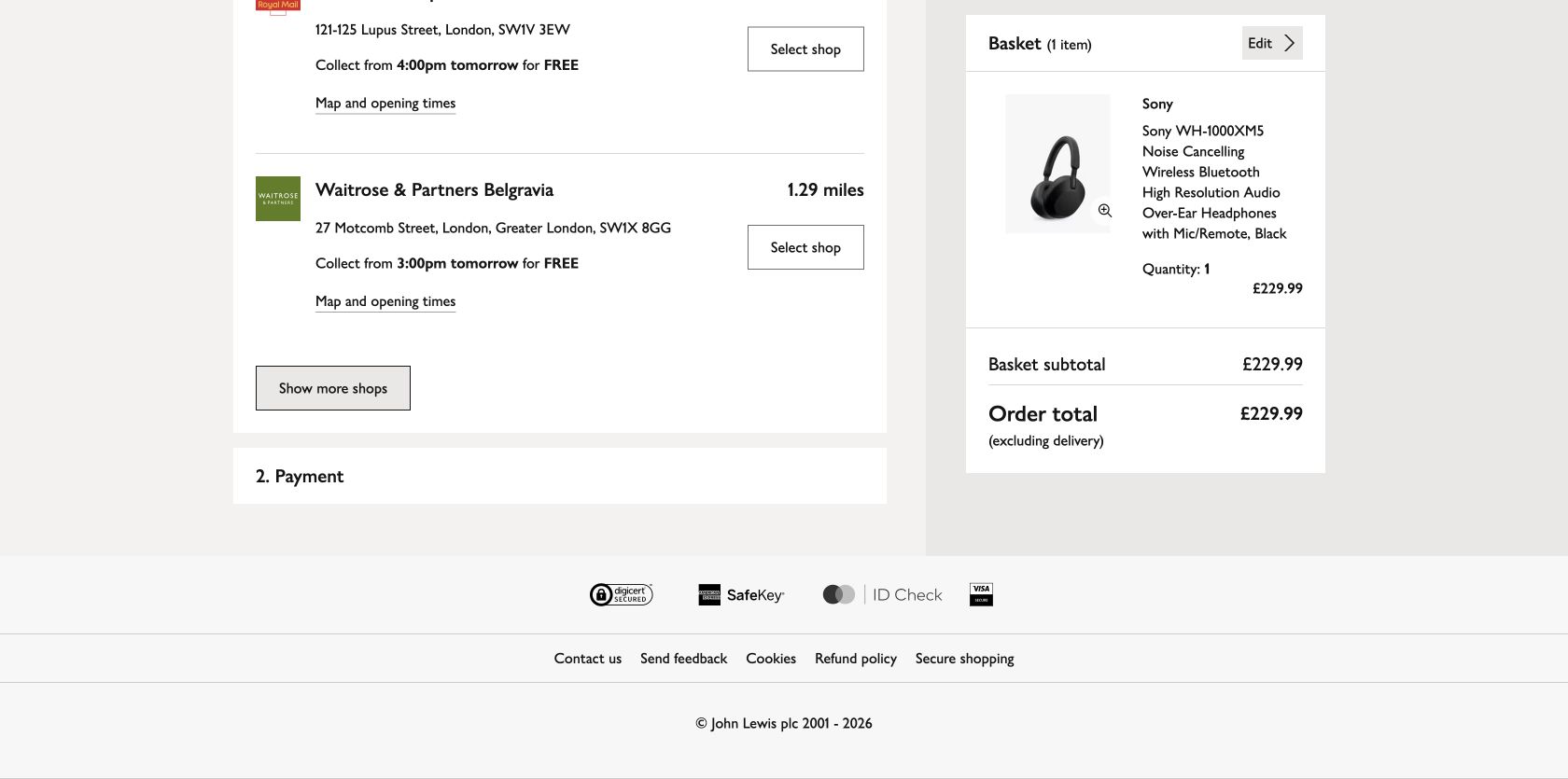
At payment, John Lewis exposed Apple Pay, Google Pay, card, PayPal and buy-now-pay-later choices. Currys reached card payment with the total intact and also presented PayPal earlier in checkout. Both preserved the product and total through the guest journey.
Round winner / John Lewis
Collection results answered where, when and how far; its payment set was also easier to inspect.
Specific messages appeared, but focus recovery was incomplete
Currys named a missing email after an empty Continue attempt, but keyboard focus stayed on Continue rather than moving to the field. John Lewis produced an error summary for an empty guest email, yet the visible route to the error was not reliably actionable and focus also remained on Continue. Its empty collection search gave a useful specific message, but focus stayed on Search. Each journey recovered once valid data was supplied; neither made the next keyboard action as obvious as it should be.
Consent needs separate attention. Currys’ email-marketing checkbox was selected by default and had to be turned off. John Lewis framed marketing as an opt-out—leave the box unticked to receive messages—so its unchecked default still meant consent. Both patterns weaken trust at the moment customers are trying to finish a purchase.
John Lewis met all three good phone field thresholds
These p75 phone Chrome UX Report records cover the exact public product URLs from 29 August to 25 September 2026. They do not measure the basket, collection or payment pages above, and they cannot prove that one component caused a metric. John Lewis met the good thresholds for loading, interaction and visual stability. Currys loaded within the good threshold, while interaction and layout movement need attention.
Automated checks found broader structural issues on Currys
The configured mobile PageSpeed run scored Currys 66 for accessibility and 92 for best practices. It identified controls and a dialog without accessible names, invalid ARIA relationships, contrast, heading order, missing labels and link names, restricted zoom, positive tabindex values, small targets and label/name mismatches. John Lewis scored 84 for accessibility and 96 for best practices, with findings around required ARIA children and parents, unnamed buttons, heading order and list structure.
Scores are triage signals, not proof of WCAG conformance. Manual follow-up should include keyboard operation of guest radio controls and cover panels, focus movement after failed submission, zoom, announcement of collection results, error-summary links and the accessible names of icon-only actions.
All ten Nielsen usability heuristics
Make selected delivery real.
Currys visually selected “Book a slot” while validation still considered delivery incomplete.
Name place, distance and time.
John Lewis made collection options concrete rather than merely saying collection was available.
Keep decline actions equal.
Both let customers refuse paid cover without losing the basket.
Make the whole radio target work.
John Lewis’s guest label worked when the control itself appeared not to.
Use affirmative marketing consent.
Currys preselected marketing; John Lewis used an opt-out construction.
Keep the product and total visible.
Both carried the selected headphones and price through guest checkout.
Preserve a direct guest route.
Neither forced account creation before payment.
Reduce protection interruption.
A secondary service became a mandatory decision after Add to basket on both sites.
Move focus to the first problem.
Both produced messages but left keyboard focus on the submitted action in the observed guest test.
Explain service terms at choice.
Guarantee, collection timing and protection term should remain beside the decision.
What each team should keep
- Currys: competitive price, visible review volume, free delivery, optional cover and a complete guest path.
- John Lewis: two-year guarantee, specific collection results, free fulfilment, optional cover and a broad payment set.
What we would change first
Replace default and opt-out marketing with an empty affirmative choice.
What
Leave marketing unselected and use a plain, standalone label.
Where
Guest contact and review steps.
Why
Consent should not depend on noticing and reversing a default or a negative sentence.
Measure
Consent rate, unsubscribe rate, complaints and checkout completion.
Unify visual selection and validation state.
What
Only show a checked delivery option when it satisfies Continue; otherwise label it as an unopened selector.
Where
The delivery-choice card and validation logic.
Why
A checked option that fails validation contradicts the interface’s status.
Measure
Delivery errors, option reselection and step completion time.
Focus and announce the first invalid field.
What
Add a linked summary and move focus to the first invalid input after submission.
Where
Guest contact, address and collection search.
Why
Specific messages were present, but the next keyboard action was not reliably surfaced.
Measure
Repeat submissions, recovery time and abandonment after errors.
Prioritise interaction and layout stability.
What
Reserve space for fulfilment and promotions, remove positive tabindex and reduce work around cart actions.
Where
Product, protection and fulfilment components.
Why
The exact product URL missed the good p75 thresholds for INP and CLS and the accessibility run exposed component debt.
Measure
Exact-page p75 INP and CLS alongside add-to-basket and checkout progression.
What this public comparison cannot see
We tested one product, one London postcode and current public fulfilment. We did not enter payment details, place an order, collect or receive the item, test returns, make a guarantee claim or buy protection. Both sites reached payment without an account.
We cannot say which journey converts, fulfils or retains customers better. GA4 could compare cover-panel exits, delivery selection errors and guest progression; Microsoft Clarity could expose dead control targets and error recovery; Search Console could monitor discovery of product and collection pages; fulfilment and service data could connect the promise to the delivered experience.