Independent public comparison
We asked Best Buy and Target to sell the same Apple AirPods 4 with Active Noise Cancellation for pickup near ZIP code 90012, then continued as far as each unsigned-in journey allowed. We are not affiliated with either retailer. This records the public journeys on 27 September 2026; prices and availability can change.
The Los Angeles pickup test
Buy Apple AirPods 4 with Active Noise Cancellation for store pickup near downtown Los Angeles and continue without signing in.
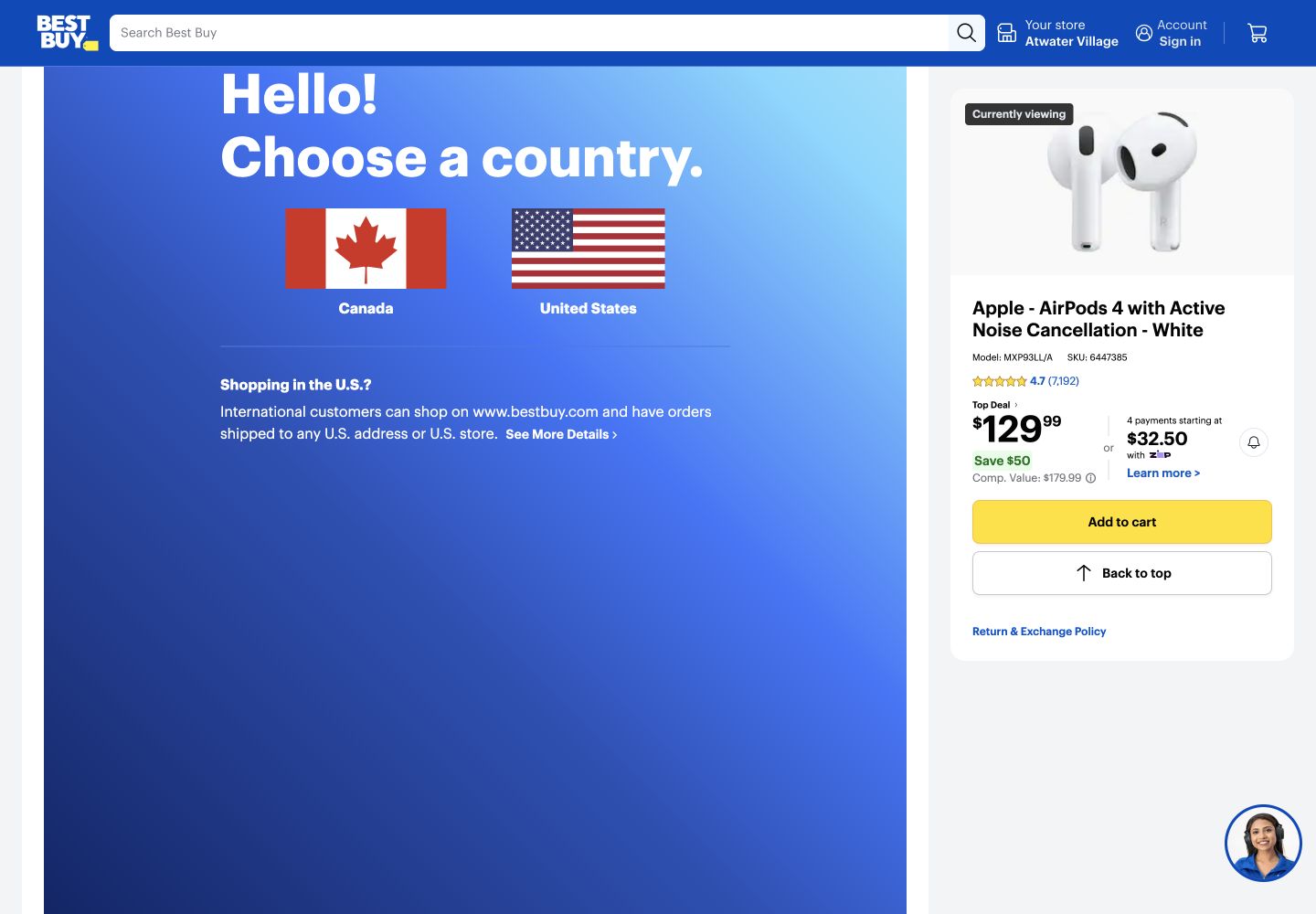
Model MXP93LL/A at $129.99, pickup at Atwater Village, with a $144.61 checkout total.
The same ANC model at $179.99, pickup at LA Bonnie Brae, with a $198.54 estimated total.
United States, unsigned-in desktop Chrome at 1440 × 1000 pixels, ZIP code 90012, prices in US dollars.
Payment for Best Buy and Target’s mandatory account-creation step. No account, order or payment authorisation was created.
The exact Apple model, one unit, current pickup availability and the total disclosed before payment.
The 30-second result
Best Buy was $53.93 cheaper at checkout and let a guest reach payment. Target turned pickup into account creation.
Best Buy wins this task. Its sale price survived the cart, it disclosed tax and the California recycling fee separately, and a guest could reach card payment. Target’s same product cost $179.99 before tax and its checkout action opened “Create an account!” with no guest route. That is a deliberate product decision rather than a broken page, but it adds a lasting commitment to a one-off pickup purchase. Target handled the empty email error better by moving focus to the field; Best Buy left focus on Continue.
Both found the exact model; Best Buy made the offer easier to value
Best Buy identified model MXP93LL/A and showed $129.99 against a $179.99 comparable value, a $50 saving. Pickup at Atwater Village was free. AppleCare+ for two years cost $29 and remained unselected. The product, saving, fulfilment and optional protection could all be checked before adding the item.
Target showed $179.99 and pickup within two hours at LA Bonnie Brae. AppleCare+ and an Allstate two-year plan each cost $29 and remained unselected. Changing the store briefly produced a mixed state: the header named Los Angeles while the product module still showed the previous Houston context. Refreshing restored a consistent pickup state, but the page should update those dependent regions atomically.
Round winner / Best Buy
The exact model was $50 cheaper before tax and the saving was explicit.
Best Buy preserved the saving through the full total
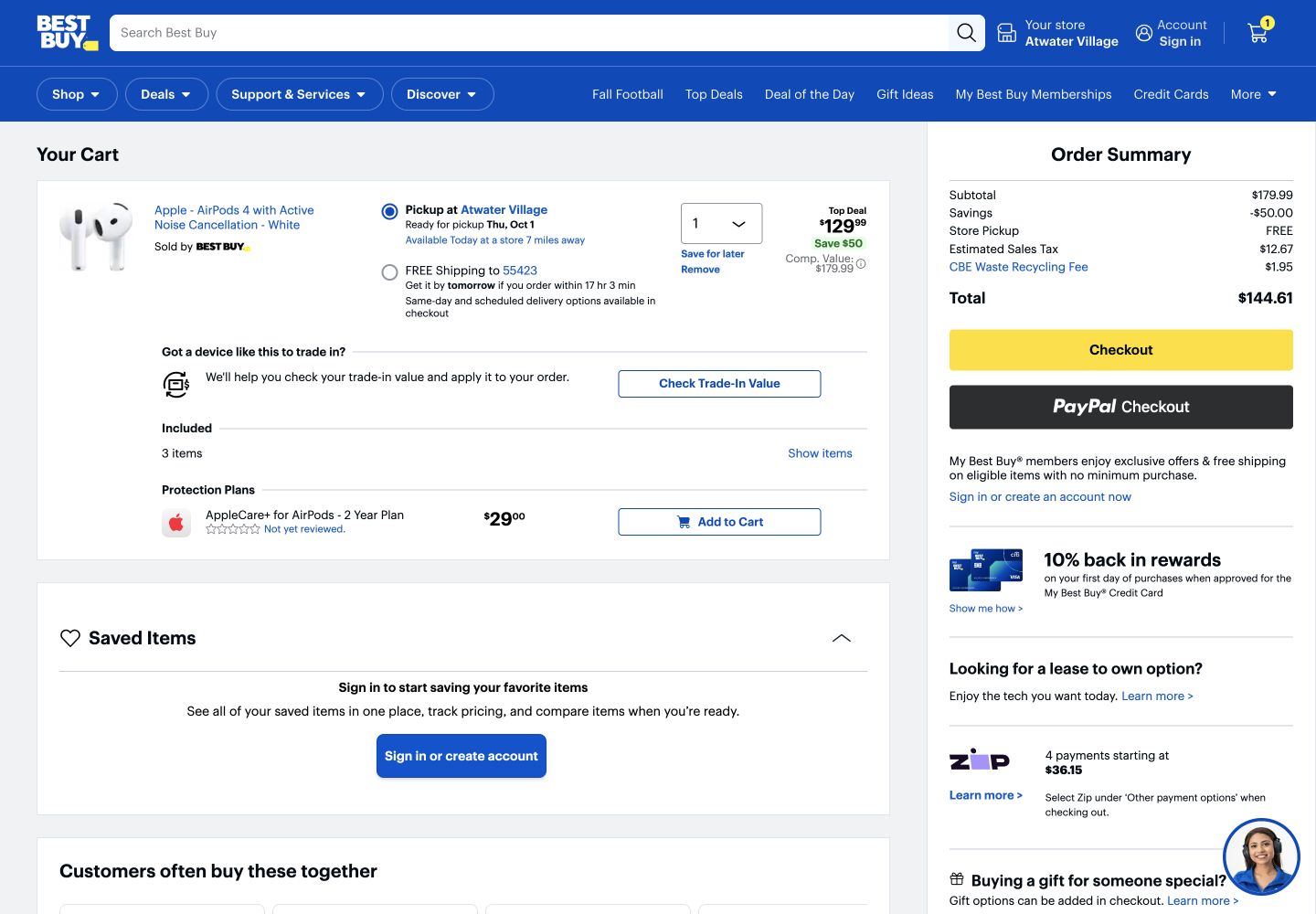
Best Buy’s cart started from $179.99, subtracted the $50 saving, added $12.67 tax and a $1.95 California battery or waste-recycling fee, then showed $144.61 due. Free store pickup remained attached to the item. The arithmetic and the reason for each addition were visible before checkout.
Target’s cart showed an estimated total of $198.54. Against Best Buy’s $144.61, the observed all-in difference was $53.93. Taxes and location-dependent fees can change, but the gap was already established by the product price rather than a late checkout surprise.
Best Buy offered guest checkout; Target required a profile
Best Buy presented guest checkout as a first-class path. After reserved contact details were entered, the journey reached card payment with the $144.61 total intact. The customer could inspect the commitment without joining a loyalty programme or creating credentials.
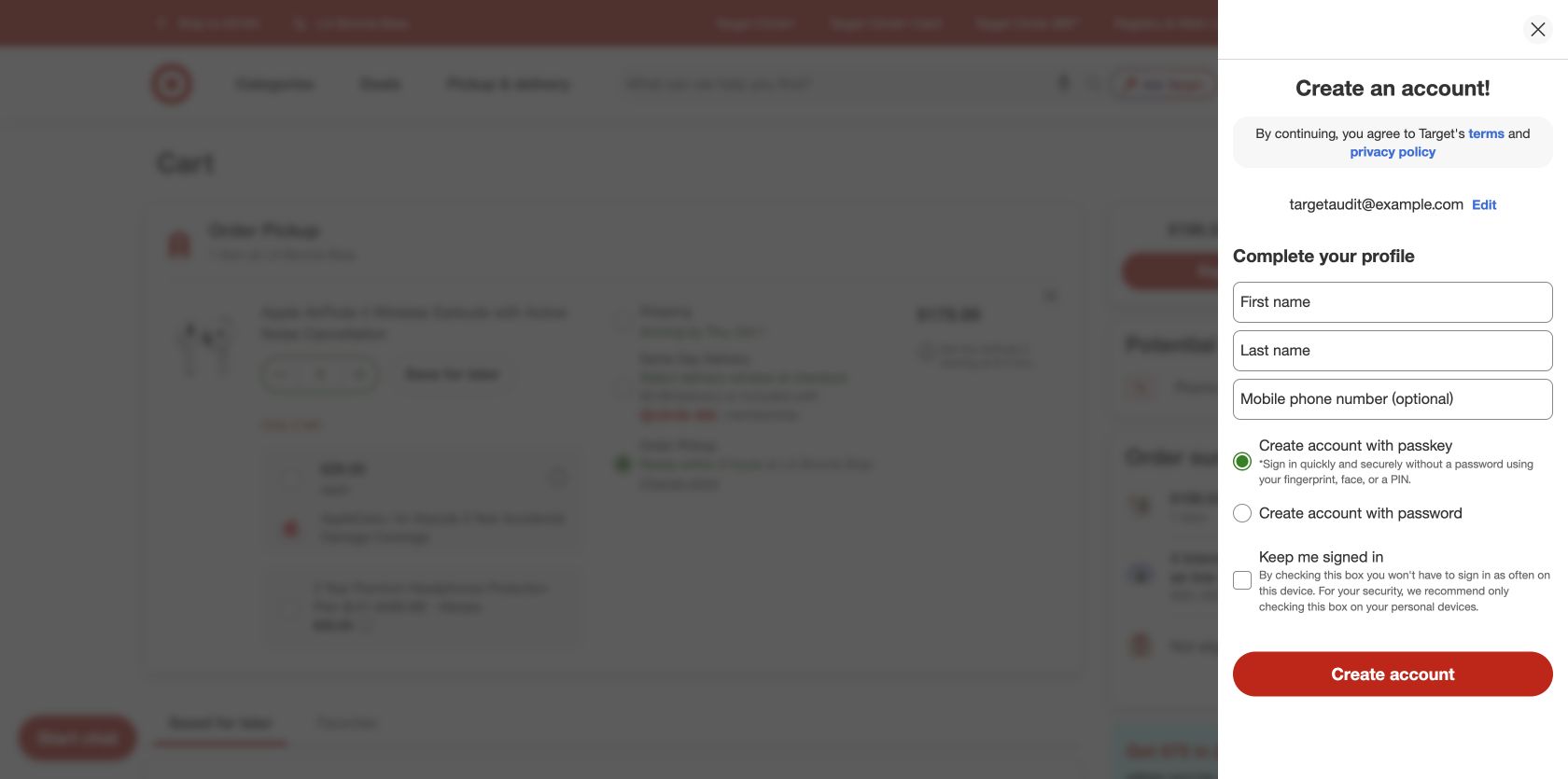
Target labelled its cart action “Sign in to check out.” Continuing with an email did not reveal a guest option; it opened a required profile form with passkey creation selected by default, password creation as the alternative and an optional “Keep me signed in” checkbox. Account creation may support fraud controls and order management, but the benefit and necessity were not explained before the cart action.
Round winner / Best Buy
A one-off pickup customer could inspect payment without taking on an account.
Target moved focus to the missing email; Best Buy only displayed the messages
Best Buy’s empty guest-contact attempt identified the missing email and phone number, but keyboard focus remained on Continue. Correcting both fields recovered cleanly and reached payment. Target’s empty account step placed focus on the email field, so the next action was immediately available. Both should keep the specific messages; Best Buy should add the same focus handoff.
Neither US origin met all three phone Core Web Vitals
These p75 phone Chrome UX Report records cover each whole public origin from 29 August to 25 September 2026. They are not measurements of the exact product, cart or account pages above. Target’s 0.41 CLS is the clearest field warning: at least 25% of measured phone visits experienced substantial layout movement. Both origins also need faster loading and interaction feedback.
The configured mobile PageSpeed run on Best Buy’s product URL scored 88 for accessibility and 50 for best practices. Its findings included heading order, disabled zoom, positive tabindex values, small touch targets and label/name mismatches. Target’s configured request returned “Unable to process request. Please wait a while and try again.” A separate mobile Lighthouse snapshot scored Target 92 for accessibility and identified untitled frames, label/name mismatches, an unfocusable skip link and small touch targets. These automated checks are diagnostic leads, not WCAG conformance claims.
All ten Nielsen usability heuristics
Keep pickup state synchronized.
Best Buy maintained one pickup state; Target briefly mixed Los Angeles and Houston until refresh.
Explain every dollar.
Best Buy named tax, saving and the recycling fee before payment.
Offer a guest route.
Target made profile creation unavoidable for the tested pickup.
Name account commitment early.
“Sign in to check out” became “Create an account” only after the email step.
Keep protection optional.
Both left extended-cover choices unselected.
Persist model, store and total.
Best Buy carried all three into checkout.
Support the one-off shopper.
Guest checkout removed an unnecessary Best Buy detour.
Keep the purchase primary.
Target’s profile panel displaced the cart and its pickup context.
Move focus to the first error.
Target did; Best Buy left focus on Continue.
Explain why an account is required.
The gate described account methods, not the customer benefit or policy reason.
What each team should keep
- Best Buy: explicit saving, fee breakdown, free pickup, optional protection and a real guest path.
- Target: clear pickup promise, restrained protection defaults and focus that moved to the missing email field.
What we would change first
Add guest checkout or explain the account requirement before commitment.
What
Offer a guest route; if policy prevents it, change the cart action to “Create account to check out” and explain the benefit and data commitment.
Where
The cart checkout action and email panel.
Why
The current label delays disclosure and stops one-off shoppers.
Measure
Account-panel exits, account completion and checkout progression.
Update every fulfilment region as one state change.
What
Invalidate stale product availability when the store changes and announce the refreshed location.
Where
The store selector, product fulfilment module and cart.
Why
The observed page briefly paired a Los Angeles header with Houston availability.
Measure
Mixed-location states, refreshes after store change and pickup reversals.
Focus and announce the first invalid field.
What
Add a linked error summary and move focus to the first invalid control after Continue.
Where
The guest email and phone step.
Why
Messages appeared, but focus stayed on the action.
Measure
Repeat submits, recovery time and assisted checkout completion.
Reduce movement and interaction delay.
What
Reserve media and fulfilment dimensions, audit late personalization and reduce main-thread work during store and cart actions.
Where
Shared product, availability and cart components.
Why
Neither origin met all good thresholds; Target’s phone CLS was 0.41.
Measure
Origin and exact-page p75 CLS and INP alongside completed pickup checkouts.
What this public comparison cannot see
We tested one product, two Los Angeles-area stores and current public prices. We did not create a Target account, enter payment details, place an order, collect the item, test returns or evaluate account security. Best Buy reached payment; Target stopped at its intentional profile requirement.
We cannot say which journey converts or retains customers better. GA4 could measure store changes, account-gate exits and payment progression; Microsoft Clarity could show stale fulfilment states and error recovery; Search Console could monitor discovery of product and pickup pages; completed-order data could separate price sensitivity from account friction.