Independent public comparison
We gave Bunnings and Mitre 10 the same Australian shopping task: find a practical entry-level 18V cordless drill kit around $100, set the location to Geelong, add it to the cart and continue as a guest to the payment boundary. We are not affiliated with either retailer. This is one public journey on one day, not a judgement on either business as a whole.
The test
Search for “cordless drill kit”, choose a practical 18V kit near $100, set Geelong VIC as the location, then continue through guest checkout to payment.
Ozito PXC 18V drill driver kit, $89.98.
Before entering payment details or placing an order. We used a reserved example.com email and fictional customer details.
Australian websites in desktop Chrome on the same computer. The products are comparable task choices, not identical products or a price-value test.
25 September 2026.
The 30-second result
Bunnings had the cleaner checkout. Mitre 10 made local stock easier to understand.
Bunnings wins this task narrowly because its three-step checkout, recovery messages and automated accessibility result were stronger. Mitre 10 gave clearer store-level stock language and faster real-user interaction times, but its product page and checkout carried more technical and accessibility friction. Bunnings still has serious work to do on search relevance and phone interaction delay.
Round 1: finding a suitable drill
Both retailers returned useful options for the broad query. Bunnings then failed a more precise model-number check badly enough to change the round.
Bunnings made the broad results easy to compare
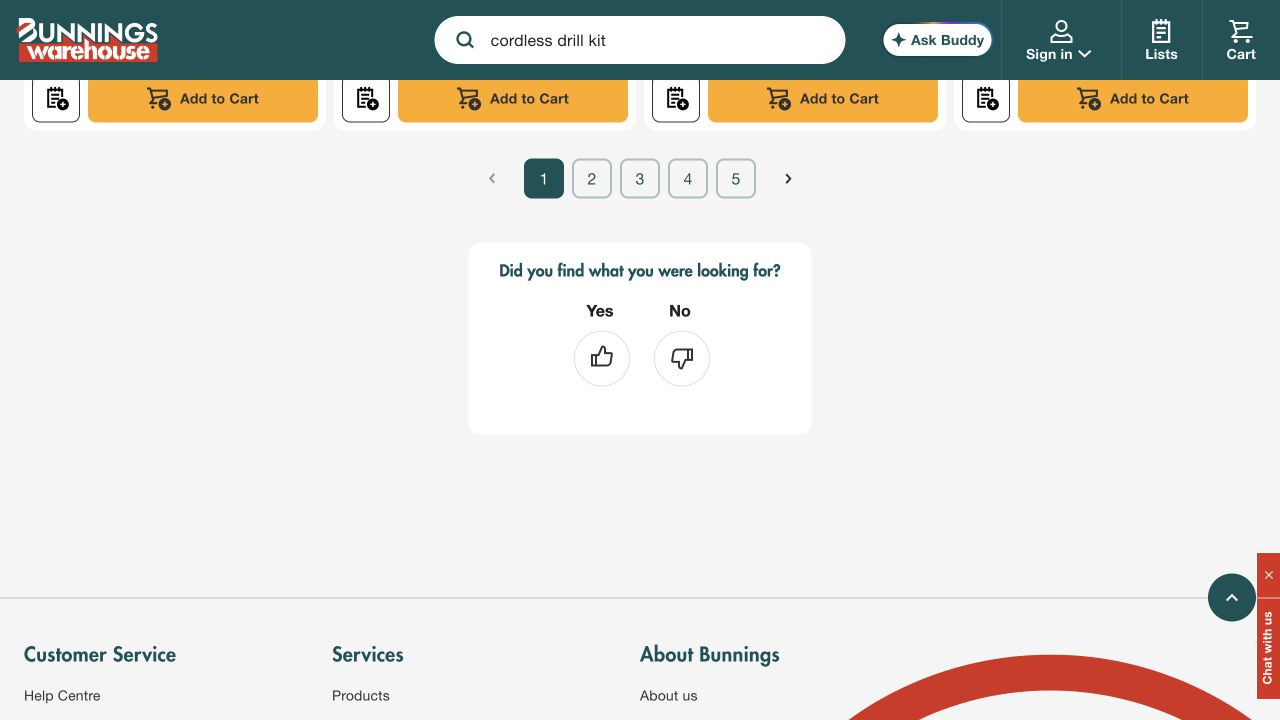
The query “cordless drill kit” returned 174 products. The first results covered entry-level options from $49.98 to $179, with prices, ratings and kit names visible in the grid. The $89.98 Ozito PXC kit clearly included a battery and charger, making it a reasonable match for the task.
The exact Bunnings search lost the product entirely
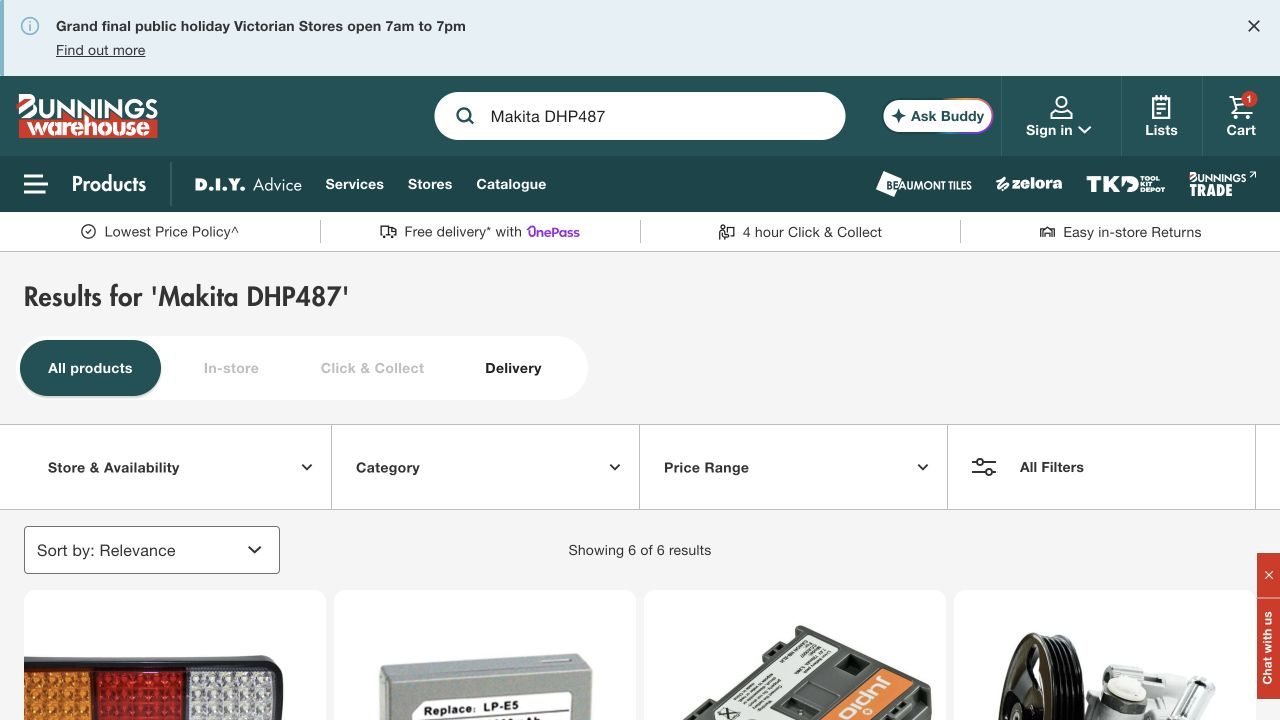
We also searched Bunnings for “Makita DHP487”, a precise drill model query. The six returned items were a trailer light, two camera batteries, a power-steering pump, printer ink and a food container. Every result was a marketplace item and none was the requested drill. A precise query should either return the product, suggest a close match or say clearly that it is unavailable.
Mitre 10 returned more products but useful filters
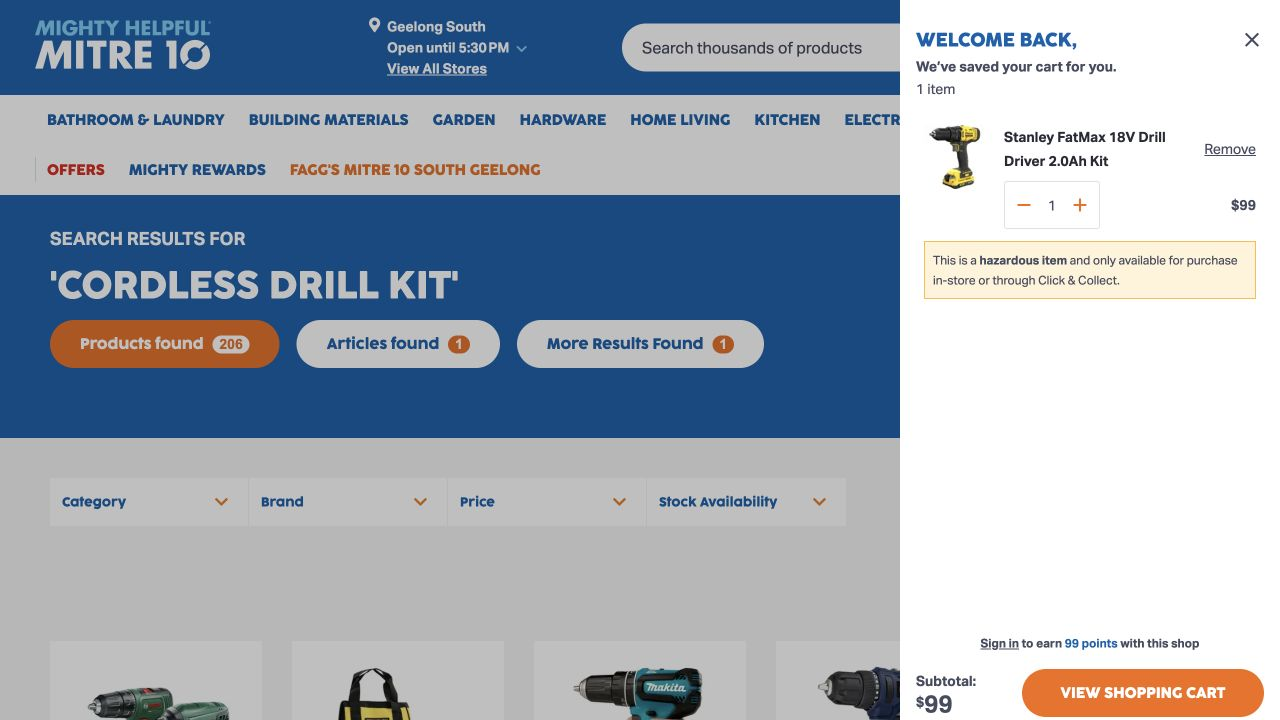
Mitre 10 returned 206 products for the broad query. Category, brand, price and stock-availability filters gave the large set structure, and the early results included several complete 18V kits between $50 and $149. The $99 Stanley FatMax kit sat near the top of the first page and matched the task closely.
Round winner / Mitre 10
Both broad searches worked, but Bunnings’ exact-query failure is a high-confidence relevance problem. Mitre 10’s large result set still kept relevant drill kits and practical filters near the top.
Round 2: choosing a store and reading stock
Mitre 10 explained the local situation more directly. Bunnings had stock, but confirming the collection store took an extra, easily missed action.
Bunnings required a suggestion and then a second confirmation
Typing 3220 exposed the suggestion “Bareena VIC 3220”, while the store list still showed the previous Mentone area until we selected that suggestion. The Geelong-area results then showed Geelong North, Waurn Ponds, Leopold and Torquay with the item in stock. Selecting Geelong North did not finish the job: it revealed a second button, “Click & Collect from Geelong North”, at the bottom of the dialog.
The two-stage commitment is defensible, but the first store click looked final. The confirming action should remain visible from the start or the selected store should be paired immediately with an explicit “Use this store” action.
Mitre 10 exposed stock confidence sooner
Typing 3220 produced Geelong, Newtown and South Geelong choices. Selecting South Geelong immediately set Fagg’s Mitre 10 and showed “Low stock in store” for Click & Collect. That phrasing is more useful than a generic available/not-available state because it signals urgency without pretending the exact count is known.
Round winner / Mitre 10
Mitre 10 turned a postcode choice into a named store and a meaningful stock message with less confirmation friction.
Round 3: cart and guest checkout
Bunnings presented a calmer three-stage checkout. Mitre 10 kept the total clear but added more account, reward and address interface around the task.
Bunnings kept the route to payment legible
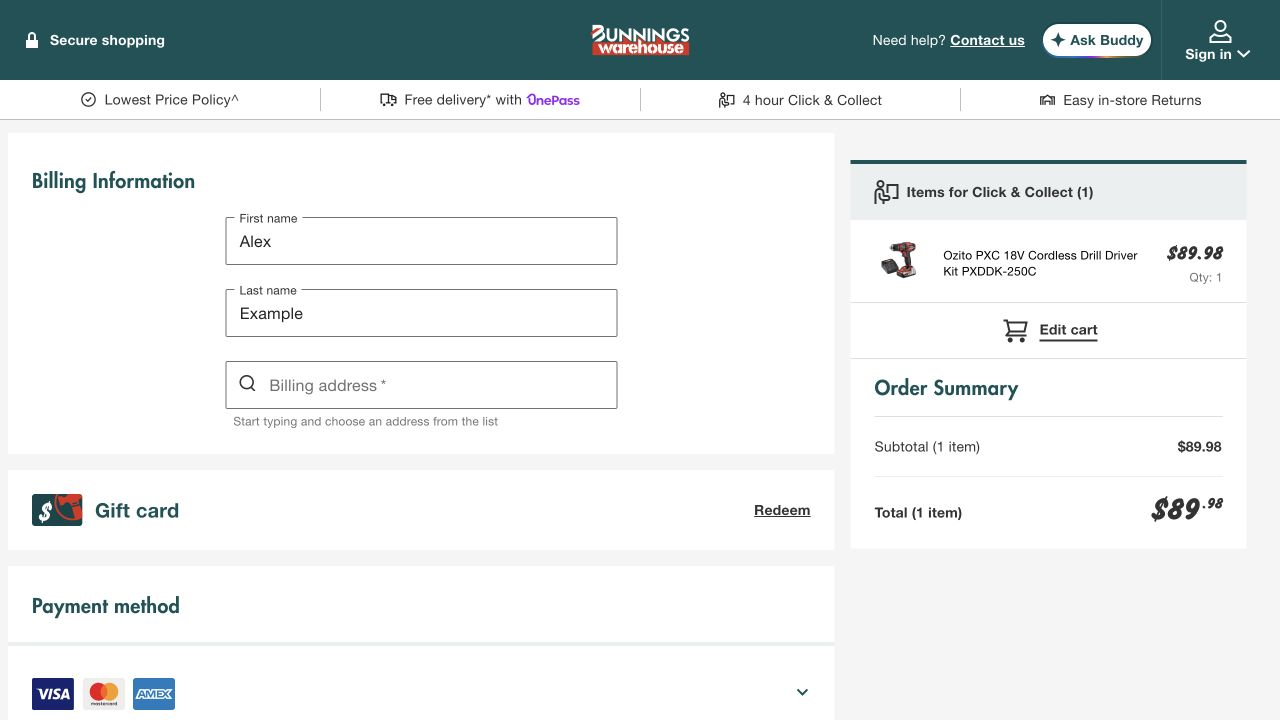
The cart named the collection store, kept the $89.98 total visible and showed three steps: Review cart, Contact details and Payment. “Continue as guest” was distinct from sign-in and OnePass. After contact details, the payment step showed billing address, gift card and the available payment families without requiring payment data first.
Mitre 10 introduced an alarming label without enough context
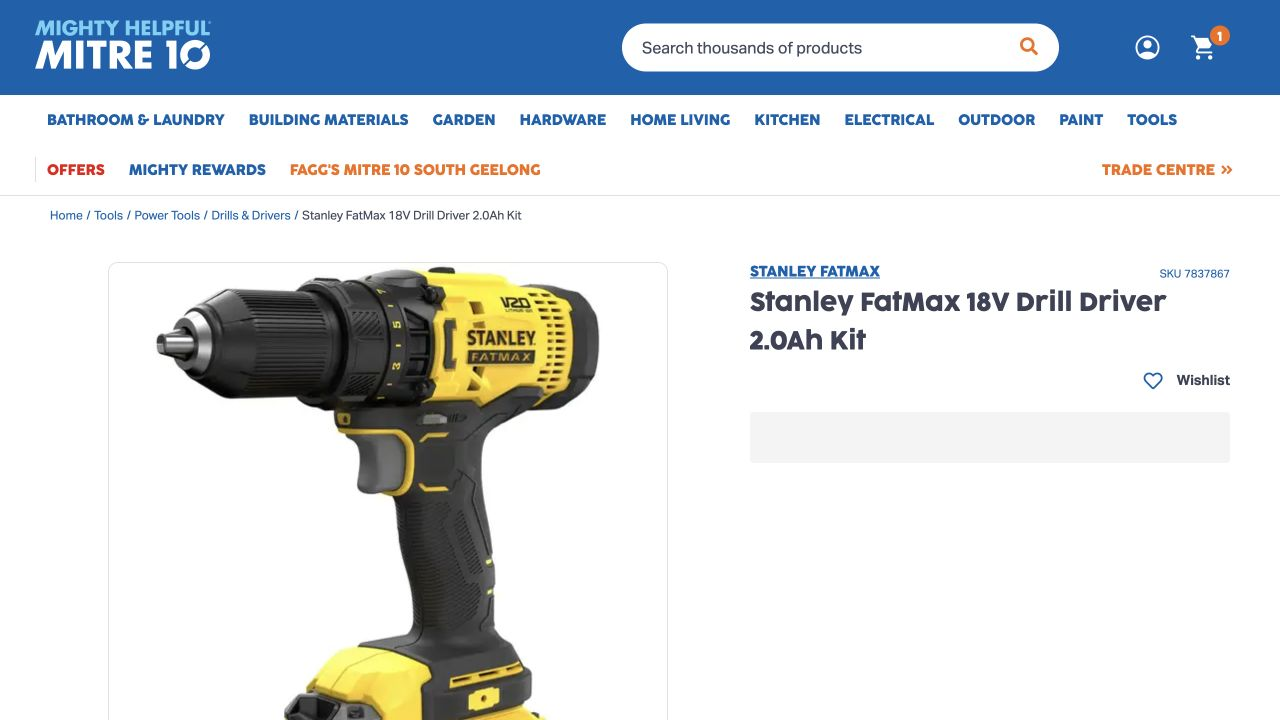
The add-to-cart panel described the drill kit as a “hazardous item” and said it was available only in store or through Click & Collect. The restriction is understandable for a kit containing a lithium-ion battery, but the wording does not explain that connection. A short reason would make the rule feel operational rather than alarming.
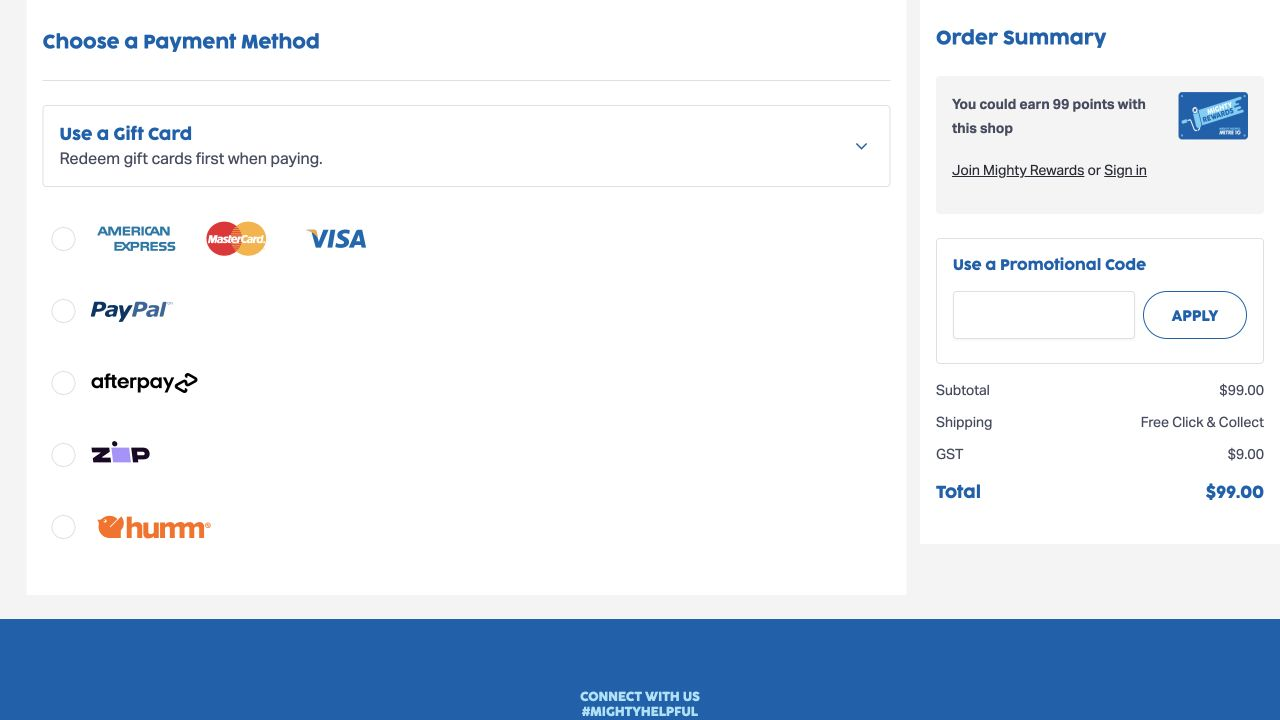
The cart itself clearly showed low stock, free collection, GST and a $99 total. Guest checkout then required an email modal before opening the details step. The payment boundary preserved the selected store, item, billing details and total, but the page’s mounted dialogs and repeated generic Edit controls made its accessible structure noisier than its visual design.
Round winner / Bunnings
Bunnings required fewer account-related decisions and made the three checkout stages easier to understand as one sequence.
Recovery test: what happens after a mistake?
On Bunnings, submitting the empty guest form produced “This field is required” beside first name, last name, email and mobile number, then focused the first missing field. After we entered fictional but correctly formatted details, the form cleared those errors and opened Payment.
On Mitre 10, the empty guest-email submission kept the guest dialog in place. A valid example.com address produced a visible “Email address is saved” confirmation and enabled Checkout. Submitting the empty billing form then exposed explicit messages for first name, last name, phone, suburb, postal code and state. Correcting those fields produced “Billing address updated successfully” and opened the payment methods. Both journeys recovered without losing the selected product, store or total.
What real-user performance data says
Bunnings rendered much sooner, while Mitre 10 reacted to interactions faster. The most serious origin-level warnings are Bunnings’ phone INP and Mitre 10’s LCP and layout movement.
These are 75th-percentile Chrome UX Report origin results for 26 August–22 September 2026. Google’s good thresholds are LCP at or below 2.5 seconds, INP at or below 200 milliseconds and CLS at or below 0.10.
Scope: these Chrome UX Report figures cover each entire public origin, not the search, product, cart or checkout pages tested above. They identify broad patterns for investigation; they cannot prove that one page or component caused a result.
The engineering order should follow those patterns and the journey evidence together: investigate Bunnings’ slow phone interactions; identify Mitre 10 templates and components responsible for slow rendering and movement; then track p75 changes alongside successful product searches, store selections and checkout progression.
Automated accessibility and quality checks
The exact desktop product pages produced a large automated quality gap: Bunnings scored 99 for accessibility, while Mitre 10 scored 75.
Desktop Lighthouse accessibility score.
Desktop Lighthouse best-practices score.
Desktop Lighthouse accessibility score.
Desktop Lighthouse best-practices score.
The checks ran through the application’s configured Google PageSpeed Insights client on 25 September 2026. Bunnings’ remaining automated accessibility failures concerned heading order and visible labels that did not match accessible names. Mitre 10’s failures included an unnamed dialog, invalid ARIA relationships, unnamed buttons and links, low contrast, missing image alternatives, heading order and small touch targets. Both product pages also requested geolocation on load and logged browser-console problems.
These are one-time lab diagnostics for the two linked product pages. They do not describe the whole origins, and automated checks do not establish WCAG conformance. The hands-on accessibility-tree inspection supported the Mitre 10 result: icon-font characters such as search and location glyphs appeared as text, and several important header links had no useful accessible name.
What each retailer should change first
Bunnings
Fix relevance, then interaction delay
- Stop unrelated marketplace products from satisfying precise model-number searches.
- Make the two-stage store choice explicit with a persistent “Use this store” action.
- Profile the components behind the 581ms phone INP and verify improvements against completed searches and checkouts.
- Correct visible-label and accessible-name mismatches on the product template.
Mitre 10
Stabilise the page, then repair semantics
- Prioritise the templates and third-party resources behind poor LCP and CLS on both form factors.
- Repair unnamed dialogs, buttons and links; remove icon-font glyphs from accessible names.
- Explain why a battery-powered kit is classed as hazardous and why delivery is unavailable.
- Reduce the account, reward and mounted-dialog noise around guest checkout.
What this public test cannot tell us
Prices, stock, promotions and result counts can change. The two kits are practical alternatives for the task, not identical products. The journey was inspected in one desktop Chrome session; a complete study would repeat it across phone breakpoints, browsers, regions, keyboard navigation and screen readers.
We cannot see either retailer’s analytics, search rules, inventory feeds, experiments, support data or conversion rates. With GA4, Search Console and Microsoft Clarity connected, UX Robot could quantify which queries fail, where store selection or checkout stalls and whether each fix improves completed purchases.