Independent public comparison
We compared the unsigned-in collection journey for a Makita 18V drill kit near central Birmingham. We are not affiliated with Screwfix or Toolstation. This records the public journeys on 28 September 2026; prices and stock can change.
The Makita collection test
As a tradesperson replacing a drill, I want to find a complete Makita 18V kit for collection so that I can return to work quickly.
Find a Makita DHP489-based kit with two 5.0Ah batteries, check the included equipment, set collection near Birmingham B1 1AA and continue toward basket and checkout where available.
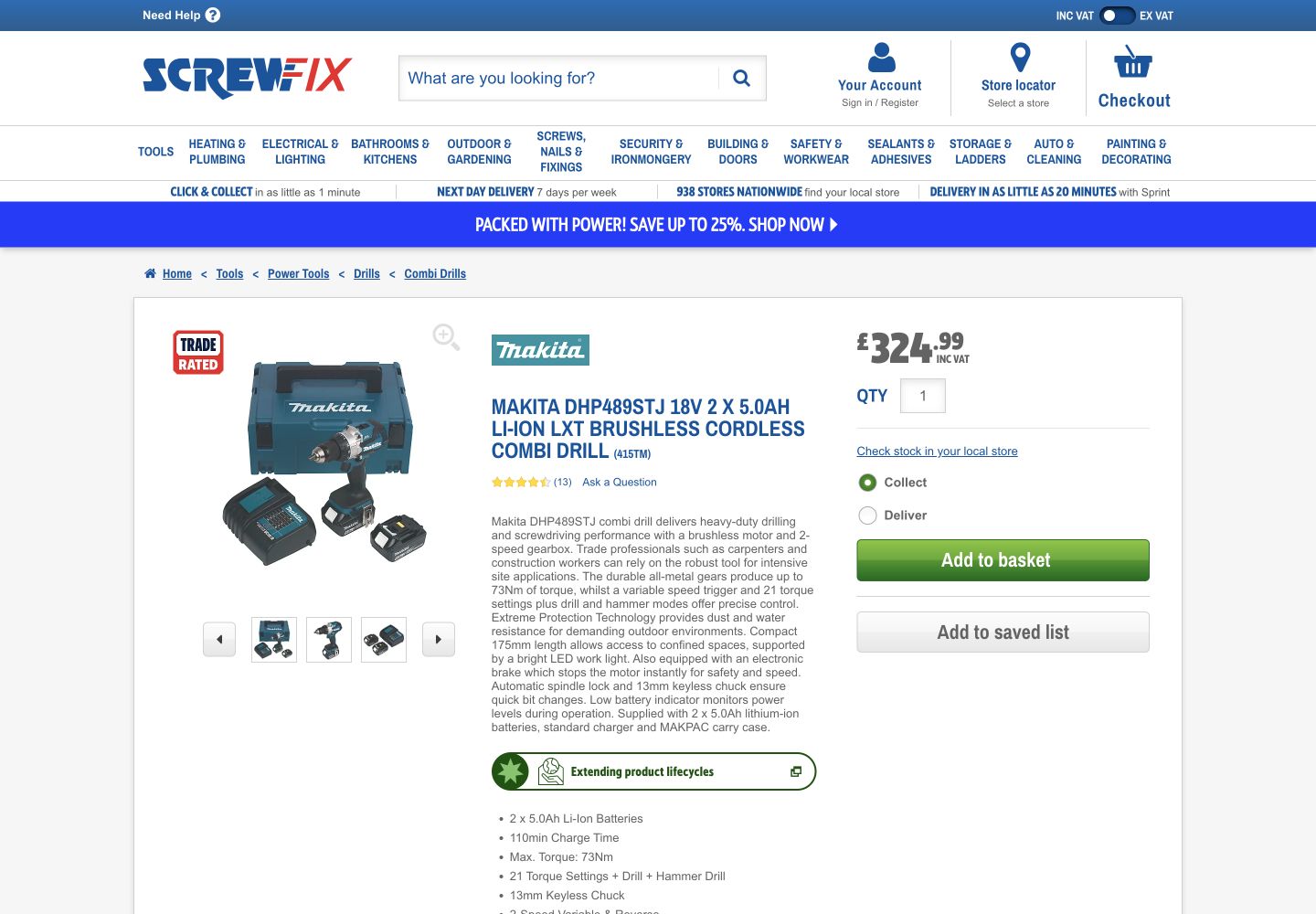
DHP489STJ drill kit at £324.99 including VAT, with two batteries, charger and MAKPAC case.
DLX2507TJ kit at £379.99 including VAT, with the DHP489 drill plus an impact driver, two batteries, charger and case.
United Kingdom, unsigned-in desktop Chrome at 1440 × 1000, Birmingham B1 1AA, prices in pounds including VAT.
Stop when stock or the interface prevents collection. No purchase, reservation, account or payment was submitted.
The 30-second result
Toolstation handles unavailable stock honestly. Screwfix accepts the location and then fails without an explanation.
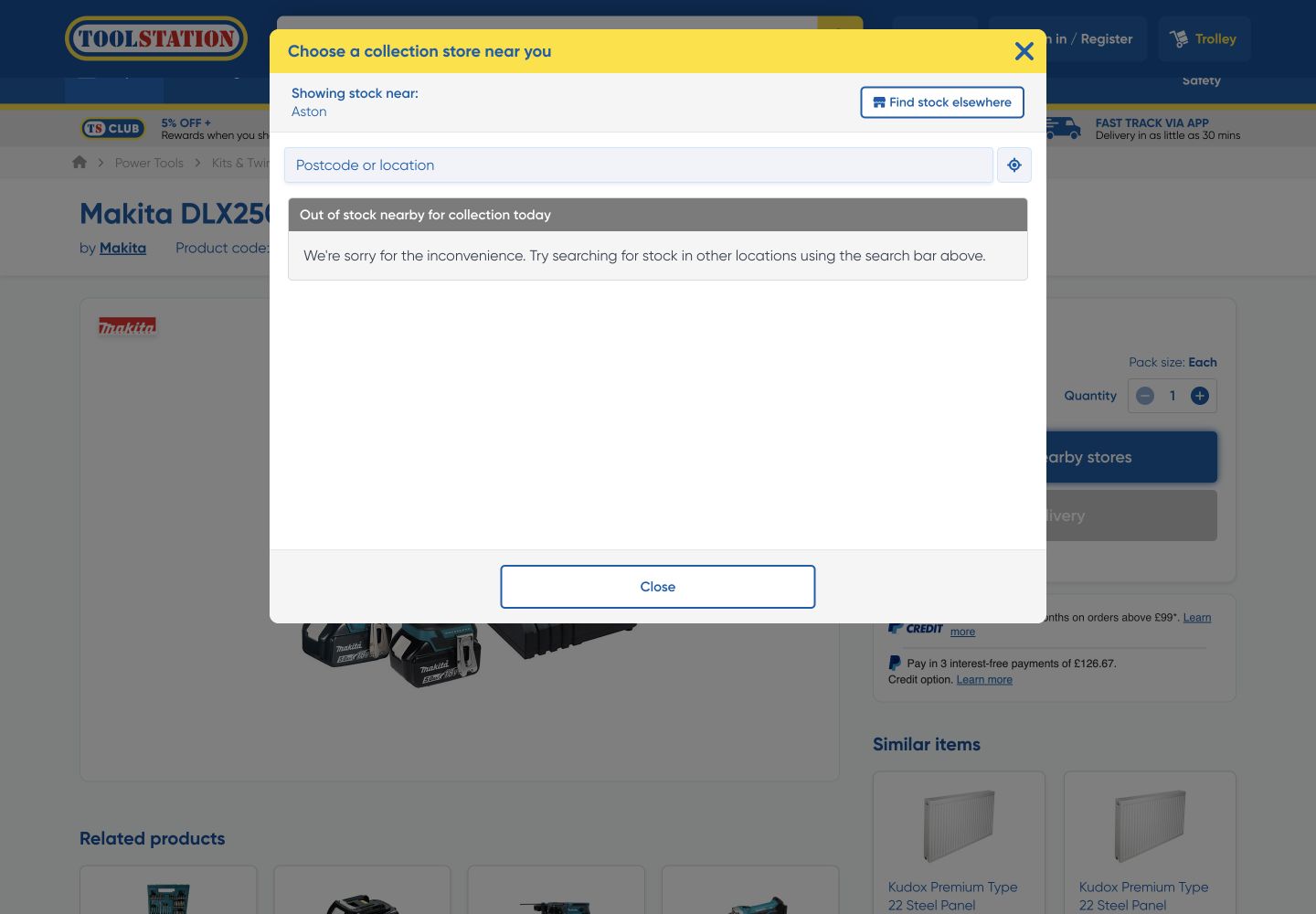
Toolstation wins the recovery comparison. Its Birmingham store finder worked, selected Aston and clearly said the tested kit was out of stock nearby, with a “Find stock elsewhere” route. That is inventory unavailability, not a UX failure. Screwfix’s product was eligible for collection, but its store search left the results area empty after a valid Birmingham selection; the same failure appeared in a clean session and the browser logged a store-service response that could not be parsed as JSON. Neither journey reached checkout, and the bundle prices are not like-for-like.
Screwfix gives the cleaner drill-only proposition
Screwfix’s product page made the DHP489STJ package legible: the DHP489 combi drill, two 5.0Ah batteries, standard charger and MAKPAC case were named together, with the £324.99 including-VAT price beside Collect and Deliver choices. A tradesperson can verify the core kit without opening a specification document.
Toolstation’s DLX2507TJ is a larger twin-tool kit: it contains the same drill family plus an impact driver. That makes its £379.99 including-VAT price unsuitable for a direct price verdict. Toolstation nevertheless names the two tools and two batteries clearly enough for the buyer to understand why the comparison is not exact.
Round winner / Screwfix
The product page makes the drill-only package and including-VAT price easier to verify.
Toolstation turns no stock into a useful next decision
Toolstation accepted B1 1AA, suggested nearby postcodes, listed Birmingham branches and allowed Aston to be selected. The tested kit was unavailable for delivery and out of stock near Aston for collection. Crucially, the interface said exactly that. It retained the selected store, explained the state and offered a postcode field plus “Find stock elsewhere”. This is a successful no-stock journey: the user receives reliable information and a recovery path even though the item cannot be collected.
Screwfix fails after the user has done the required work
On Screwfix, Add to basket with Collect selected opened the store-search page. Raw B1 1AA did not return stores. Typing Birmingham produced duplicated location suggestions, and one keyboard attempt unexpectedly resolved to B1 in Downpatrick. Selecting “Birmingham, West Midlands, United Kingdom” and pressing Find Stores still left the page blank beneath the search controls.
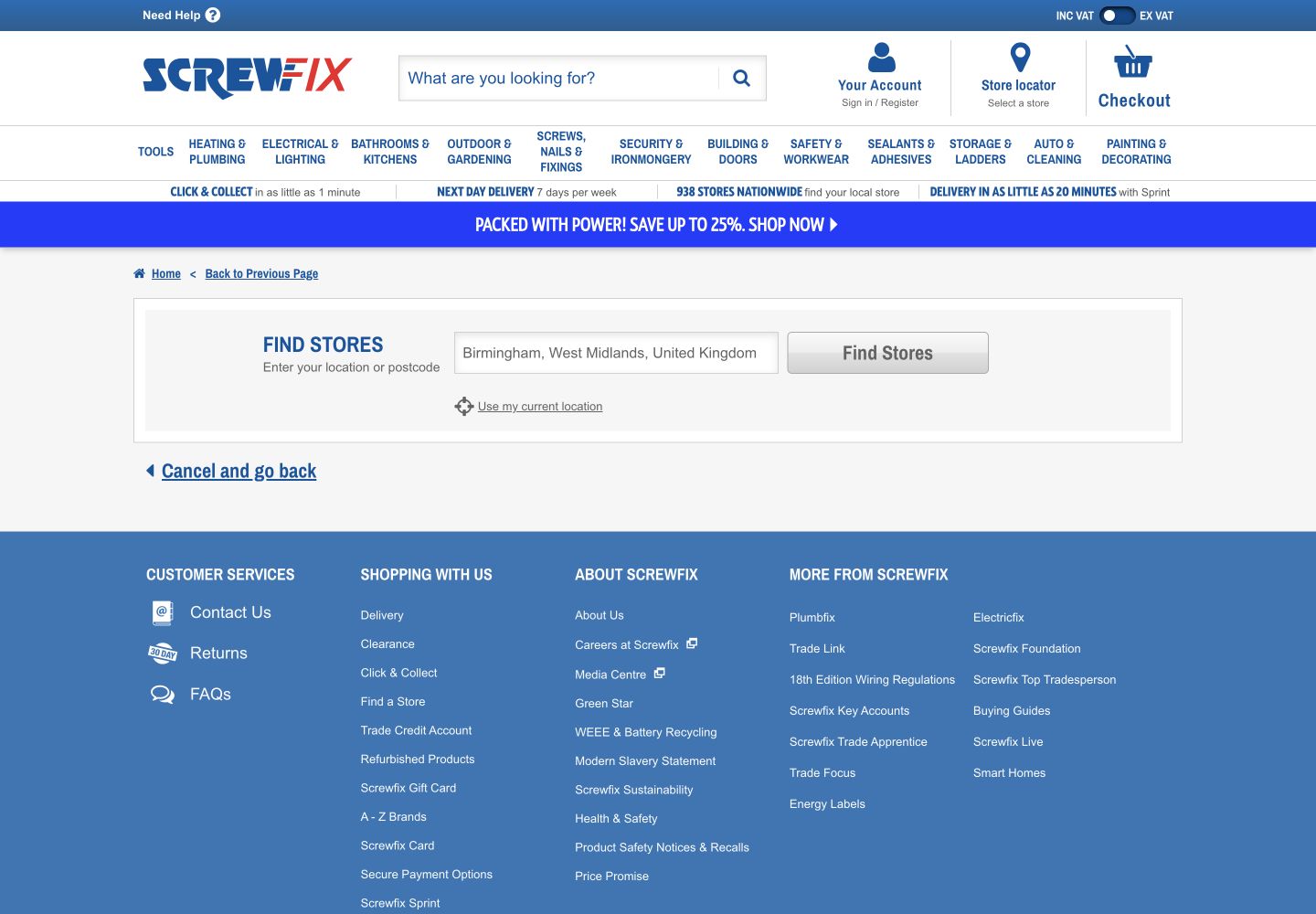
We repeated the flow in a separate clean browser context. The result area was still empty, and the console recorded seven instances of a store-service parser error: the page expected JSON but received an HTML response. That makes this a supported UX-caused failure rather than an inference from stock. The page should catch the service error and provide retry, alternate lookup and support routes.
Loading is not the main failure, but interaction and stability still need work
These are p75 phone Chrome UX Report results for each whole public origin from 30 August to 26 September 2026; they are not measurements of the exact product or store-search states. Both origins load within the good LCP threshold. Toolstation sits at the upper edge of the needs-improvement CLS band, while both miss the good INP threshold.
Clean desktop traces of the exact product pages observed 1.54s LCP and 0.00 CLS for Screwfix, versus 2.40s and 0.00 for Toolstation. Screwfix’s trace also transferred about 2MB through Google Tag Manager and attributed roughly 483ms of main-thread work to it. The configured mobile PageSpeed runs scored Screwfix 94 for accessibility and 100 for best practices, and Toolstation 89 and 96. Toolstation’s automated findings included contrast, heading order, unnamed links, small targets, missing SVG alternatives and label/name mismatches; Screwfix’s included positive tabindex, small targets and label/name mismatches. These checks identify risks, not WCAG conformance.
All ten Nielsen usability heuristics
Always resolve the store search.
Toolstation states no stock; Screwfix leaves a silent gap.
Describe tool bundles plainly.
The extra impact driver explains why Toolstation costs more.
Keep alternate locations available.
Toolstation’s “Find stock elsewhere” protects the user’s next move.
Use one unambiguous place picker.
Duplicated Birmingham suggestions and the Downpatrick result break confidence.
Validate service responses before rendering.
An HTML response should not fall into a JSON path and erase the result state.
Repeat store, item and stock together.
Toolstation’s modal keeps the chosen Aston context visible.
Accept postcodes directly.
A tradesperson should not need to translate B1 1AA into a city suggestion.
Reserve result space for a message.
Blank space without status looks unfinished rather than calm.
Offer retry and alternate lookup.
Screwfix supplies neither after the store service fails.
Explain availability boundaries.
No-stock copy should distinguish nearby, delivery and wider-area availability.
What we would change first
Catch non-JSON responses and render a recoverable error.
What
Validate status and content type, then show Retry, change location and contact options.
Where
The check-stock service boundary and collection results component.
Why
A repeated parser failure left the customer with a blank result area.
Measure
Service parse errors, successful retries, store selections and collection add-to-basket rate.
Make postcode input deterministic.
What
Accept valid UK postcodes without requiring a suggestion and remove duplicate city options.
Where
Find Screwfix Stores autocomplete.
Why
B1 1AA did not resolve cleanly and one keyboard path selected Downpatrick.
Measure
Autocomplete corrections, wrong-region selections and time to first store result.
Show the nearest in-stock alternative in the same modal.
What
Supplement the no-stock state with the nearest matching branch or an equivalent kit.
Where
The nearby collection-stock modal.
Why
The current message is clear but still requires another search.
Measure
Find-stock-elsewhere use, alternate-store selection and successful collection reservations.
Fix interaction, shifting and automated accessibility failures by component.
What
Prioritise Toolstation layout movement and semantic failures, then remove heavy nonessential script work on Screwfix.
Where
Product, autocomplete, modal and store-result templates.
Why
Field and lab evidence point to separate responsiveness, stability and accessibility risks.
Measure
p75 INP and CLS, component audit regressions and keyboard store-selection completion.
What this public comparison cannot see
The products are related but not identical: Toolstation includes an impact driver. We therefore do not name a price winner. Toolstation’s unavailable stock is not treated as a UX defect; the tested Screwfix interface failure is supported by repeated visible behaviour and a matching service-parser error.
We could not test basket, checkout, payment or collection handover because neither route produced a collectible item. Analytics should distinguish no-stock exits from interface errors and connect store-service failures to retries and completed collection orders.