Independent public comparison
We compared the unsigned-in journey for finding a complete cordless drill kit and collecting it near Austin, Texas. We are not affiliated with Lowe’s or Ace Hardware. This records the public journeys on 28 September 2026; prices, tax and local inventory can change.
The cordless-drill pickup test
As a DIY homeowner, I want to find a complete cordless drill kit for local pickup so that I can begin a repair without discovering that essential parts are missing.
Find an equivalent DeWalt 20V compact brushless drill/driver kit with one 2.0Ah battery and charger, set pickup near Austin 78704, add it to the cart and reach guest checkout.
DCD793D1 at $179, with one battery, charger, soft bag and pickup at S.E. Austin on E. Stassney Lane.
DCD794D1 at $179 on the product page, with one battery, charger and pickup at Breed & Co Ace Hardware in Rolling Hills.
United States, unsigned-in desktop Chrome at 1440 × 1000, Austin postcode 78704, prices in US dollars.
Trigger and correct an invalid email message at guest checkout. Stop before submitting contact, pickup or payment details; no order or account was created.
The 30-second result
Ace makes the kit and guest checkout easier to understand. Lowe’s makes local pickup harder to set than it should be.
Ace wins this controlled journey by a small margin. Its product page names the battery and charger in the title, keeps the chosen store beside the pickup option and reaches a conventional guest checkout. Lowe’s reaches the same $193.77 post-tax total, but entering 78704 did not replace the Hawaii pickup store inherited by the session; the customer had to open “Check Other Stores” and use a quantity control inside the store list to add the item. Both checkouts gave specific, recoverable email feedback.
Ace makes completeness visible at the decision point
Ace’s result and product title explicitly said “Kit (Battery & Charger)”. The product page then repeated the DCD794D1 model, $179 price, pickup state and selected store in the purchase panel. That is strong recognition over recall: the buyer does not need to infer whether the photographed accessories are included.
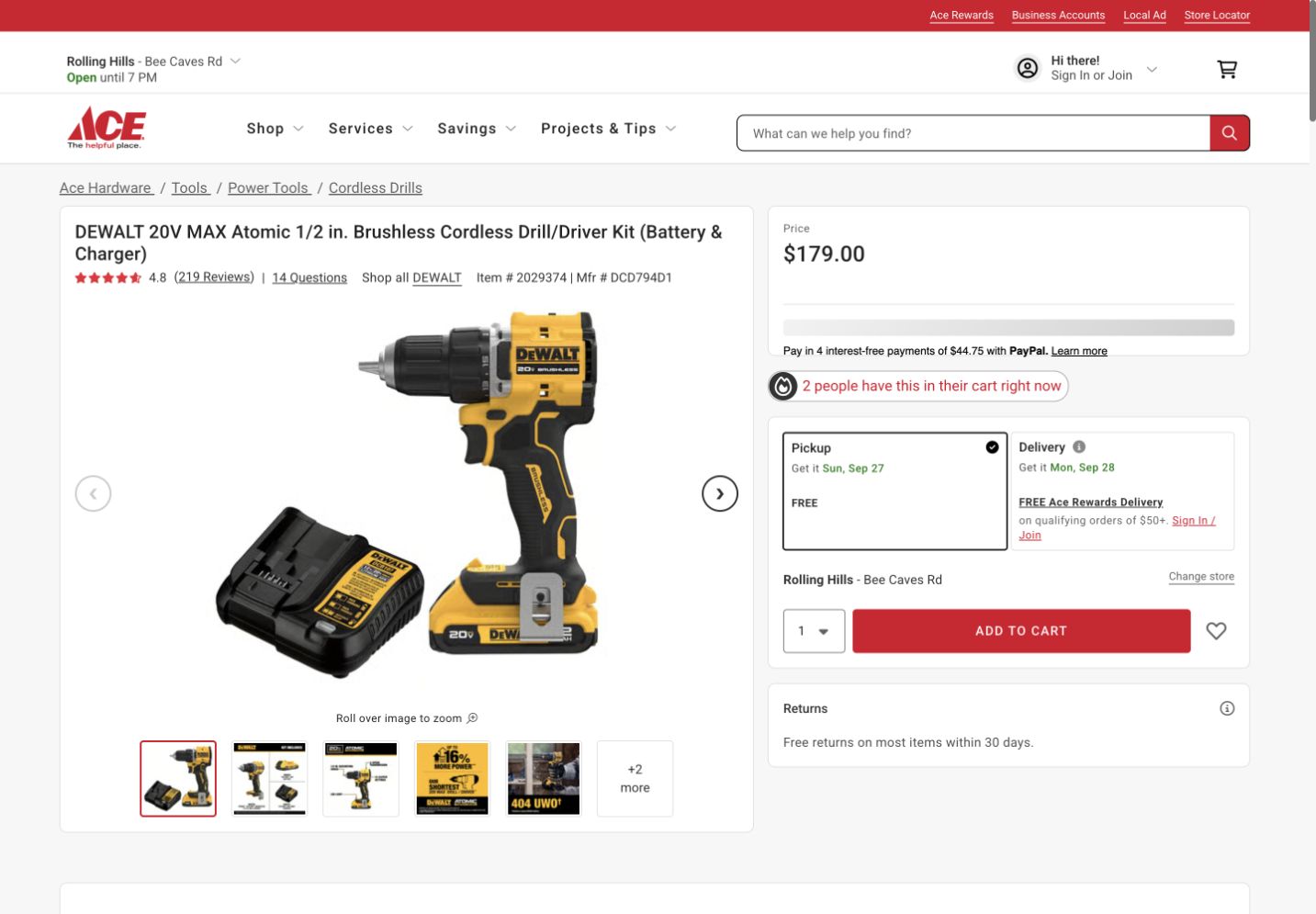
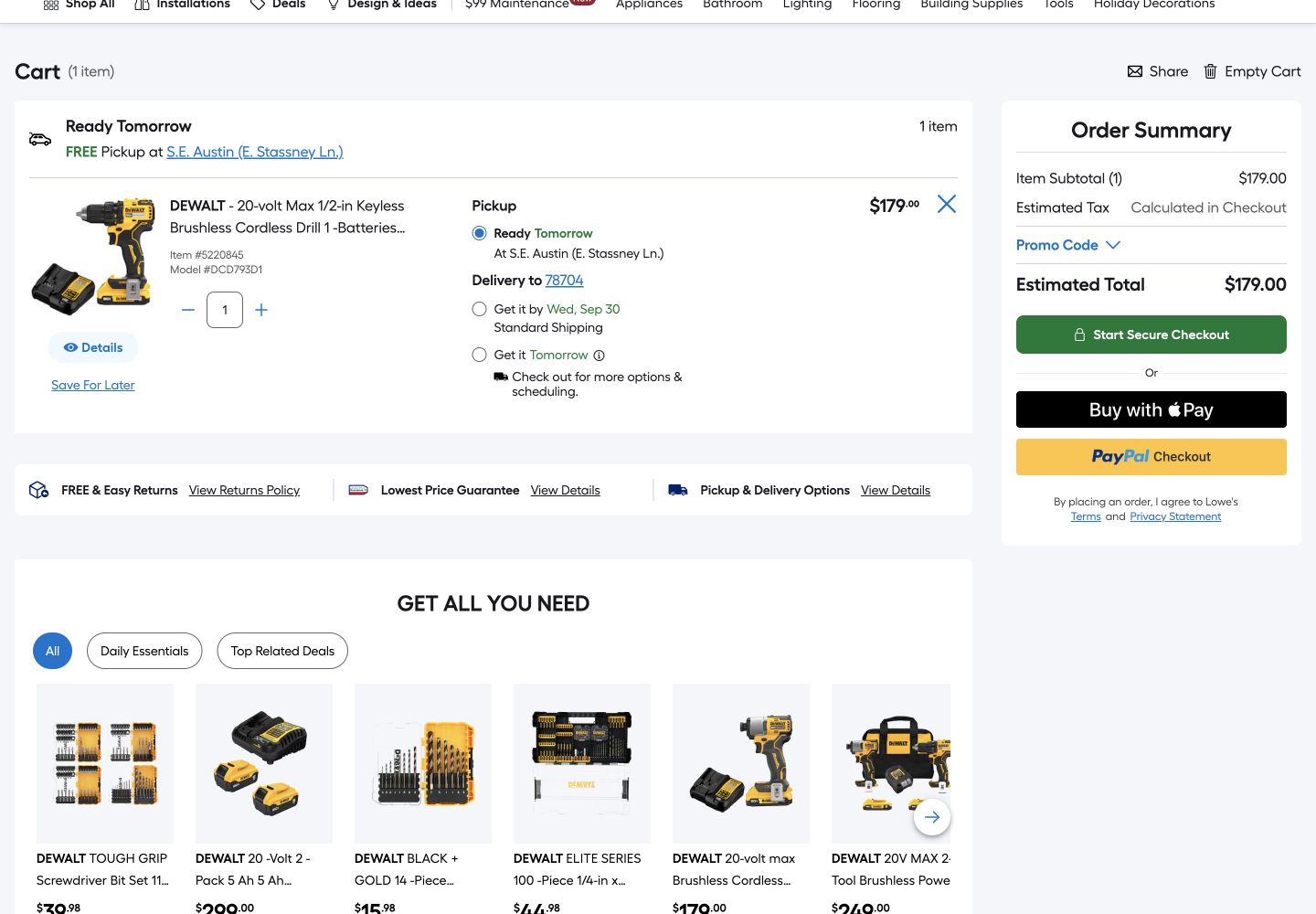
Lowe’s also described a complete DCD793D1 kit and added a soft bag. The cart confirmed the model, battery count, $179 price and the S.E. Austin pickup location. The two products are equivalent for this task rather than identical, so this audit does not claim that one drill model is the better purchase.
Round winner / Ace
It states the essential package contents in the product name and keeps the store choice in view.
Lowe’s separates the postcode from the pickup store
The Lowe’s session began with Waipahu, Hawaii as the pickup store. Updating the delivery postcode to 78704 changed the postcode but left Waipahu selected. “Check Other Stores” then found S.E. Austin, 3.9 miles away with 21 in stock, but the store row offered a quantity stepper rather than an explicit “Select store” action. Setting the row quantity to one enabled a modal-level Add to Cart button. The flow worked, yet its state model asks the buyer to understand that delivery postcode, pickup store and store-row quantity are separate controls.
Ace’s store finder also inherited an unrelated Hawaii store at first, but the nearby-store list made the distance and address visible and a direct store selection updated the product panel. Its search was less efficient: the specific drill query returned 329 results, and the chosen item was shown at $179.99 in results but $179 on the product page. Search relevance and price continuity both need tightening.
Both preserve the total and recover from an email error
Lowe’s checkout split the work into Contact Information, Pickup Details and Payment. Ace first offered “Continue as a Guest” and then presented contact, pickup person and order summary together. Each showed a $179 subtotal, $14.77 estimated tax and $193.77 total before the stopping point.
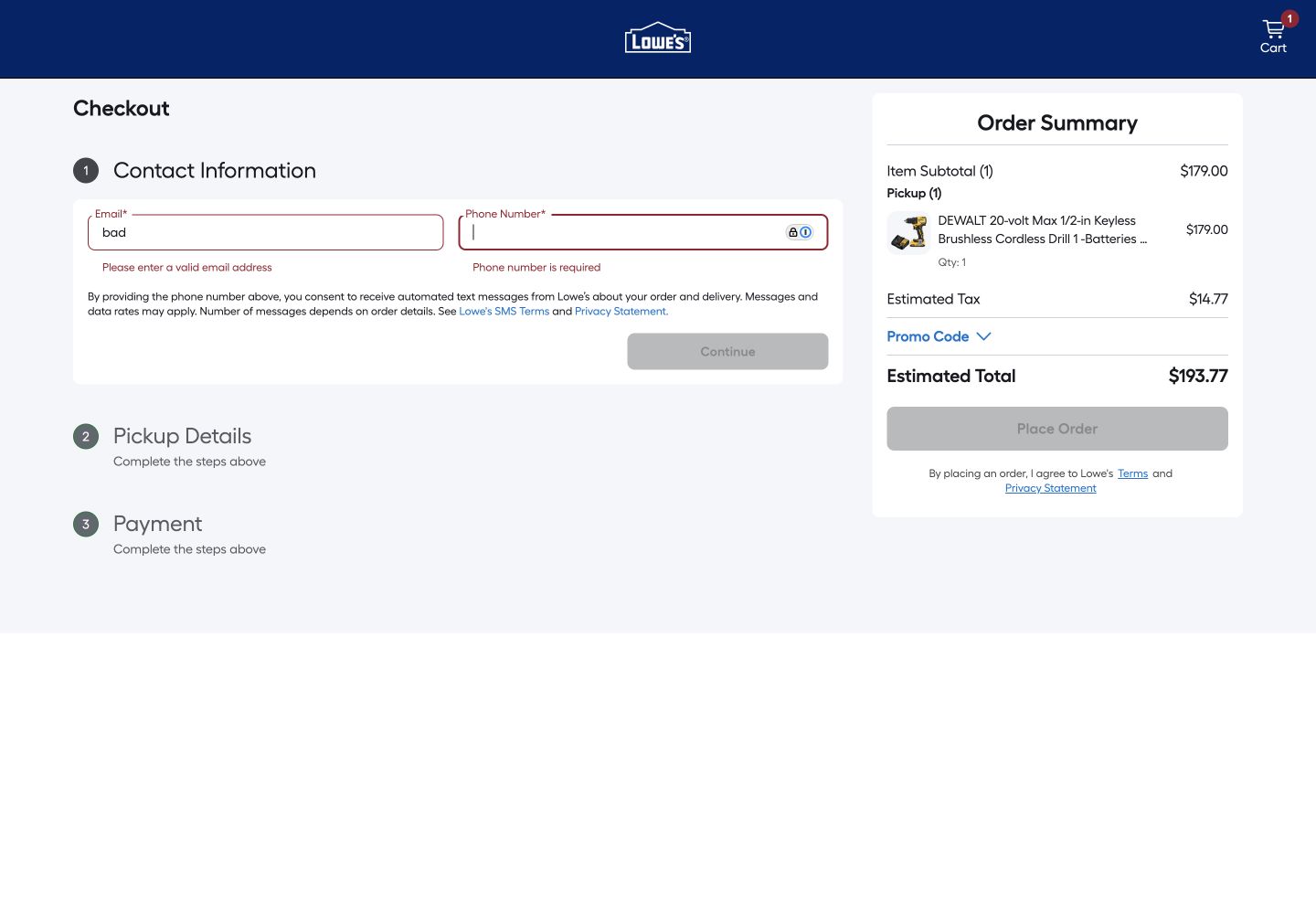
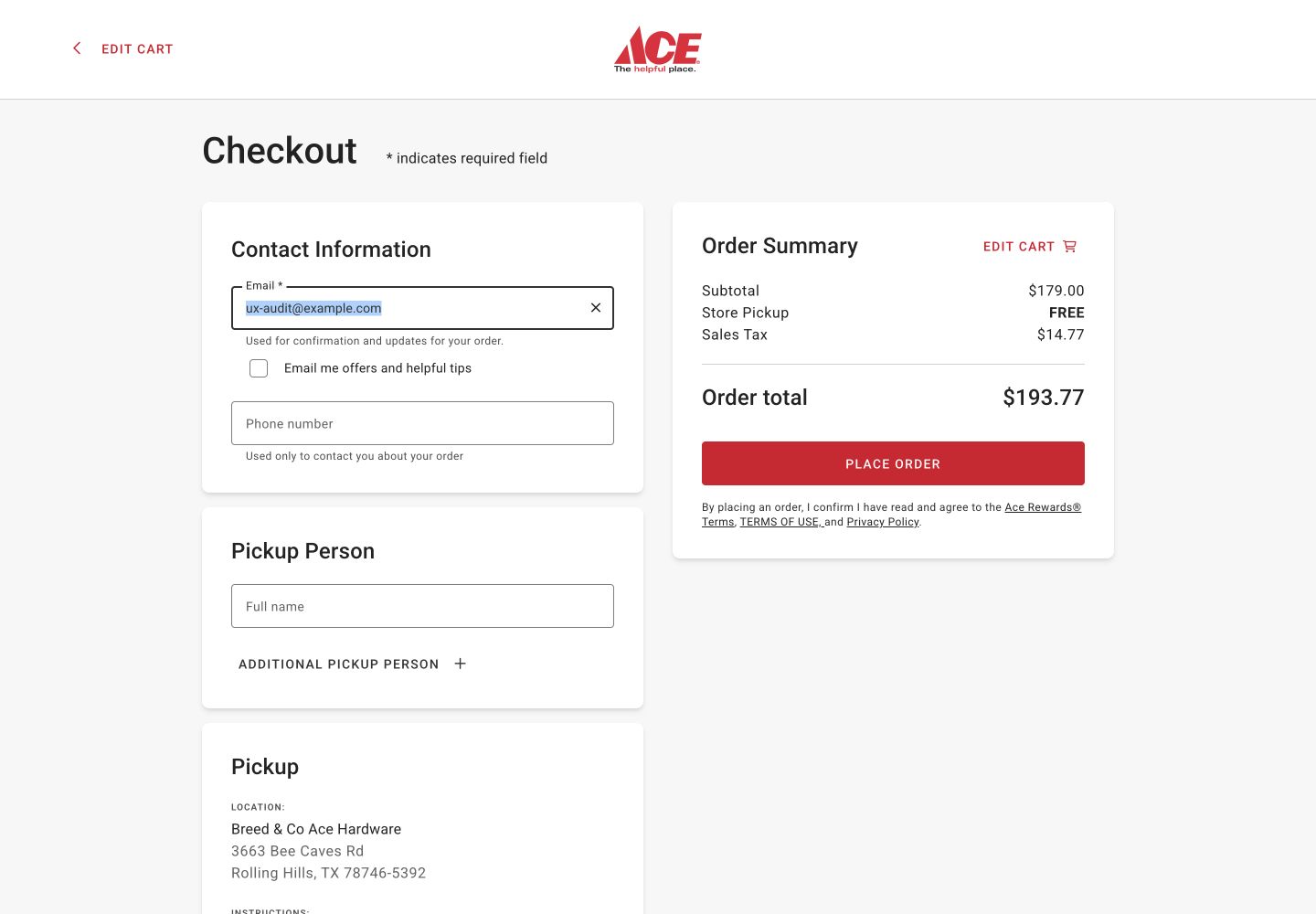
Entering an invalid email produced “Please enter a valid email address” on both sites. Replacing it with a valid-format test address and leaving the field cleared the message. We did not continue into personal details or payment.
Neither phone experience has a clean field record
These are p75 phone Chrome UX Report results from 30 August to 26 September 2026. Lowe’s had enough data for the exact product URL; Ace did not, so its figures describe the whole public origin. They do not prove that this product page caused a metric. Ace’s origin-level interaction delay is the clearest engineering priority, while both teams should isolate layout movement and slow largest-content rendering on their phone templates.
The configured mobile PageSpeed run scored Ace 85 for accessibility and 92 for best practices. It flagged list structure, disabled zoom, an unlabelled quantity select, small touch targets and a visible-label/accessibility-name mismatch. Lowe’s exact-page PageSpeed request timed out twice after 120 seconds, so no current lab score is reported for it; its exact-page CrUX record above remains available. Automated checks identify risks and do not establish WCAG conformance.
All ten Nielsen usability heuristics
Keep postcode and pickup store synchronized.
Lowe’s displayed 78704 while Waipahu remained the pickup store.
Name what comes in the box.
Ace’s battery-and-charger wording matches the shopper’s practical question.
Make changing stores explicit.
A clear Select store action is easier to reverse than a quantity control embedded in results.
Use one price across search and product.
Ace moved from $179.99 in results to $179 on the item page.
Block checkout with precise contact guidance.
Both sites kept progression unavailable and explained the malformed email.
Repeat model, contents and store.
The strongest states keep all three visible from product through cart.
Support postcode-first store selection.
Austin shoppers should not have to undo an inherited Hawaii store.
Reduce irrelevant search breadth.
A 329-result Ace set adds work to a specific kit query.
Preserve the working inline pattern.
Both email messages cleared after correction without losing the cart state.
Explain inclusions beside the purchase control.
Compatibility and package contents should not depend on product imagery.
What we would change first
Make a postcode update replace or reconfirm the pickup store.
What
After postcode entry, show nearby stores and require one explicit selection.
Where
Header location control, product fulfilment card and store modal.
Why
78704 and Waipahu coexisted in the observed journey.
Measure
Store changes, failed pickup attempts, cart removals and completed pickup orders.
Return the exact kit early and keep its displayed price stable.
What
Weight model and included-accessory terms more strongly, and use one price source.
Where
Search results, product tile and product detail header.
Why
The precise query returned 329 items and changed price by 99 cents.
Measure
Result reformulation, product exits, price discrepancies and add-to-cart rate.
Repair form names, list semantics, zoom and touch targets.
What
Associate quantity labels, use valid list parents, allow zoom and enlarge small controls.
Where
Product and fulfilment components used across the mobile origin.
Why
The current automated run scored 85 and identified these specific failures.
Measure
Zero automated regressions plus successful keyboard, zoom and screen-reader task checks.
Pair interaction and stability work with checkout outcomes.
What
Trace slow interactions and shifting components by template, then monitor p75 alongside the journey funnel.
Where
Phone search, product, store selector, cart and checkout templates.
Why
Neither field record passed all three Core Web Vitals.
Measure
p75 LCP, INP and CLS plus store selection, add-to-cart and checkout progression.
What this public comparison cannot see
We stopped before submitting personal details or payment. We did not verify collection notifications, identity checks, payment authorization or the handover at either store. Inventory, tax and prices are the states displayed during the test.
Public testing cannot show which journey converts better. Analytics could connect search reformulation, store changes, cart additions, validation loops and completed pickups; session replay could then show where customers hesitate without turning an expert review into a claim about real-user prevalence.