Independent public comparison
We asked Deliveroo and Just Eat to deliver the same McDonald’s Strand meal to London SE1 7PB as a new, unsigned-in customer. We are not affiliated with either platform or restaurant. This records the public journeys on 27 September 2026; prices, fees, promotions and delivery times can change.
The London delivery test
Set SE1 7PB, open McDonald’s Strand, configure a Medium Big Mac Meal with medium fries, Coca-Cola Zero Sugar and no add-on, then inspect the full delivered total.
£9.09 meal, £2 small-order fee, £1 service fee and £2.09 delivery: £14.18 total. Estimated 20–35 minutes.
£9.09 meal, £2 small-order fee, £0.99 service fee and £1.39 delivery: £13.47 total. Estimated 25–40 minutes.
Unsigned-in new customer, delivery as soon as available, prices in pounds sterling.
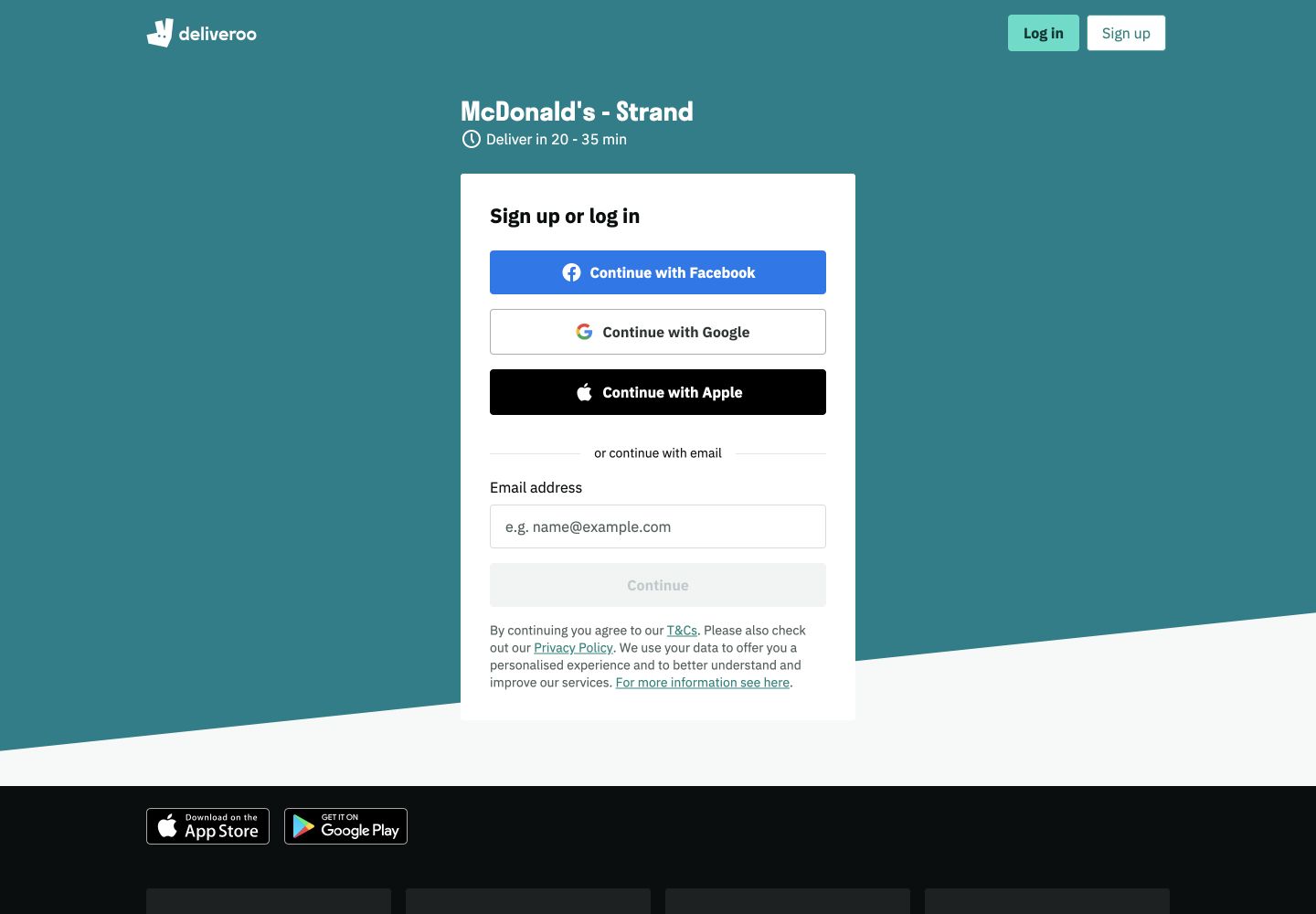
The mandatory sign-in or account-creation page. We entered no email, address or payment data and placed no order.
Desktop Chrome fieldwork, exact-menu mobile PageSpeed and phone CrUX origin fallback where exact menu records were absent.
The 30-second result
Just Eat was 71p cheaper and handled missing meal choices better. Deliveroo promised the faster window.
Just Eat wins this exact basket because it exposed the service-fee rule, prevented an incomplete meal from being added and reached a £13.47 total. Deliveroo’s £14.18 total was equally clear once the basket existed, and its 20–35 minute estimate was five minutes faster at both ends. Neither platform allowed a guest checkout: both stopped at account access, and both inserted the same McDonald’s school-delivery and allergen warning before that gate.
Deliveroo made browsing calmer; Just Eat repeated paid placements
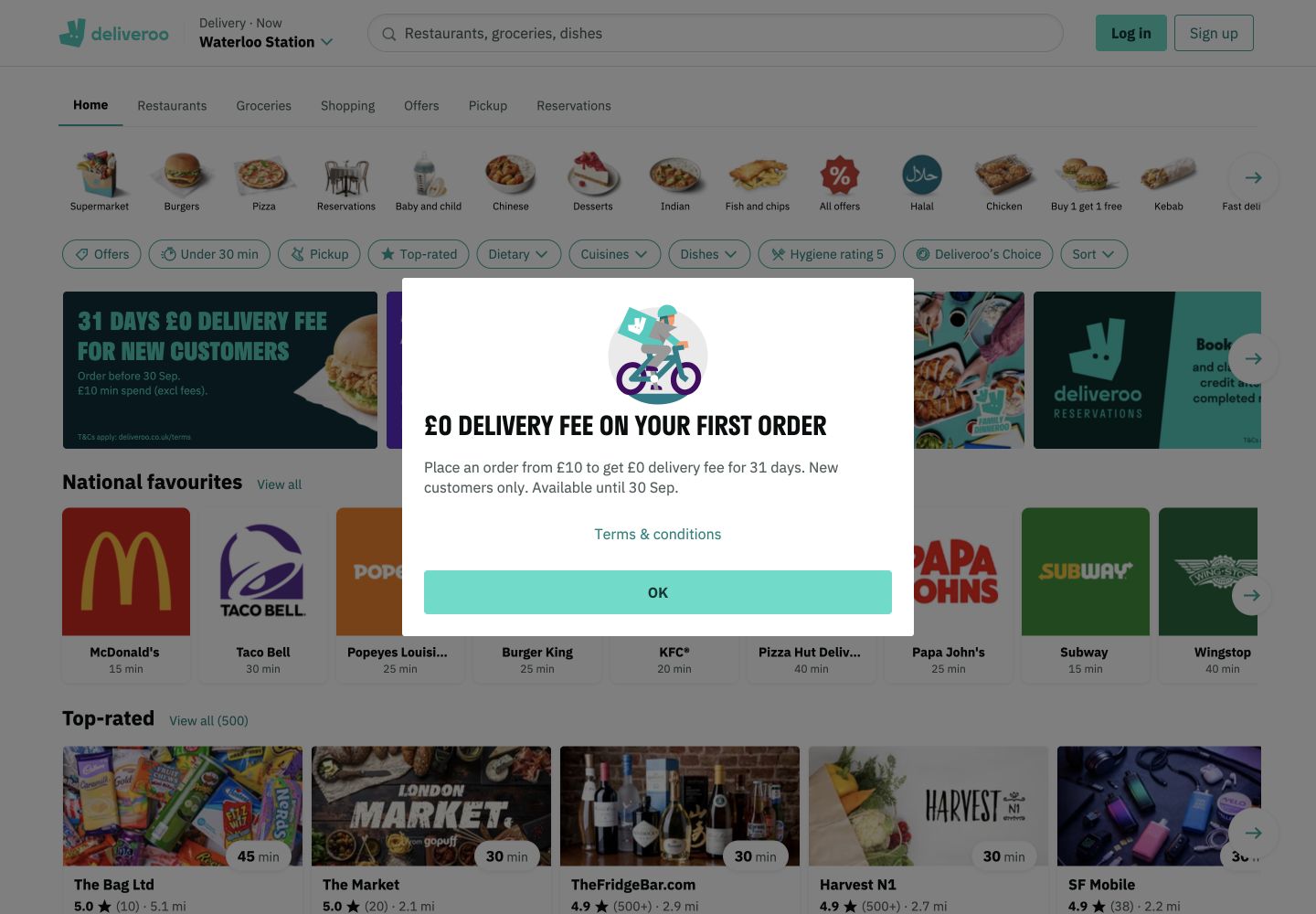
Deliveroo confirmed London SE1 7PB, then presented category shortcuts, filters and a “National favourites” row with McDonald’s at 15 minutes. The broader page said 1,665 restaurants were available. Its card hierarchy was visually quiet enough to find the known brand without a separate search.
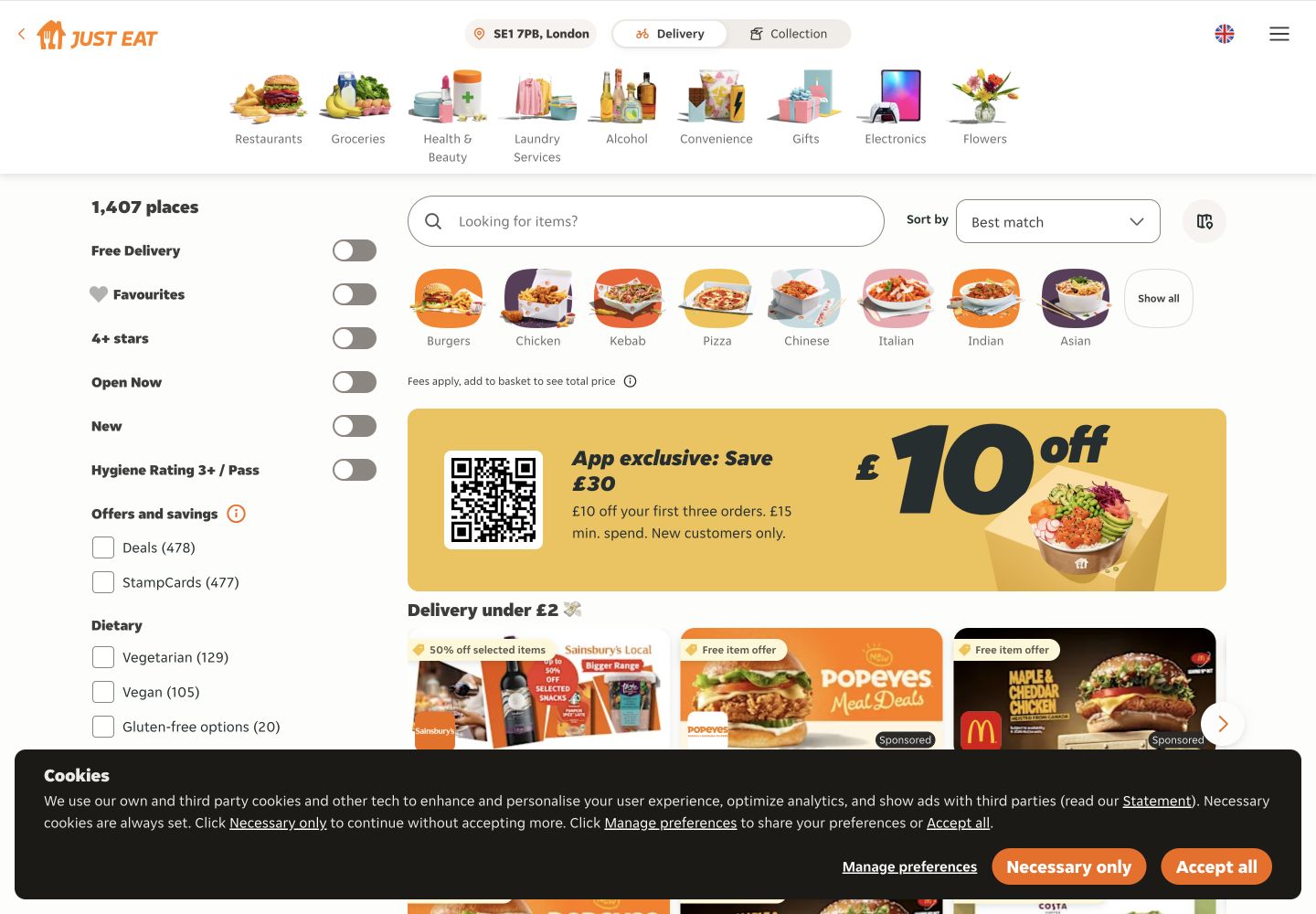
Just Eat reported 1,407 places and put a useful warning above the list: “Fees apply, add to basket to see total price.” McDonald’s Strand appeared as Sponsored in several modules, including the opening results, Popular brands and Tasty offers. Sponsorship was labelled, but repetition still made the commercial priority dominate the page.
Round winner / Deliveroo
The known restaurant was easier to isolate without repeated sponsored copies competing for attention.
The menus matched, but the recovery pattern did not
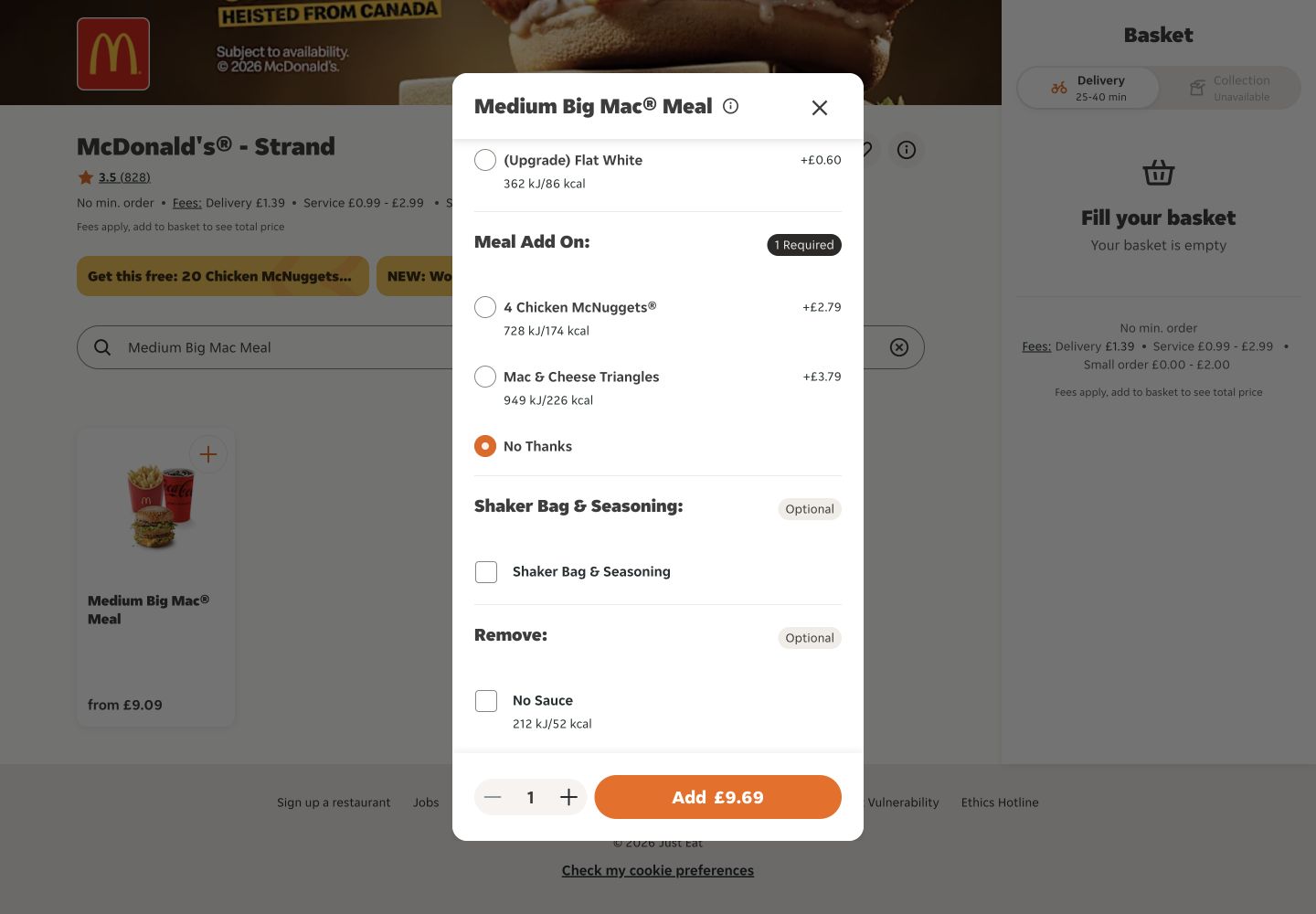
Both platforms priced the Medium Big Mac Meal at £9.09 and presented the same three required groups: side, drink and meal add-on. Calories and upgrade prices were visible. Choosing medium fries, Coca-Cola Zero Sugar and “No Thanks” kept the base price unchanged on each service.
On Deliveroo, selecting Add before completing those groups left the meal open and focus on the Add button, but did not produce a visible error summary or move to the first missed group. Just Eat instead kept the action unavailable and displayed “See what you missed” and “Make sure you choose all your options for this item.” Prevention was clearer than a silent failed action.
Just Eat’s lower delivery fee decided the total
Deliveroo’s £9.09 basket added £2 for a small order, £1 service and £2.09 delivery, for £14.18. Just Eat added the same £2 small-order fee, an 11% service fee at its £0.99 minimum and £1.39 delivery, for £13.47. Just Eat therefore cost 71p less for the same configured meal. Deliveroo estimated 20–35 minutes; Just Eat estimated 25–40.
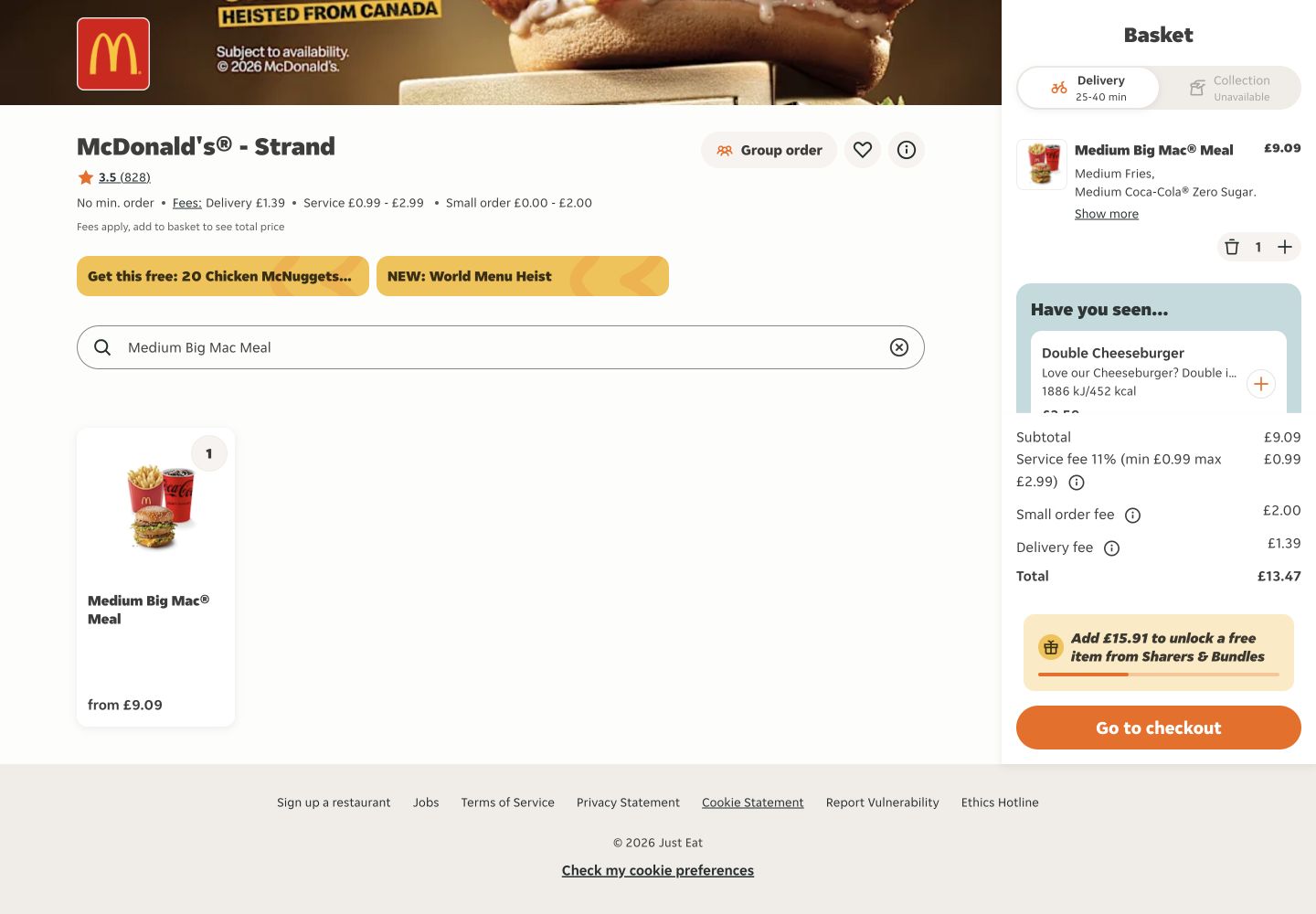
Both baskets also promoted extra food. Deliveroo opened a “Fancy anything else?” interstitial after Go to checkout. Just Eat kept “Have you seen…” suggestions inside the basket rather than requiring a separate dismissal. The inline pattern preserved the customer’s sense of progress.
Two warnings and two mandatory accounts
Before account access, both platforms displayed McDonald’s rules about school delivery and allergens. Deliveroo separated its upsell and safety notice into two consecutive gates; Just Eat used the safety notice as the only modal. The warning content is consequential, but repeating modal decisions immediately before sign-in makes checkout feel further away.
Deliveroo then offered Facebook, Google, Apple or email. Just Eat offered the same providers and an email verification code. Neither exposed a guest path, so we stopped without supplying credentials. The configured meal and totals survived through each account gate.
The field data covers each origin, not these two menus
The exact menu URLs returned no eligible phone CrUX record, so these p75 figures are the documented origin fallback for 29 August to 25 September 2026. They represent real Chrome users across each public origin and cannot prove that the result, menu or basket templates above caused a metric. Just Eat’s origin-level layout movement and both origins’ interaction delay merit template-level investigation.
The configured mobile PageSpeed runs did cover the exact menu routes. Deliveroo scored 91 for accessibility and 96 for best practices, with unnamed dialog and button findings. Just Eat scored 93 and 96; its accessibility run identified a meta refresh, and its best-practices run logged console errors. Automated checks are investigation leads, not WCAG conformance claims.
All ten Nielsen usability heuristics
Keep the total live.
Both baskets showed configured items, fee lines and final amount.
Name the food and fees plainly.
Meal choices, calories, delivery and small-order fees were understandable.
Avoid sequential gates.
Deliveroo required separate upsell and safety decisions before sign-in.
Keep sponsorship proportionate.
Just Eat repeated the same sponsored restaurant in several modules.
Prevent incomplete meals.
Just Eat blocked Add and explained what was missing; Deliveroo’s failed Add gave little feedback.
Summarise chosen options.
Both baskets repeated fries, drink and “No Thanks”.
Support menu search.
Just Eat’s in-restaurant search found the exact meal quickly.
Keep upsells in context.
Just Eat’s inline suggestions were less disruptive than Deliveroo’s extra modal.
Move to the missing group.
Deliveroo should identify and focus the first required choice after a failed Add.
Keep allergen advice available.
Both presented the restaurant’s warning and nutrition link before checkout.
What we would change first
Make missing choices explicit and focusable.
What
Add an announced summary, mark each incomplete group and focus the first one.
Where
The meal modal after Add is selected.
Why
The observed failed action left focus on Add without useful recovery guidance.
Measure
Repeat Add attempts, customisation time and basket additions.
Merge the upsell and required notice.
What
Keep optional suggestions inline and reserve the modal for the consequential safety message.
Where
Go to checkout from the basket.
Why
Two sequential gates delayed account access.
Measure
Gate exits and time from basket to sign-in.
Cap repeated sponsored exposure.
What
Deduplicate a restaurant across adjacent modules or clearly explain repeated placement.
Where
Opening results, Popular brands and offer rails.
Why
The same sponsored McDonald’s appeared repeatedly on one page.
Measure
Unique-result discovery, sponsored-card comprehension and selection diversity.
Reduce phone interaction delay.
What
Profile menu filtering, customisation and basket updates for long tasks and forced reflow.
Where
Shared restaurant and basket templates.
Why
Origin p75 INP was 337ms for Deliveroo and 368ms for Just Eat.
Measure
Template p75 INP beside successful adds and checkout starts.
What this public comparison cannot see
We did not create an account, enter a full delivery address, apply a promotion, choose a tip, pay or observe fulfilment. The postcode represented an area rather than a supplied private residence. Restaurant supply, estimates and fees can change minute by minute.
We cannot say which platform delivers more reliably or converts better. Connected analytics could quantify menu search, customisation errors, upsell exits, account-gate abandonment and completed orders.