Independent public comparison
We priced the same two-pound parcel from New York to Boston with USPS and UPS. We used the public calculators without signing in and stopped at the quote results. We are not affiliated with either carrier. This records the public journeys on 26 September 2026; prices and delivery commitments can change.
The New York-to-Boston parcel test
Compare delivery date and public price for one ordinary parcel.
ZIP 10001 in New York to ZIP 02108 in Boston.
Two pounds, 12 × 9 × 4 inches, rectangular packaging and no declared value.
Rates requested on Saturday 26 September 2026 for the next available mailing or pickup date shown by each calculator.
At the service-and-price results. No label, pickup, account or payment was created.
Unsigned-in public Chrome session on desktop, followed by a 500-pixel phone-width review. Retail and online USPS prices are reported separately; UPS showed a public retail quote.
The 30-second result
USPS made the cheapest ordinary option easier to compare. UPS explained the parcel’s billable weight.
USPS wins this quote journey. Ground Advantage showed Thursday 1 October at US$12.20 retail or US$8.26 online, while UPS Ground showed Tuesday 29 September at US$15.96. UPS was faster in the observed quote and explicitly raised the two-pound parcel to a three-pound billable weight. USPS offered the clearer price ladder and a much more responsive results page.
USPS separated counter price from online price
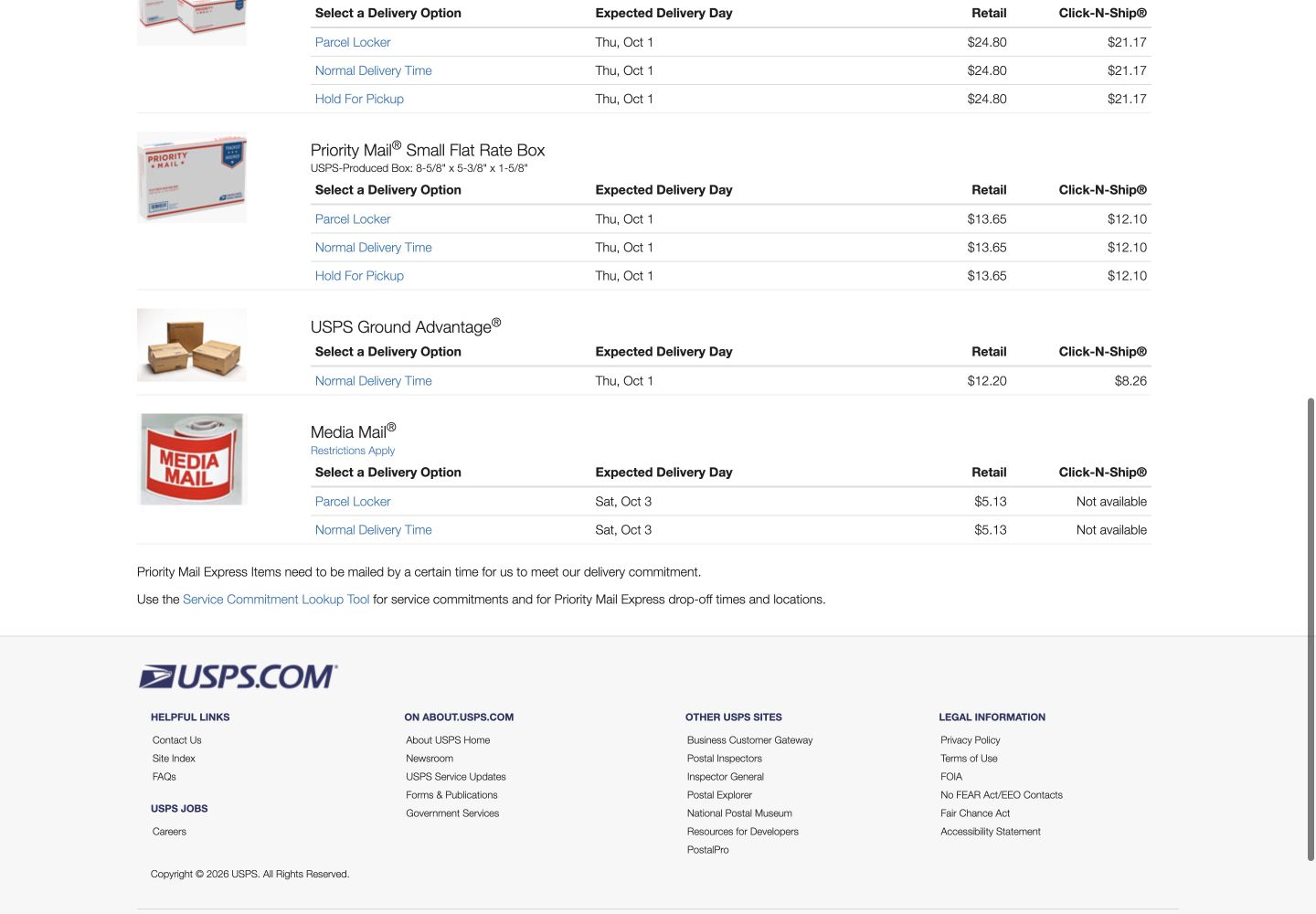
USPS carried the route and weight into one long service list. Priority Mail Express promised Tuesday 29 September for US$41.40 retail or US$37.05 online. Priority Mail showed Thursday 1 October for US$13.45 retail or US$9.78 online. Ground Advantage showed the same Thursday expectation for US$12.20 retail or US$8.26 online. Media Mail was cheaper at US$5.13, but the calculator also marked it as restricted, so it was not treated as a general-parcel alternative.
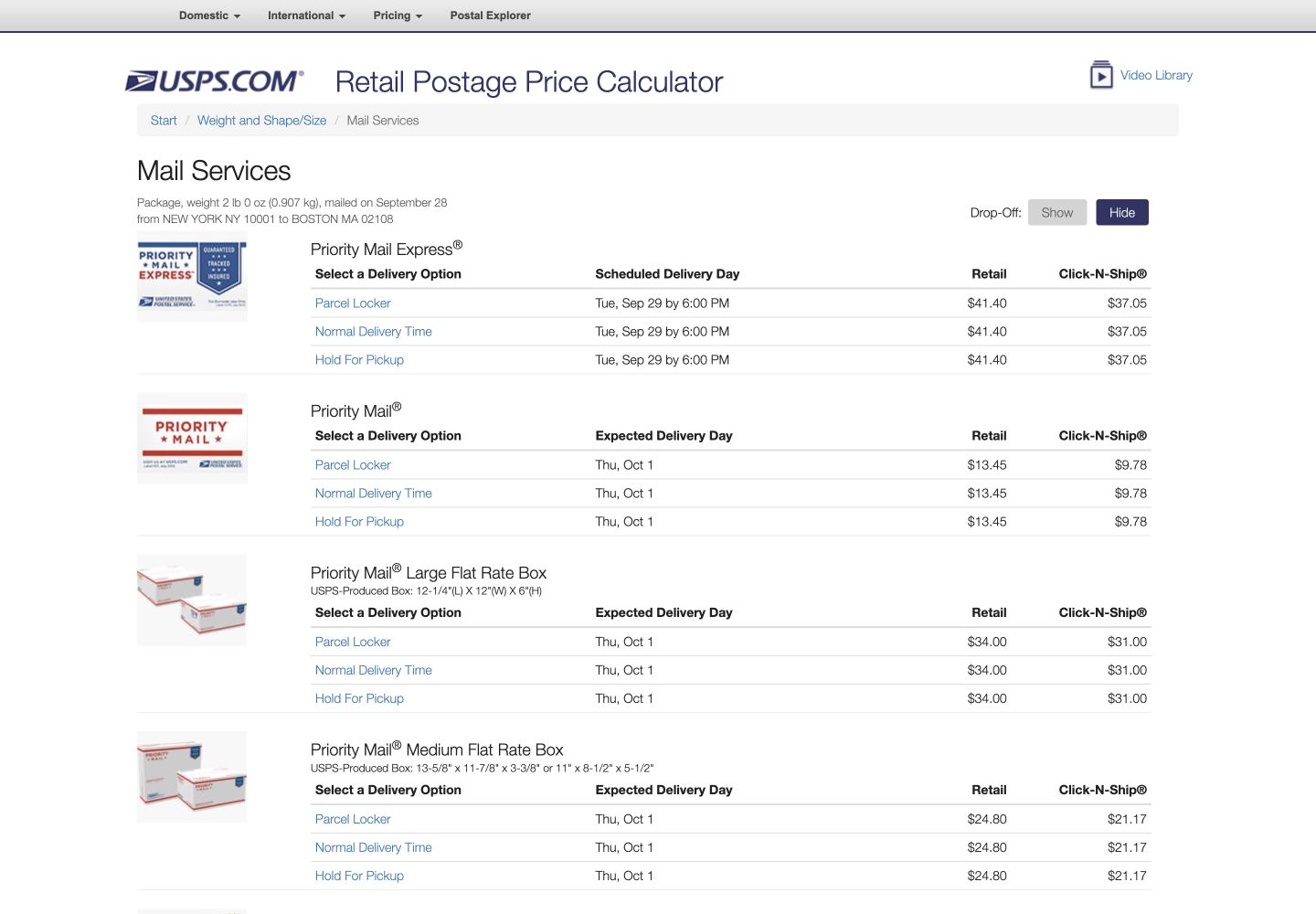
The online saving was visible without mental arithmetic: Ground Advantage was US$3.94 less online and Priority Mail was US$3.67 less online. The drawback was scanning. Flat-rate boxes appeared among the services for the customer’s own 12 × 9 × 4-inch package, making the relevant Ground Advantage row easy to miss lower on the page.
UPS offered a faster ground date, but in a cramped result table
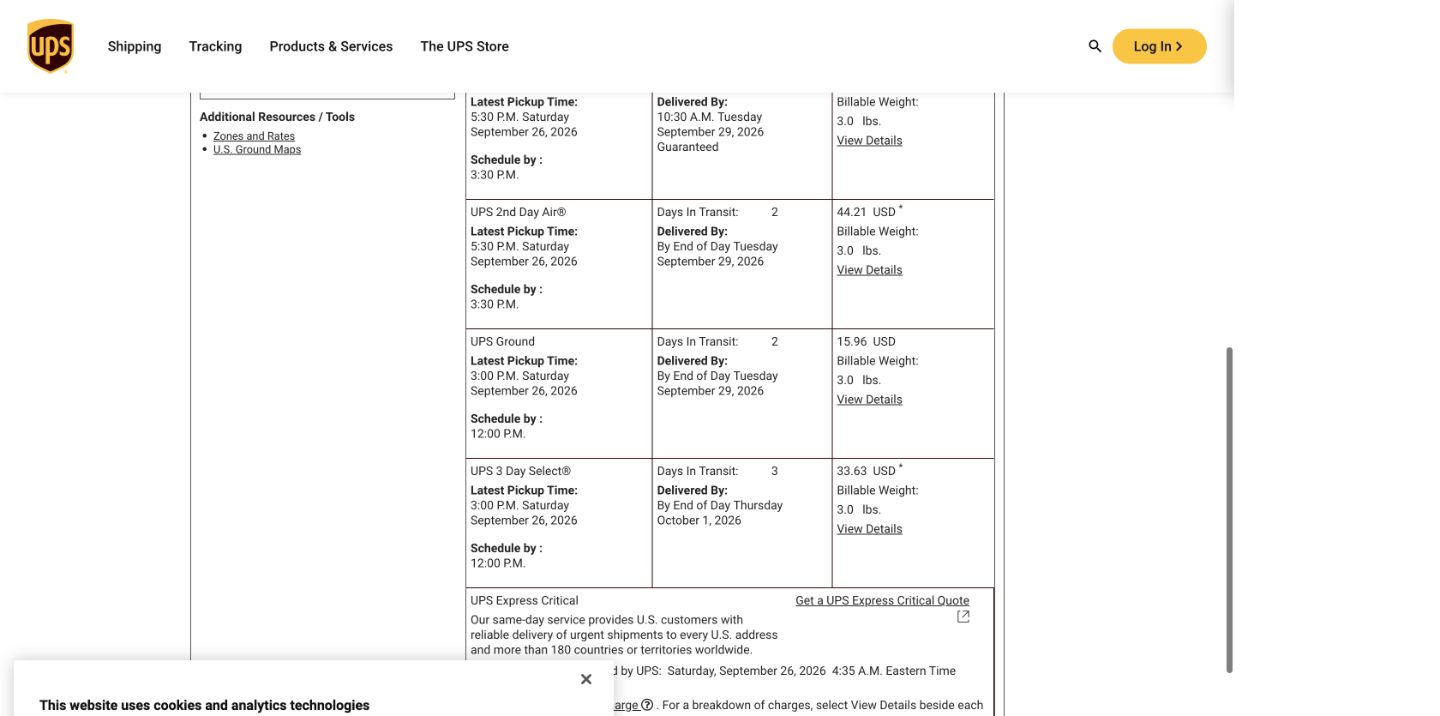
UPS Ground returned a two-day transit estimate with delivery by the end of Tuesday 29 September for US$15.96. UPS 3 Day Select was US$33.63; 2nd Day Air was US$44.21; the fastest options ranged from US$84.44 to US$139.25. Fuel surcharge was included, and UPS warned that retail-location rates may vary.
The calculator also stated a three-pound billable weight. That was useful because it explained why a two-pound parcel was being priced differently after dimensions were considered. The result table itself was narrow, visually dense and left a large unused area on the page.
Round winner / USPS
The relevant ordinary service was cheaper, and the online-versus-retail comparison was visible in the result row. UPS deserves credit for the earlier observed Ground delivery date.
Both caught a bad ZIP code; neither moved focus to it
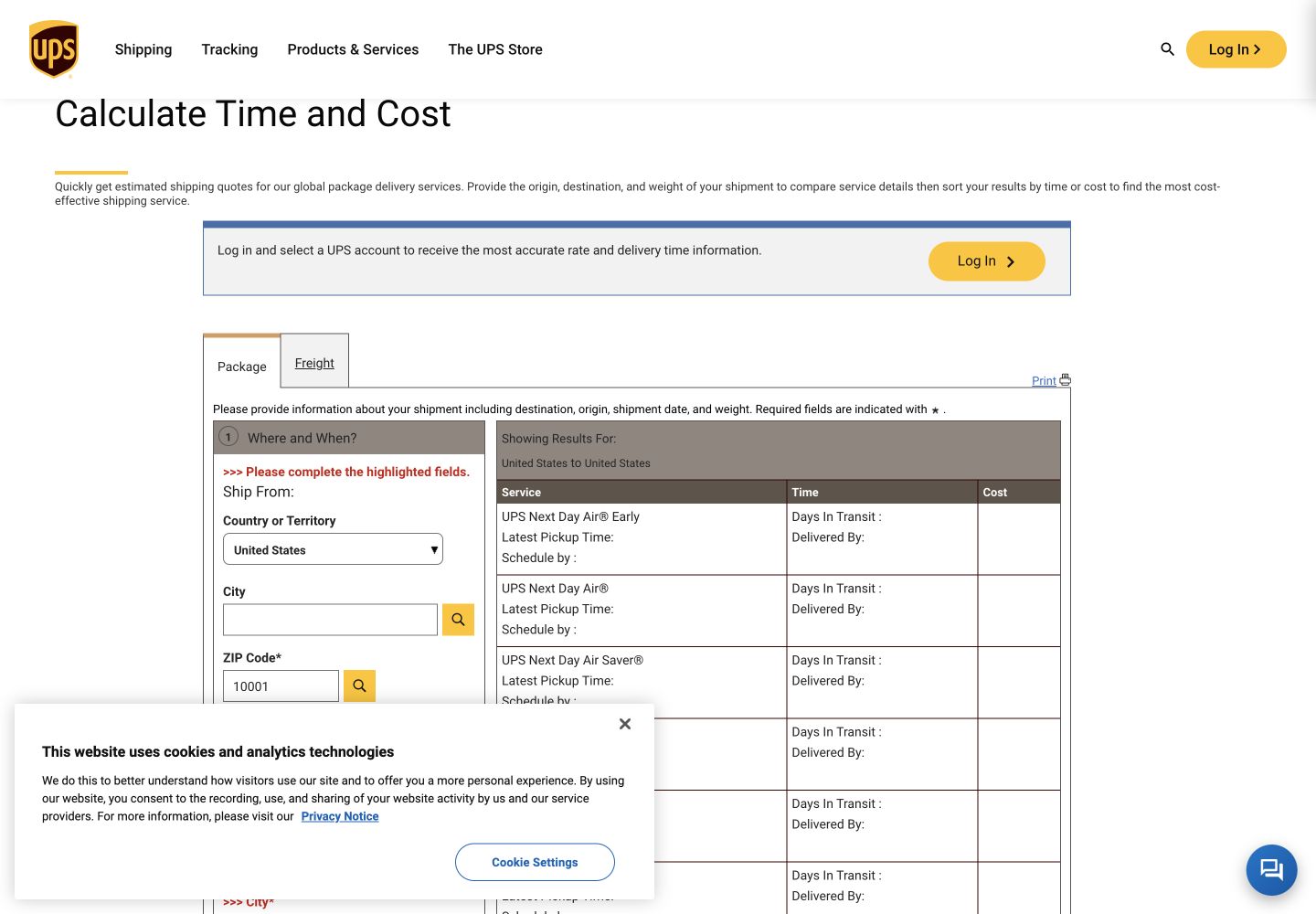
We replaced the destination with the harmless malformed value 000. USPS said “The Destination ZIP Codes must be 5 digits.” UPS gave a page summary, “Please complete the highlighted fields,” and identified City and ZIP Code. In both tests, keyboard focus remained on the page body or Update button instead of moving to the invalid field. Correcting the ZIP restored the quote.
UPS was slow and unresponsive in public field data
These are 75th-percentile Chrome UX Report results for the exact calculator URLs on phones, collected from 28 August to 24 September 2026. LCP is when the main content appears, INP is the delay after an interaction and CLS is unexpected movement. USPS loaded quickly but had substantial layout movement. UPS missed the good threshold by a wide margin for both loading and interaction. Desktop field data told the same broad story: USPS recorded 1.14s LCP, 97ms INP and 0.29 CLS; UPS recorded 6.08s LCP, 3,084ms INP and 0.02 CLS.
The configured mobile PageSpeed runs scored USPS 83 and UPS 95 for accessibility. USPS flagged a missing page language, an unnamed footer link, positive tabindex values and small targets. UPS flagged restricted zoom and a visible-label/accessibility-name mismatch; its best-practices score was 50, with geolocation on load, deprecated APIs, third-party cookies and console errors. At 500 pixels wide, USPS fit the viewport while the UPS calculator remained 960 pixels wide and required horizontal scrolling. Automated scores guide investigation; they do not prove accessibility or WCAG conformance.
What each website gets right
- USPS: aligned delivery and price columns, separate retail and online prices, and service restrictions shown in the result list.
- UPS: explicit billable weight, pickup deadline, transit time and delivery date for each service.
All ten Nielsen usability heuristics
Keep the quote inputs beside the results.
Both summarised the route and parcel; UPS added billable weight and cutoff information.
Use delivery dates, not service names alone.
Both translated products into expected or promised calendar dates.
Make editing obvious.
The customer could revise inputs, but UPS’s long page and narrow table made that route less visible.
Use one readable comparison grid.
USPS’s columns were easier to scan; UPS mixed labels and values inside compressed cells.
Validate ZIPs before recalculating.
Both detected the malformed destination but could guide the customer earlier.
Repeat package dimensions in the result.
UPS explained the resulting billable weight; both could keep every input visible beside the quote.
Offer cost and speed sorting.
A shortest-to-longest or cheapest-first control would reduce scanning across long service lists.
Remove irrelevant packaging options.
USPS showed flat-rate boxes despite the customer entering their own dimensions; UPS left much of the result canvas unused.
Move focus to the first invalid field.
The messages were understandable, but neither focus position helped keyboard users recover.
Explain price qualifications in place.
USPS labelled restricted Media Mail; UPS disclosed retail variation and billable weight.
What we would change first
Fix the long interaction delay and responsive layout.
What
Reduce main-thread work and rebuild the result table to reflow without a fixed 960-pixel canvas.
Where
The public Calculate Time and Cost form and results.
Why
Phone p75 INP was 2,558ms, LCP was 6.89s and the 500-pixel check required horizontal scrolling.
Measure
p75 INP and LCP alongside successful quote completion and service selection.
Prioritise services that match the entered package.
What
Group own-packaging results first and move alternative flat-rate packaging behind a secondary comparison.
Where
The Mail Services result list.
Why
Ground Advantage was below several flat-rate rows even though dimensions for the customer’s package had already been entered.
Measure
Time to first service selection, result-page scrolling and backtracking to package type.
Stabilise the page while results and images arrive.
What
Reserve space for the shipping-date content and service imagery before it renders.
Where
The calculator result template and service rows.
Why
Exact-page phone CLS was 0.34 and desktop CLS was 0.29; PageSpeed also identified the shipping-date area.
Measure
p75 CLS and misclicks during result loading.
Send focus to the first ZIP error.
What
Keep the summary, associate the message with its field and focus that field after submission.
Where
Origin and destination ZIP validation.
Why
Both named the error but left keyboard focus elsewhere.
Measure
First-attempt recovery, repeated validation errors and keyboard task completion.
What this public comparison cannot see
This was one route, package and quote date. We did not buy a label, visit a counter, schedule pickup, track a parcel or test claims and support. USPS online and retail prices are different purchasing contexts, while UPS warned that a retail-location price may vary.
Public evidence cannot say which journey converts better. With consented GA4 and Microsoft Clarity data, the next comparison would connect field errors, result scrolling, service selection and horizontal scrolling to completed label purchases.