Independent public comparison
We shopped for the same 15kg bag of Royal Canin Medium Breed Adult dry dog food from Petbarn and Petstock for delivery to Melbourne 3000. We continued through the bag and stopped before entering identity or payment. We are not affiliated with either retailer. This records the public journeys on 26 September 2026; prices, stock and delivery options can change.
The Melbourne dog-food test
Find the 15kg product, understand the one-off and subscription prices, set Melbourne availability, add one bag and reach checkout.
Royal Canin Medium Breed Adult dry dog food, 15kg.
Melbourne postcode 3000; Petstock South Melbourne Moray was selected when a store was required.
Unsigned in and buying once. Membership and repeat-delivery offers were compared but not joined.
At guest checkout before identity, delivery address, payment or order submission.
Public Chrome journey on desktop, followed by a 500-pixel phone-width review. Both sites received the same postcode and product size.
The 30-second result
Petstock made the unsigned-in price and fulfilment choice easier to trust.
Petstock wins this journey. Its 15kg buy-once price stayed at A$158 from product page to bag, while Autoship was A$142.20 with a visible A$15.80 saving. Petbarn led with A$150 for members and A$142.50 for Repeat Delivery, but the unsigned-in bag became A$233.99. Petbarn offered the broadest delivery promise, including two-hour and next-day options; Petstock presented collection, same-day and standard delivery more coherently in the bag.
Petstock gave every 15kg customer a stable buy-once price
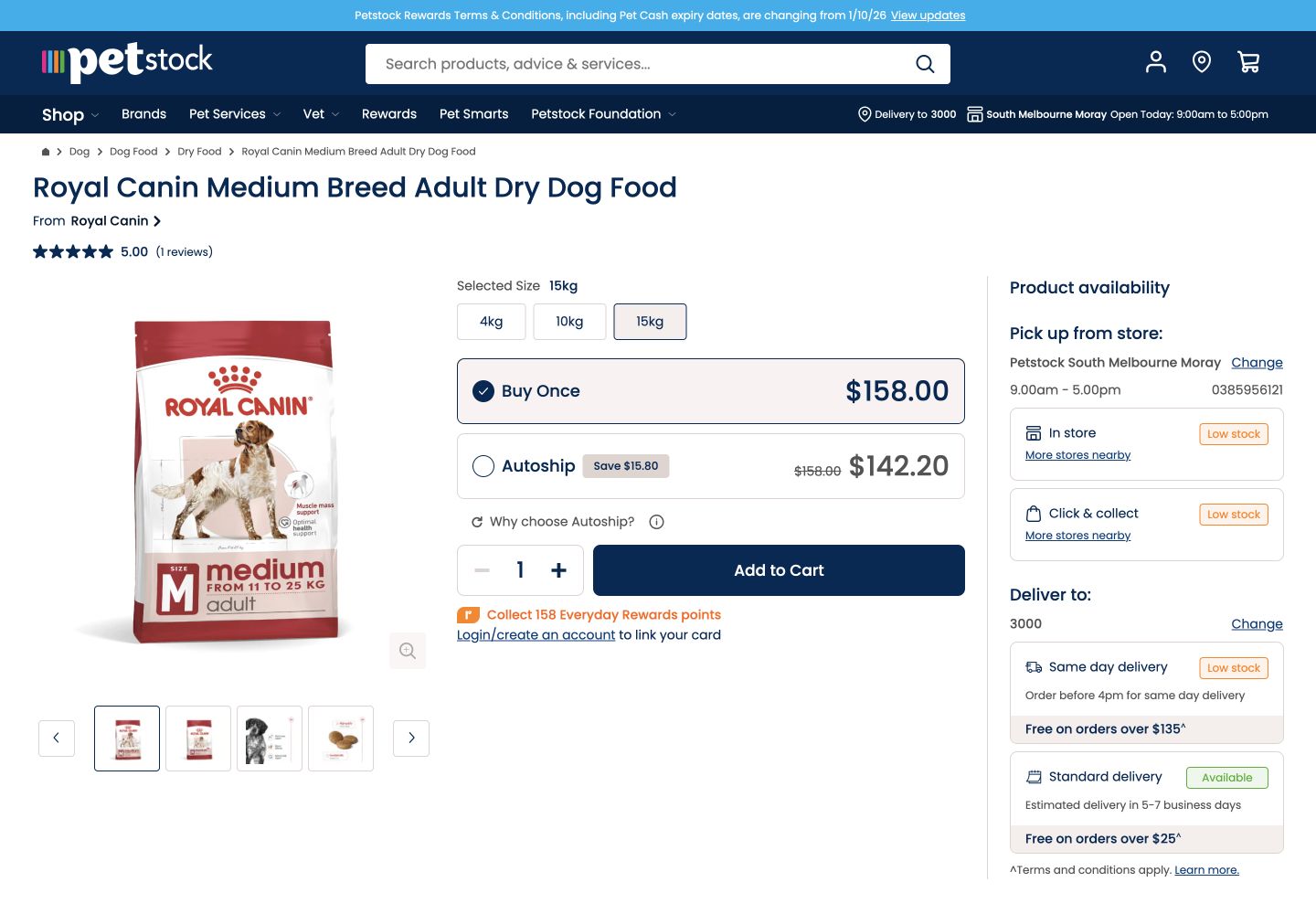
Petstock selected the 15kg size and presented two choices together: A$158 to buy once or A$142.20 on Autoship, a saving of A$15.80. The product page also kept the delivery-area prompt close to stock status. The subscription saving was specific enough to compare without calculating a percentage.
Petbarn showed three materially different prices: A$150 for members, A$233.99 for non-members and A$142.50 for Repeat Delivery. The spread made membership highly consequential, but the lower figures dominated the product choice before the unsigned-in customer reached the bag.
Petbarn promised more delivery modes; Petstock explained the local stock
After Melbourne 3000 was selected, Petbarn showed two-hour delivery when ordered by 4pm, next-day delivery when ordered by 11:59pm, a pick-a-day-and-time option and standard delivery expected 28–30 September. That range supports urgent and planned replenishment.
Petstock asked for a delivery area and store, then showed low stock at South Melbourne Moray for in-store shopping and click and collect. Same-day delivery was also low stock, available for orders before 4pm and free over A$135. Standard delivery was available in five to seven days and free over A$25. The stock qualification made the promise more credible, even though “low” does not say how many bags remain.
Round winner / Petbarn for speed, Petstock for clarity
Petbarn offered the fastest stated fulfilment. Petstock did the better job of qualifying local stock and delivery thresholds.
The bag exposed Petbarn’s non-member price jump
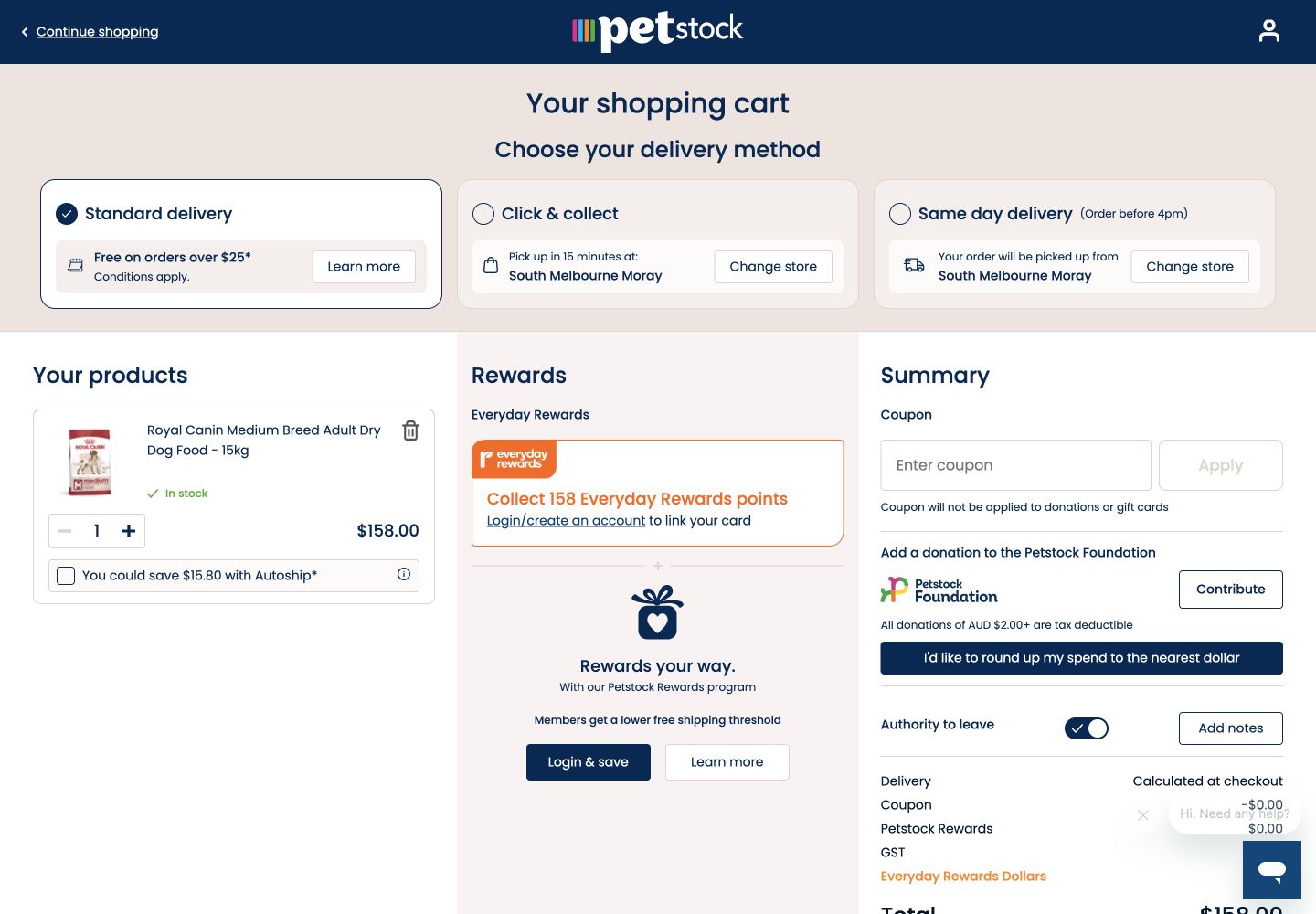
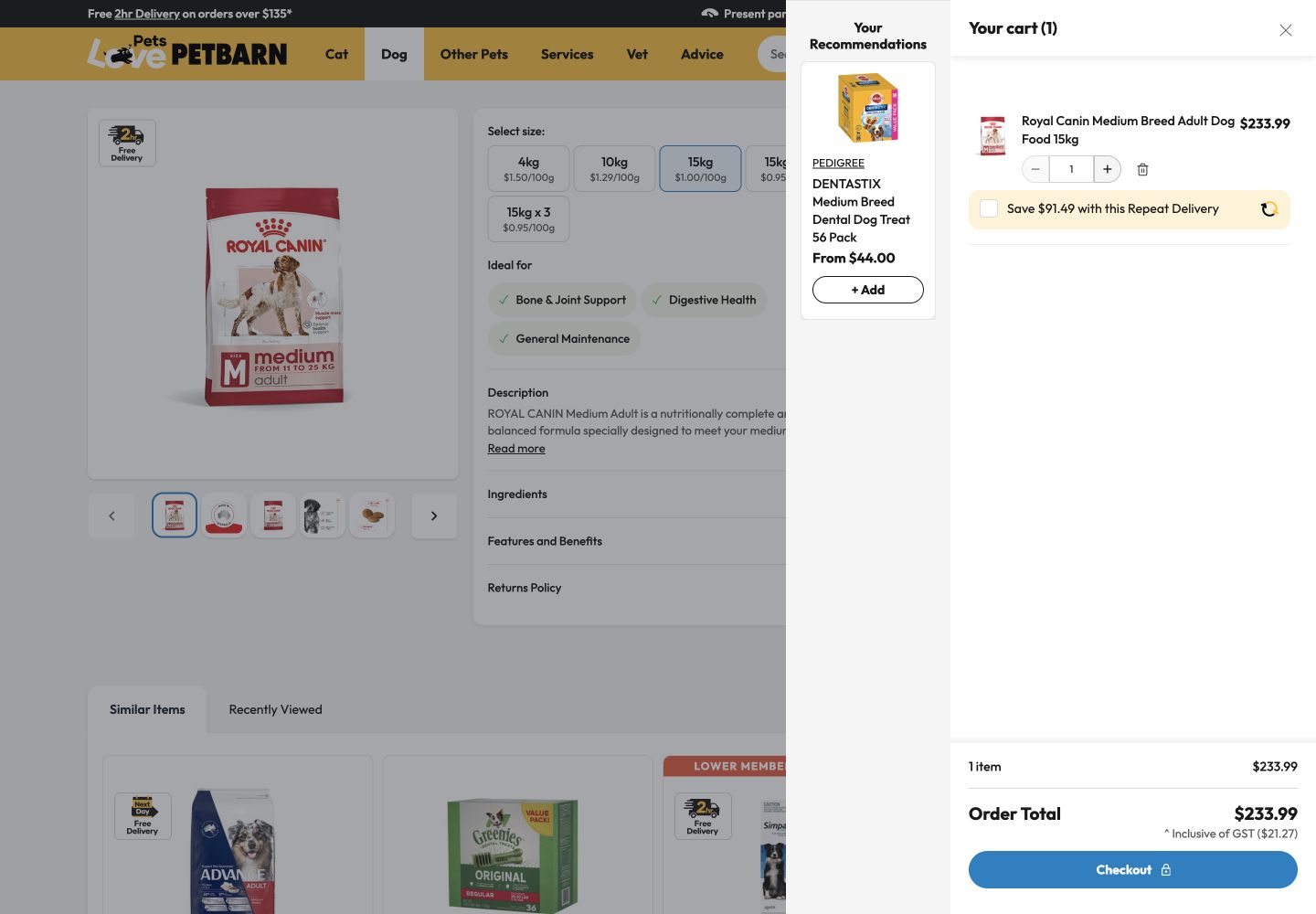
As an unsigned-in customer, the Petbarn bag total was A$233.99. A panel said Repeat Delivery could save A$91.49, while the checkout promoted an A$83.99 member saving. These are useful prompts for eligible shoppers, but they also make the ordinary buy-once price feel like a penalty revealed after selection.
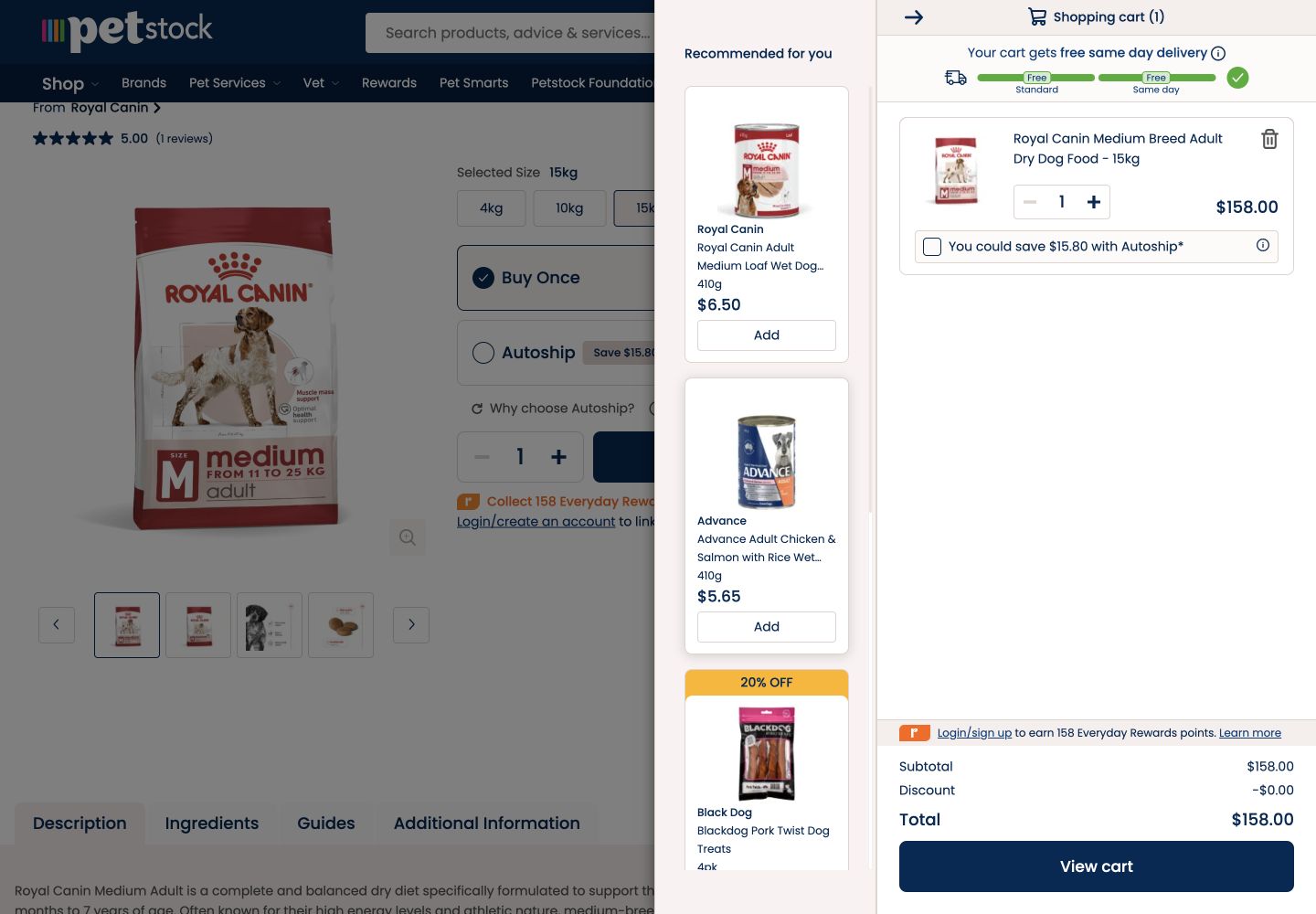
Petstock’s bag held at A$158 and offered Standard Delivery, Click & Collect with “Pick up in 15 minutes”, and Same Day in one fulfilment area. Standard and same-day delivery were both free for this basket. The Shopify checkout then kept contact, delivery and payment in a recognisable single-page sequence. Petbarn also allowed guest checkout and showed identity and payment on the same page. We stopped before entering personal details on either site.
A partial postcode failed silently on both sites
We entered 300 into each postcode control. Neither site displayed a clear validation message, and focus remained on the search action. After correction to 3000, both offered Melbourne as a suggestion and allowed the journey to continue. Recovery was possible, but the customer had to infer that four digits and a listed suggestion were required.
Petstock’s public origin met all three phone thresholds
These are 75th-percentile Chrome UX Report results for each whole public origin on phones, collected from 28 August to 24 September 2026. They are not measurements of these exact product or checkout pages and cannot identify which template caused a metric. Petstock’s public origin met the good thresholds for loading, interaction and stability. Petbarn’s origin needed improvement for both LCP and INP. On desktop, Petbarn recorded 3.13s LCP, 147ms INP and 0.05 CLS; Petstock recorded 1.69s, 135ms and 0.06.
The configured mobile PageSpeed runs scored Petbarn 84 and Petstock 81 for accessibility. Petbarn flagged contrast, heading order, unlabelled selection controls, unnamed links, restricted zoom and label/name mismatches. Petstock flagged unnamed buttons, contrast, heading order, an unlabelled input and positive tabindex. Both product pages fit a 500-pixel viewport without horizontal scrolling. Automated checks guide investigation; they do not prove accessibility or WCAG conformance.
What each website gets right
- Petbarn: unusually broad delivery timing, guest checkout and strong visibility of membership and repeat-delivery savings.
- Petstock: stable one-off pricing, a precise Autoship saving, qualified store stock and a coherent fulfilment chooser in the bag.
All ten Nielsen usability heuristics
Show location, stock and delivery together.
Both updated availability after location; Petstock made low local stock explicit.
Describe when the food can arrive.
Two-hour, same-day, next-day and standard labels matched the replenishment decision.
Keep buy-once prominent.
Petstock presented it as a complete option; Petbarn’s membership economics dominated the unsigned-in journey.
Carry one price through every step.
Petstock stayed at A$158. Petbarn moved from promoted lower prices to A$233.99 in the bag.
Validate Australian postcodes as four digits.
Both accepted a three-digit attempt without explaining what was missing.
Keep savings beside the baseline.
Petstock showed the A$15.80 Autoship difference in place; Petbarn required customers to reconcile several saving amounts.
Let customers choose speed in the bag.
Both supported multiple fulfilment modes without requiring an account.
Quiet the loyalty message after the choice.
Price, stock and delivery should dominate over repeated membership promotion.
Explain the postcode rule and focus the field.
The valid suggestion worked, but the invalid state was silent.
Explain subscription control before checkout.
Frequency, cancellation and change rules should be reachable beside Repeat Delivery or Autoship.
What we would change first
Make the unsigned-in buy-once price impossible to miss.
What
Give A$233.99 equal prominence before Add to Cart and label A$150 as member-only in the same price line.
Where
The 15kg selector, purchase controls and sticky add-to-cart area.
Why
The ordinary bag total was A$83.99 above the member price highlighted earlier.
Measure
Bag removals, price-related help opens, sign-in starts and checkout progression.
Turn an incomplete postcode into an actionable error.
What
State “Enter a four-digit Australian postcode,” associate it with the field and move focus there.
Where
Product availability and delivery-location dialogs.
Why
The three-digit test produced no message on either site.
Measure
Repeated postcode attempts, time to a valid location and keyboard completion.
Quantify or contextualise “low stock”.
What
Show a meaningful threshold such as “few left” and whether the item is reserved only after checkout.
Where
Store, click-and-collect and same-day availability rows.
Why
Three low-stock messages created urgency without enough information to judge risk.
Measure
Store changes, unavailable-at-checkout events and fulfilment switching.
Fix the named accessibility defects, then retest the complete task.
What
Correct labels, accessible names, heading order, contrast, zoom behaviour and tabindex use.
Where
Size selectors, postcode dialogs, purchase choices and bag controls.
Why
The lab runs identified component-level barriers on both exact product pages.
Measure
Zero recurrence in automated component tests plus successful keyboard and screen-reader completion.
What this public comparison cannot see
Stock, membership eligibility, subscription terms and delivery capacity can change by postcode and time. We did not create an account, join a programme, enter an address, test payment, submit an order or assess delivery and returns after purchase.
Public evidence cannot say which journey converts better. With consented GA4, Search Console and Microsoft Clarity data, the next comparison would connect size changes, postcode attempts, membership interactions, fulfilment switching and bag exits to completed orders.