Independent public comparison
We asked Village Cinemas and HOYTS to book two adult tickets for Coyote vs. Acme in central Melbourne on Saturday 26 September 2026, close to 6pm. We are not affiliated with either cinema. This records the public journeys on 25 September 2026; sessions, prices and seat availability can change.
The Melbourne movie-ticket test
Find the closest suitable session to 6pm, choose two adjacent adult seats, reconcile the full online total and continue until customer details or payment.
Village Crown, 6:25pm Standard session, seats H6 and H7.
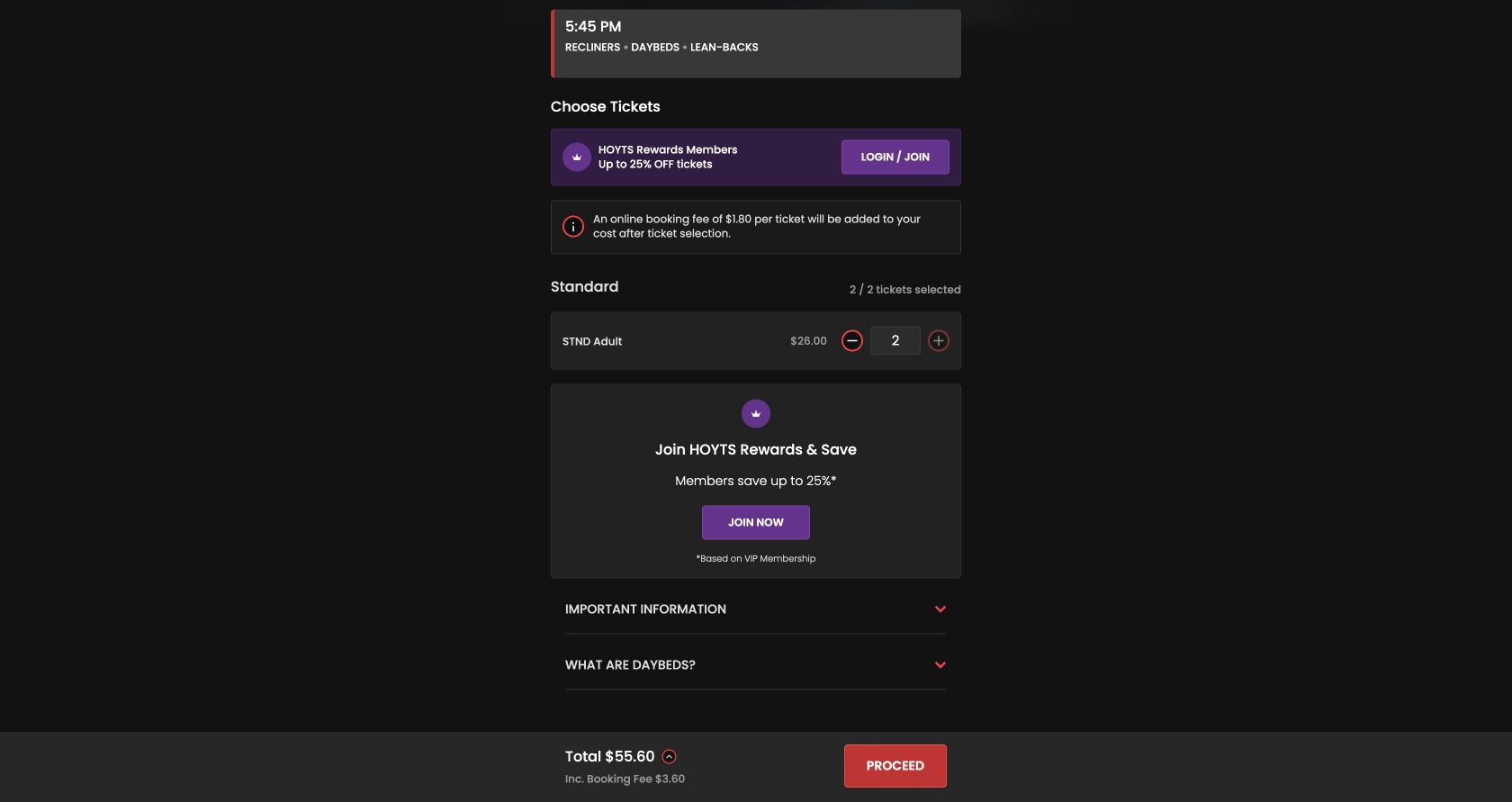
HOYTS Melbourne Central, 5:45pm session with recliners, daybeds and lean-backs, seats H11 and H12.
Two adults, no membership price, voucher or food included in the comparison.
Before personal details, payment or order submission. No tickets or snacks were purchased.
The venues and session formats were different because each chain has its own central-Melbourne inventory. Price is reported as observed, not as a like-for-like auditorium benchmark.
The 30-second result
Village made the total easier to reconcile. HOYTS explained the cinema experience better.
Village narrowly wins the observed purchase journey. Two adult tickets reached a clear $51.80 total, including the $1.90-per-person online fee. HOYTS was stronger while choosing a session: recliners, daybeds, lean-backs and D-BOX were named where they mattered. Its two-adult total was also explicit at $55.60, but the journey inserted an optional snack step before checkout. HOYTS recovered cleanly when the wrong ticket mix was corrected; Village’s second adult price appeared without a useful label in the accessible text.
HOYTS made the format part of the session decision
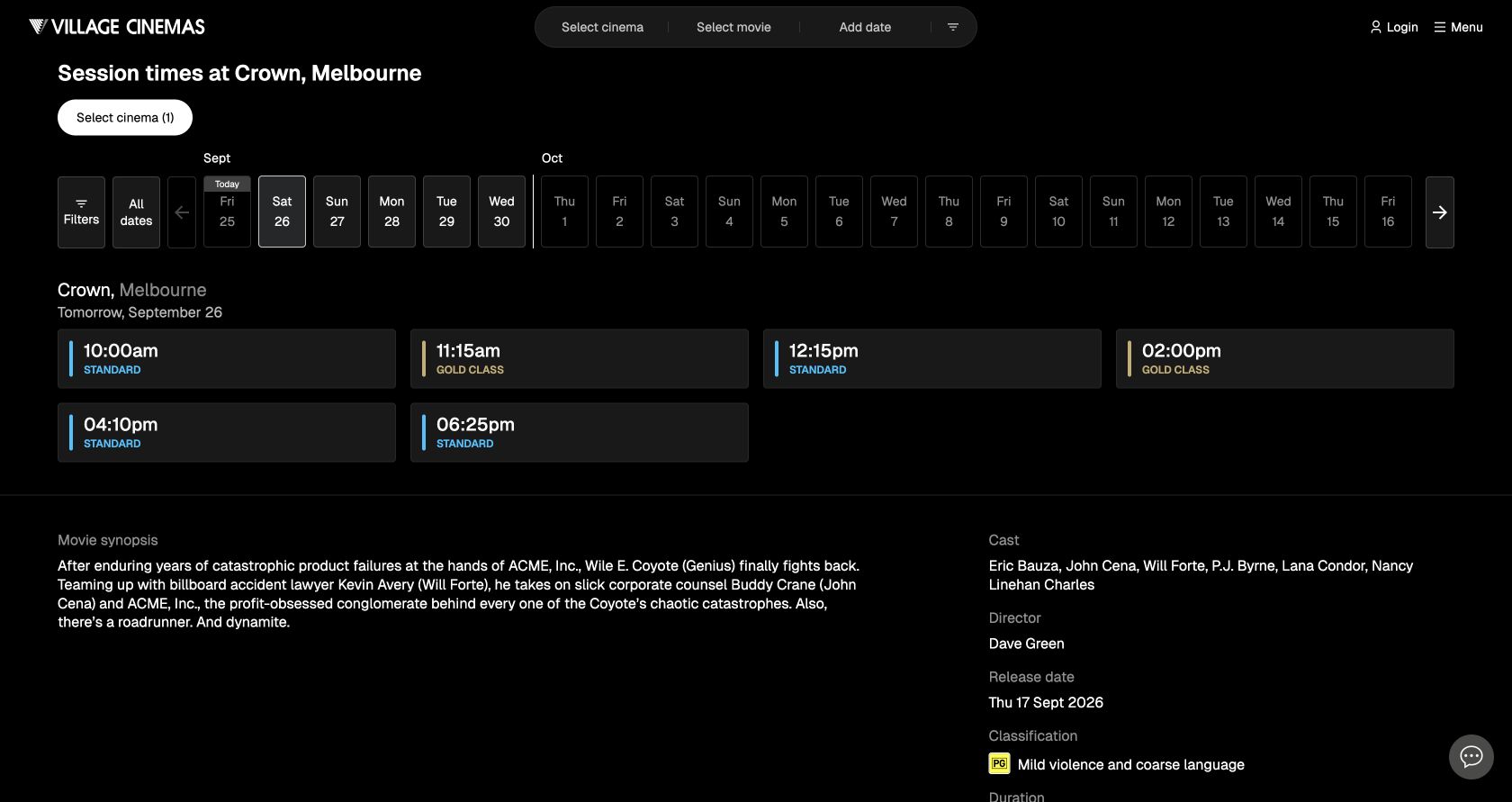
Village’s film page made Crown easy to select and offered six sessions across Standard and Gold Class. The 6:25pm Standard option was the closest match to the brief. Its compact presentation made time and broad class scannable, but left the customer to learn more about the room later.
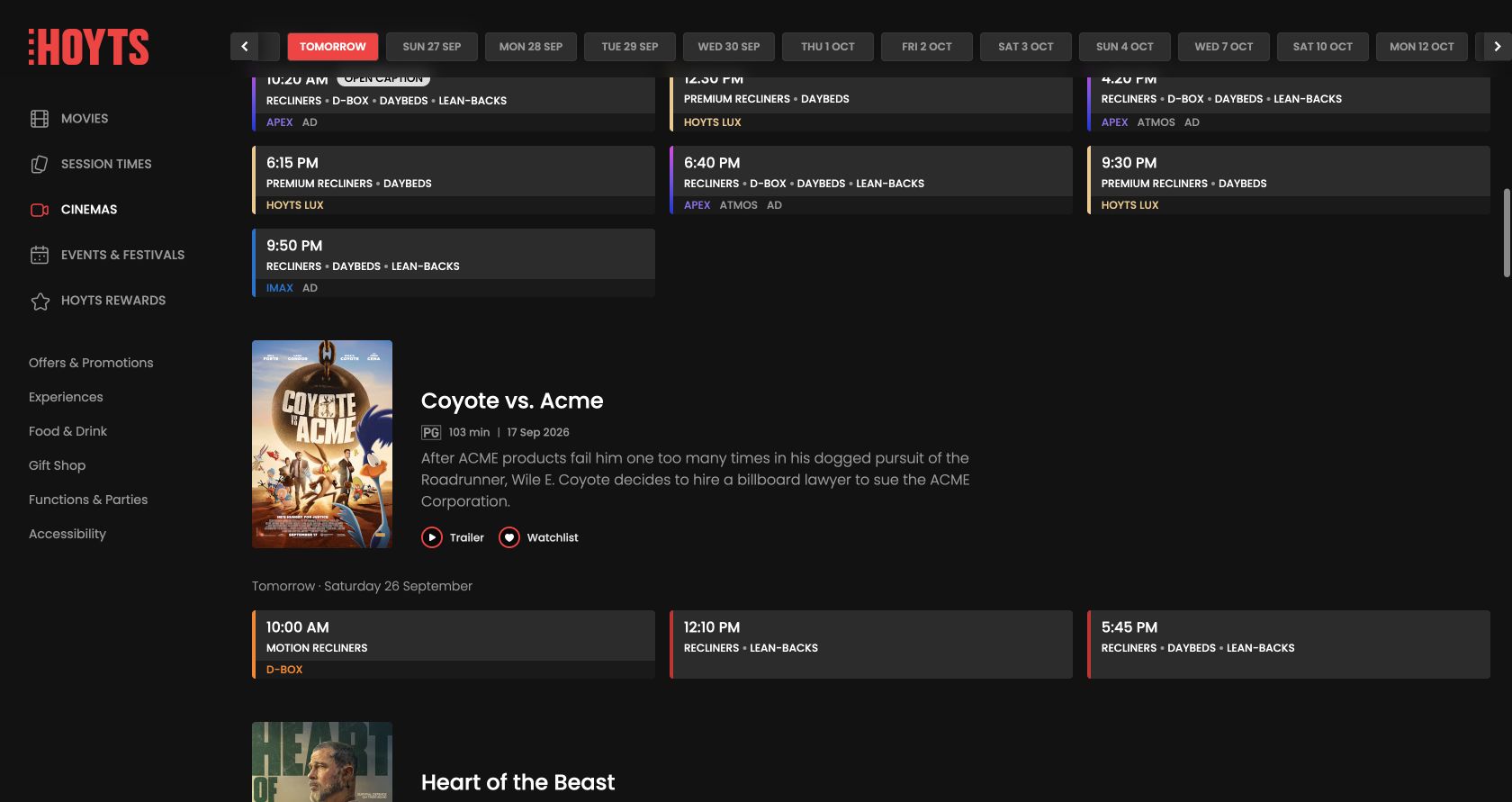
HOYTS Melbourne Central showed the same day’s sessions with the auditorium experience attached. The 5:45pm card said Recliners, Daybeds and Lean-backs; the morning alternative named Motion Recliners and D-BOX. Those labels make a price or comfort difference understandable before a customer commits to a time.
Round winner / HOYTS
The customer could understand what kind of seat and cinema experience sat behind each time.
Both seat maps supported the basic adjacent-seat task
Village allowed H6 and H7 to be selected together and carried them forward to ticket pricing. HOYTS did the same for H11 and H12, while the session labels prepared the customer for the seating variety. Neither observed map forced a seat change or introduced an unavailable-seat surprise during this test.
The more important distinction came after seats were chosen. Village moved directly to ticket types and price. HOYTS moved through ticket types, then placed an optional food-and-drink step before Checkout. The snack page was clearly optional, but it extended a task whose main decision was already complete.
Village showed the online fee early; both totals were checkable
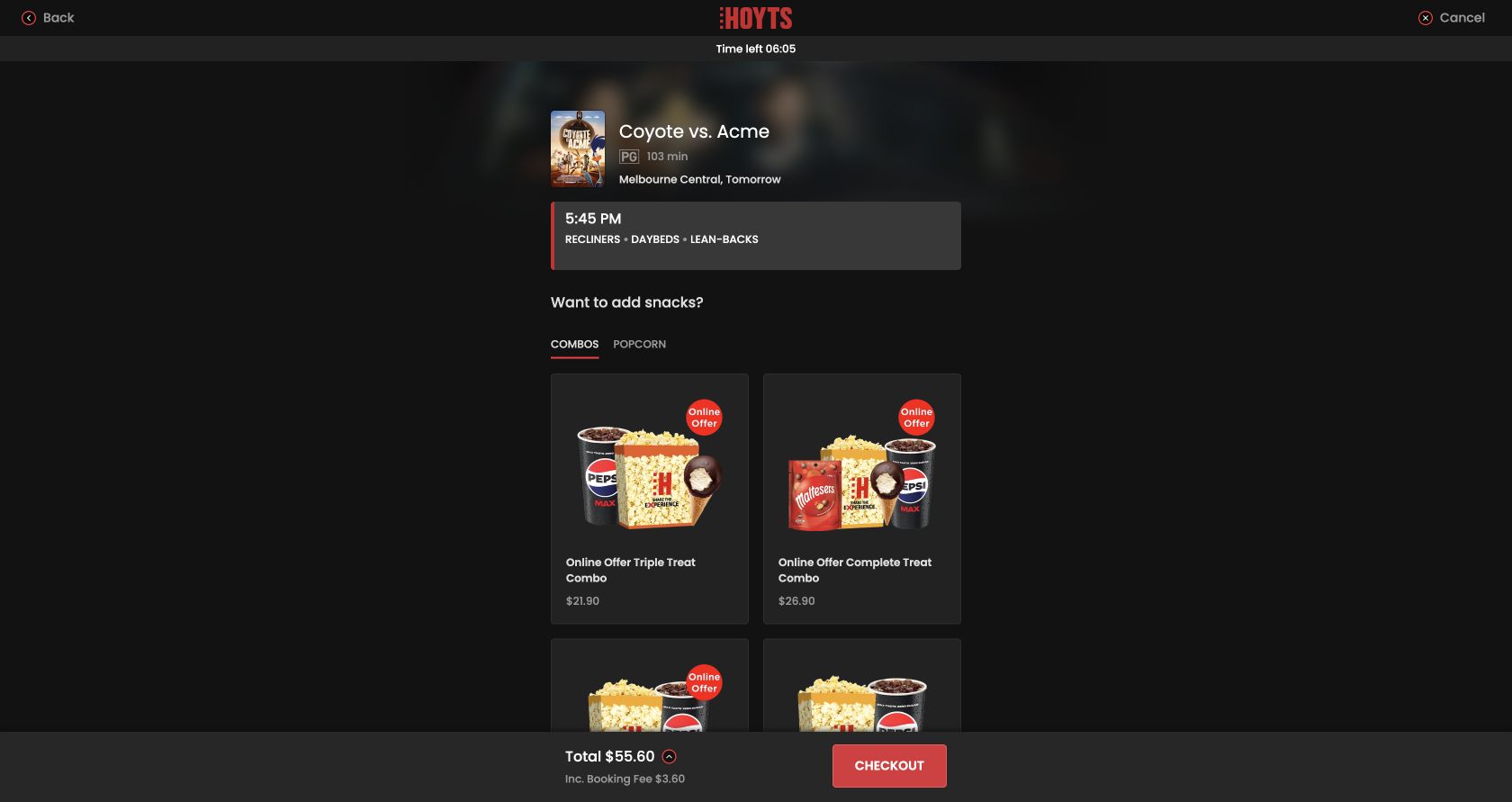
Village listed an Adult ticket at $24 and disclosed that displayed prices were for in-cinema purchases, with a $1.90 online booking fee per person. Two adults therefore reached $48 in tickets plus $3.80 in fees: $51.80. The total reconciled cleanly. However, an additional $22 adult price appeared in the accessible text without a nearby explanation, which could confuse keyboard or screen-reader users even if the visual design supplies context.
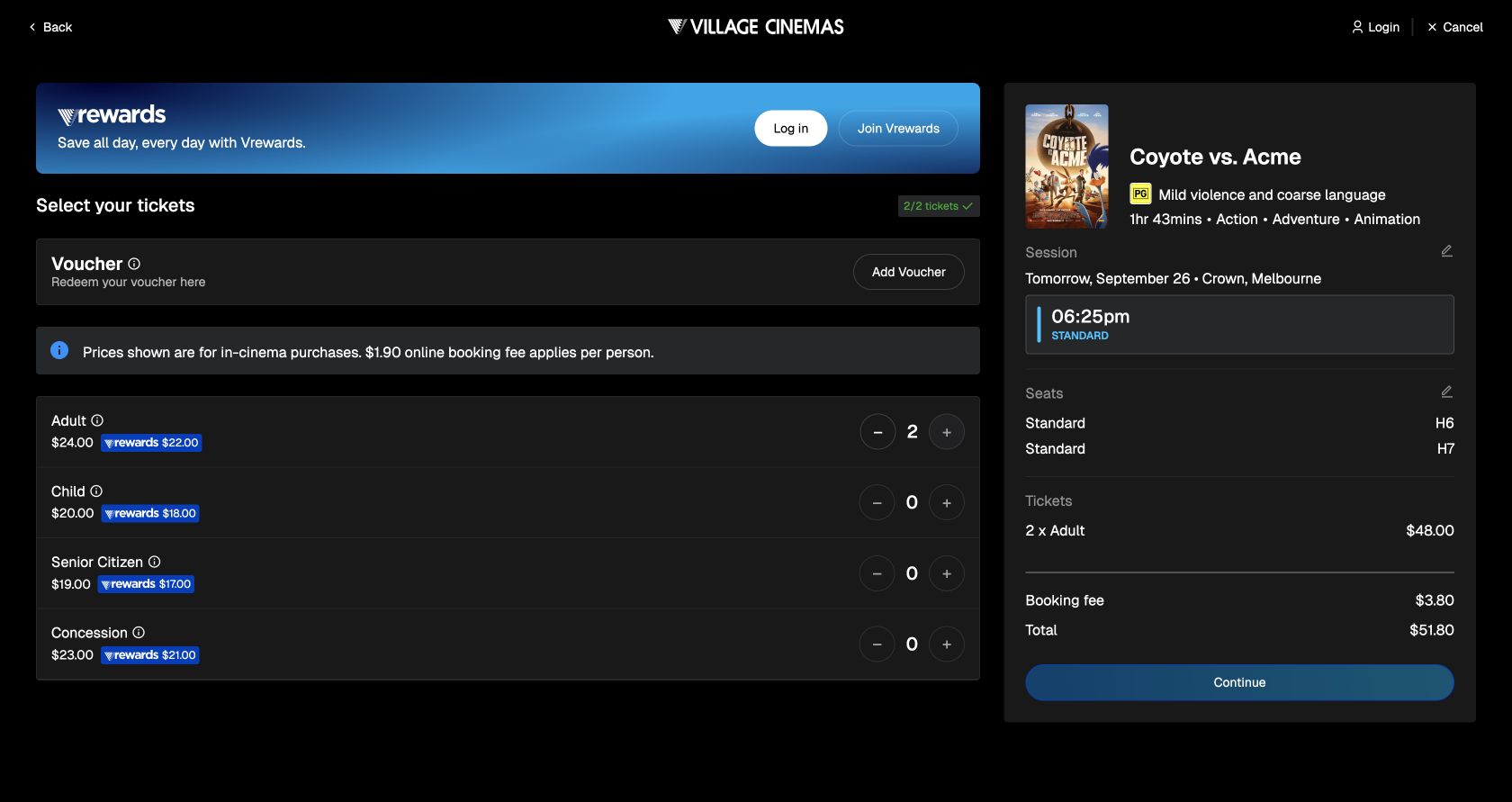
HOYTS listed Adult at $26 and an online booking fee of $1.80 per ticket. Two adults produced $52 in tickets and $3.60 in fees: $55.60. That was $3.80 more than Village in this test, but the comparison is not a pure price contest because the venue and seating experience differed.
HOYTS corrected the ticket mix without sacrificing the seats
We deliberately created a reversible mistake by selecting one adult and one child. Reducing the child quantity and increasing the adult quantity preserved H11 and H12 and updated the total from $50.10 to $55.60. The customer did not have to return to the map or reconstruct the order. Village’s selected seats also persisted while ticket quantities were reviewed, but the observed Continue action did not advance, so we did not treat that single browser state as a general defect.
HOYTS loaded faster; Village moved less
These are 75th-percentile Chrome UX Report results for the exact film URLs on phones, collected from 27 August to 23 September 2026. They describe those film pages, not every seat, ticket or snack step. HOYTS was markedly faster to present its main content and responded within the good INP threshold, while its 0.16 CLS showed more unexpected movement. Village’s 2.75-second LCP and 207-millisecond INP narrowly missed the good thresholds.
The configured mobile PageSpeed checks scored Village 89 for accessibility and 100 for best practices, and HOYTS 96 and 73. Village’s run identified unnamed buttons, heading-order problems and small touch targets; its LCP breakdown included a 4.33-second resource-load delay, while Okta, first-party and Adyen styles appeared in render-blocking work. HOYTS’s run identified low colour contrast, third-party cookies, console errors and DevTools issues, plus unused code and large payloads. These automated results are investigation leads, not WCAG conformance findings.
All ten Nielsen usability heuristics
Keep session, seats and running total together.
Both retained the core booking; HOYTS’s snack detour made the checkout boundary feel one step farther away.
Name what the auditorium feels like.
HOYTS’s recliner, daybed and D-BOX labels translated product names into a recognisable experience.
Let customers correct tickets without losing seats.
HOYTS preserved H11 and H12 while the ticket mix was repaired.
Label every price in every mode.
Village’s second adult figure lacked enough accessible context even though the visual layout may distinguish it.
Make ticket categories hard to mix accidentally.
Row-level labels, quantities and subtotals should stay aligned as the mix changes.
Carry the auditorium label beyond session selection.
Customers should not have to remember which format explained a higher total.
Offer a direct route past concessions.
HOYTS exposed Checkout, but the snack page still occupied a full journey step.
Keep upsells proportional to the ticket task.
Village stayed closer to the core purchase; HOYTS’s food step added choice after commitment.
Update totals immediately and preserve work.
HOYTS handled the deliberate adult/child correction well.
Explain fees before the final total.
Both disclosed the per-ticket online fee, supporting a checkable calculation.
What we would change first
Give every adult price an explicit label.
What
Associate standard, member or promotional qualifiers programmatically and visually with each price.
Where
The Adult row after seat selection.
Why
The observed accessible text exposed $24 and $22 without explaining the second amount.
Measure
Screen-reader task success, price-detail opens and ticket-type corrections.
Collapse snacks into an optional drawer.
What
Keep Checkout primary and open food in a secondary drawer without changing page context.
Where
After seats and ticket quantities are confirmed.
Why
The current full step extends an otherwise complete ticket task.
Measure
Snack-step exits, checkout progression, attach rate and purchase completion.
Reserve space for late session content.
What
Pre-size date, session and alert regions and verify the colour contrast of changing states.
Where
The exact film and session templates.
Why
Phone CLS was 0.16 and the lab run identified contrast failures.
Measure
p75 CLS, accidental taps and automated plus manual contrast checks.
Reduce the delay before the main film content.
What
Prioritise the LCP resource, defer non-critical identity and payment styles, and reduce unused code.
Where
The film-page template and shared asset graph.
Why
Field LCP was 2.75 seconds and the lab run recorded 4.33 seconds of LCP resource delay.
Measure
p75 LCP alongside session selection and checkout progression.
What this public comparison cannot see
The central-Melbourne venues, start times and seat formats were not identical, so the $51.80 and $55.60 totals should not be read as a universal chain price comparison. We stopped before personal details and payment, and did not test member pricing, refunds, ticket delivery, accessibility seating or support after purchase.
Public testing cannot reveal completed-sale rates. With consented analytics, the useful measures would be session-to-seat progression, seat-map abandonment, ticket-type corrections, snack-step exits and paid-order completion by device and auditorium type.