Independent public comparison
We asked Royal Mail and Evri to price and prepare the same 1kg small parcel from London to Manchester, choose tracked standard delivery and continue as a new customer until payment or a mandatory account step. We are not affiliated with either carrier. This records the public journeys on 25 September 2026.
The parcel test
Send a 1kg small parcel from London N1C 4AP to Manchester M60 7RA, use a drop-off point and choose standard tracked delivery.
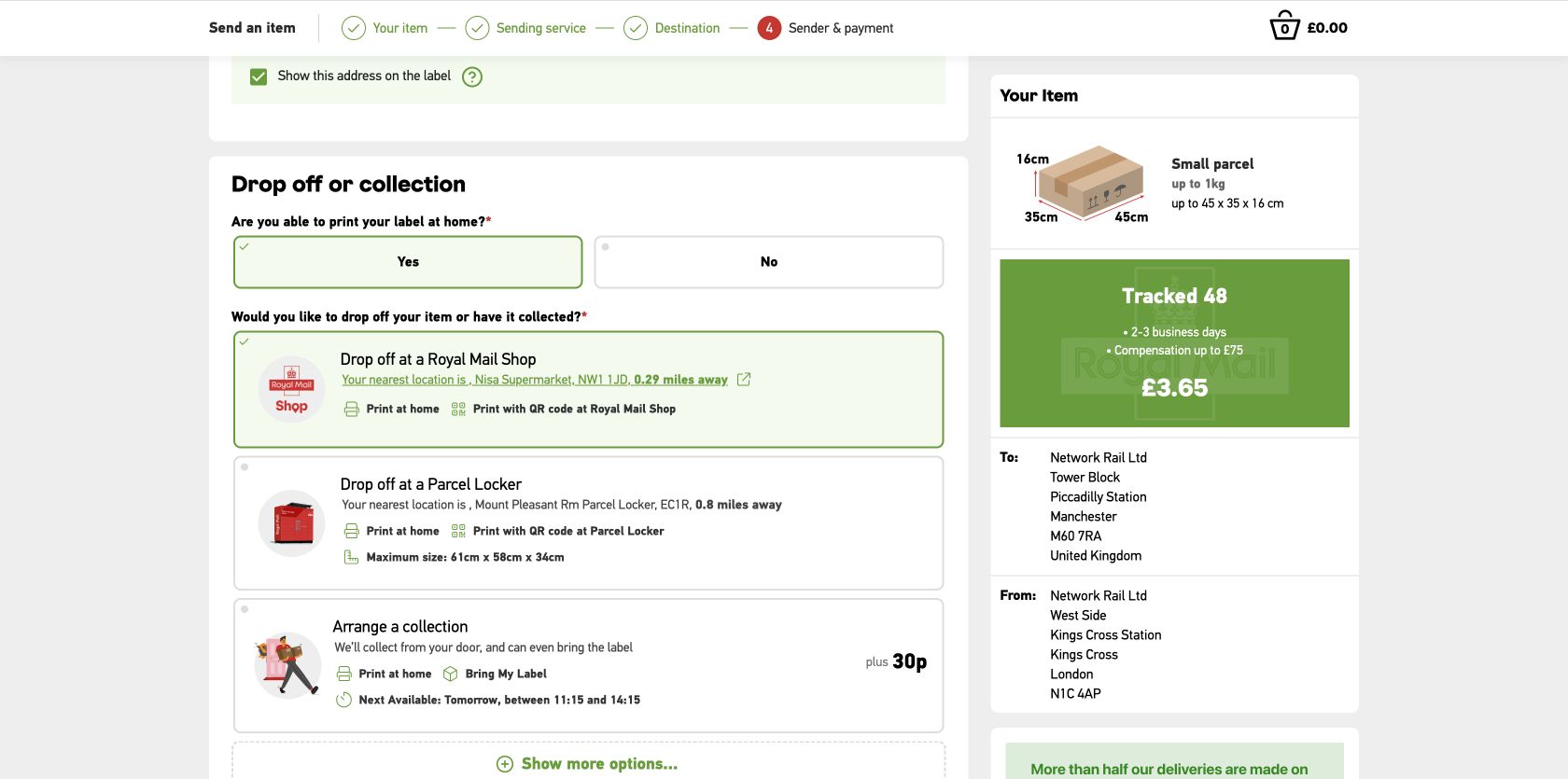
Tracked 48: £3.65, two to three days, tracking and a delivery photo. Royal Mail Shop drop-off.
Standard: £3.04 including VAT, usually two to four working days, ParcelShop drop-off and £20 cover.
Public railway-station business addresses, a reserved example.com email and fictional contact details were used where the form required them.
Royal Mail payment and Evri’s mandatory account dialog. No payment was entered, authorised or submitted.
Desktop Chrome with additional checks at a 390-pixel phone width. Prices and promotion terms can change.
The 30-second result
Royal Mail cost 61p more and reached payment as a guest. Evri saved money, then required an account.
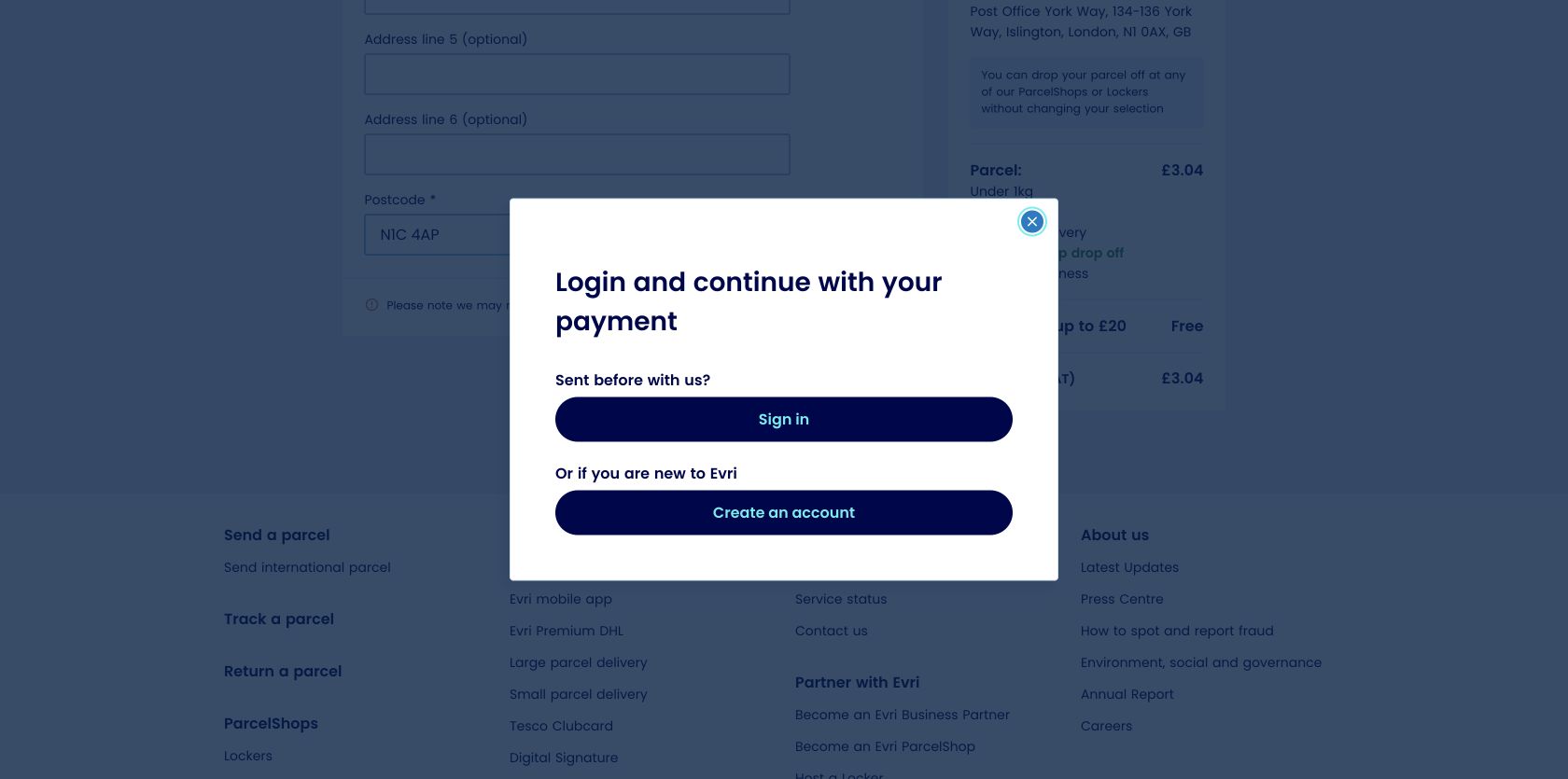
Royal Mail wins the end-to-end public journey. Its size selector, service comparison, address forms, drop-off choice and £3.65 payment boundary all worked without registration. Evri was cheaper at £3.04 and kept a useful summary beside every step, but “Add to basket” opened a dialog offering only Sign in or Create an account. The lower price remains meaningful; the forced account changes the commitment required to access it.
Evri won on price; Royal Mail made the service easier to compare
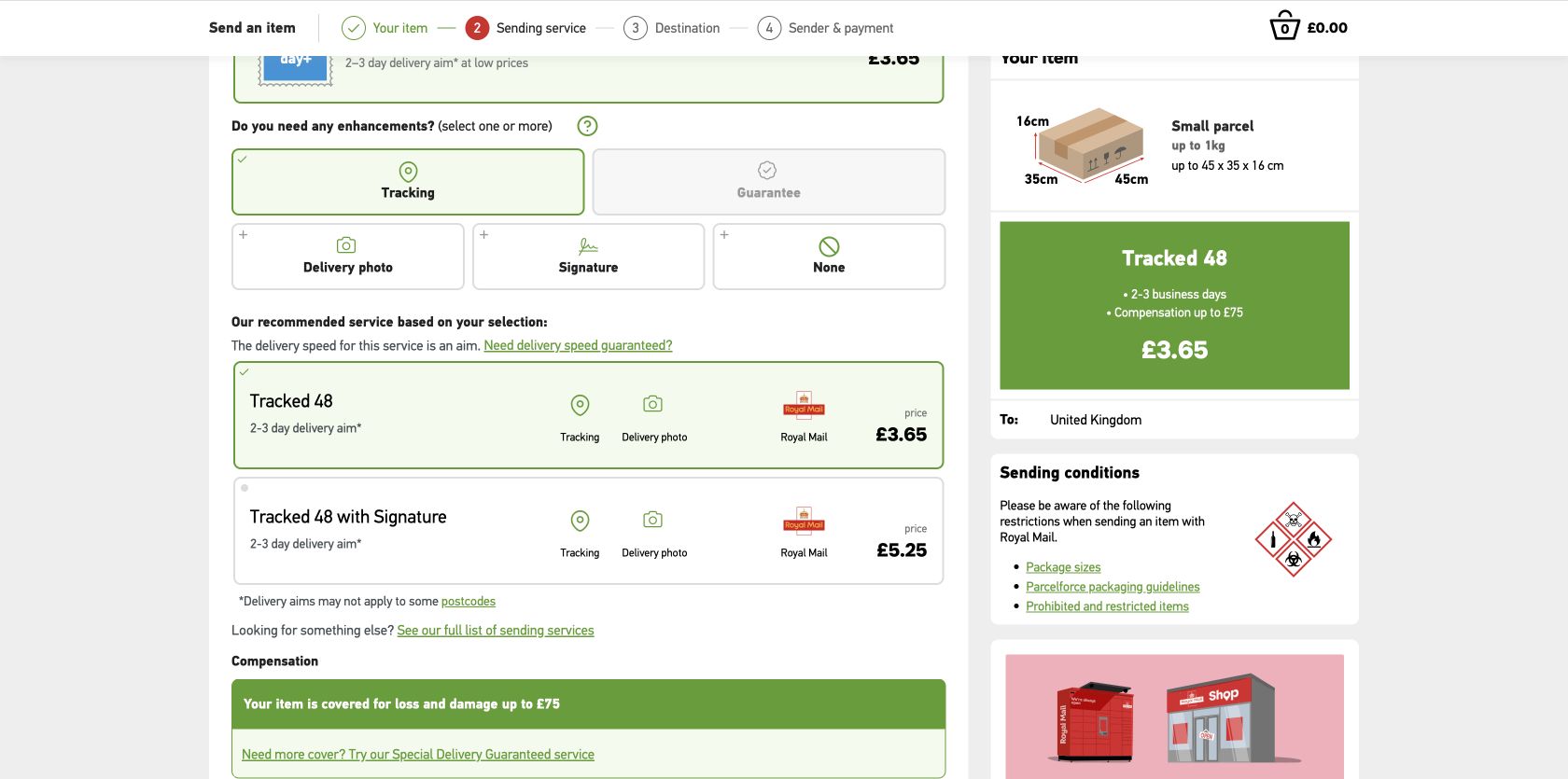
Royal Mail began with familiar format tiles. Small parcel stated its 45 × 35 × 16cm limit, 2kg maximum and “from £3.65” price before the form asked for weight. After we selected up to 1kg, two-day-plus and tracking, Tracked 48 appeared at £3.65 with a two-to-three-day estimate, tracking and delivery photo. Signature raised the price to £5.25.
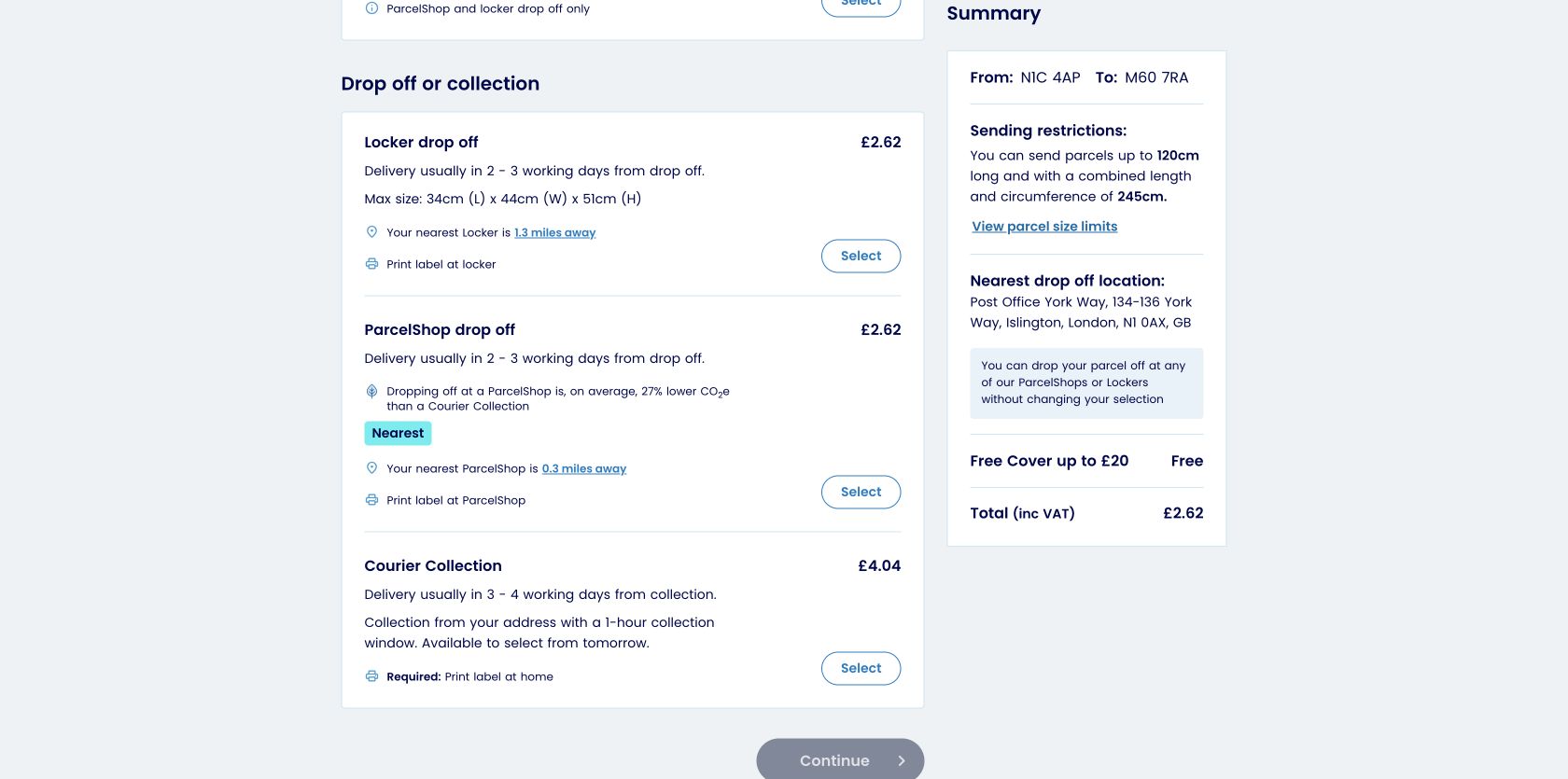
Evri priced the same size and weight at £3.04 including VAT for ParcelShop drop-off and home or business delivery. Courier collection cost £4.04; recipient collection from a ParcelShop reduced the price to £2.62. Standard delivery was described as two to four working days, while the route summary said delivery was usually two to three days after drop-off. Free cover up to £20 was included.
Round edge / Evri
The selected standard service was 61p cheaper and the summary made the effect of collection and recipient-pickup choices immediately visible.
Both used postcode lookup; Royal Mail handled missing contact details better
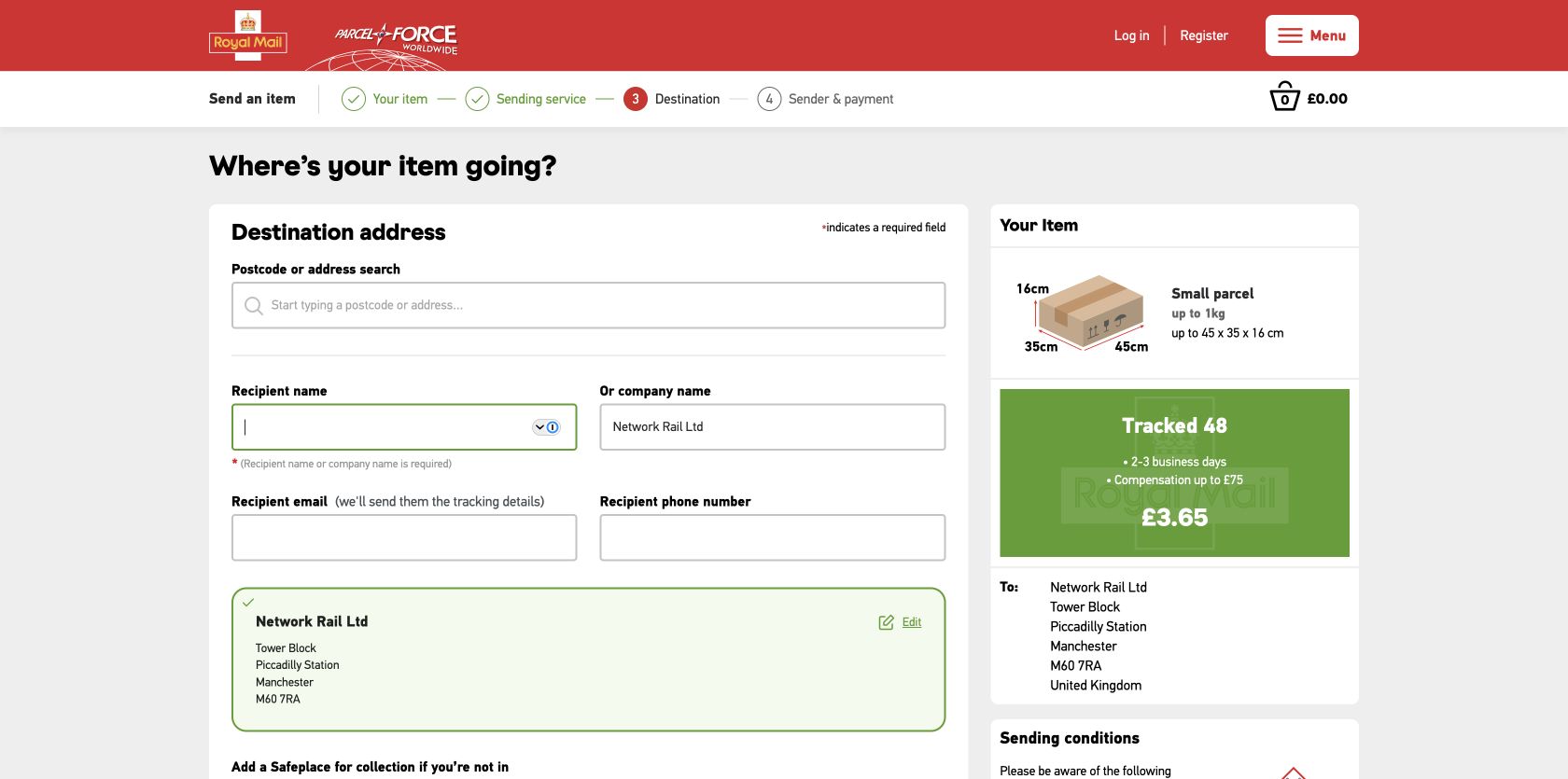
Royal Mail separated recipient and sender into clear steps. Leaving the recipient email and phone empty produced a useful warning that the recipient would not receive tracking notifications, but it still allowed the sender to continue. That matched the consequence to the choice without inventing a requirement.
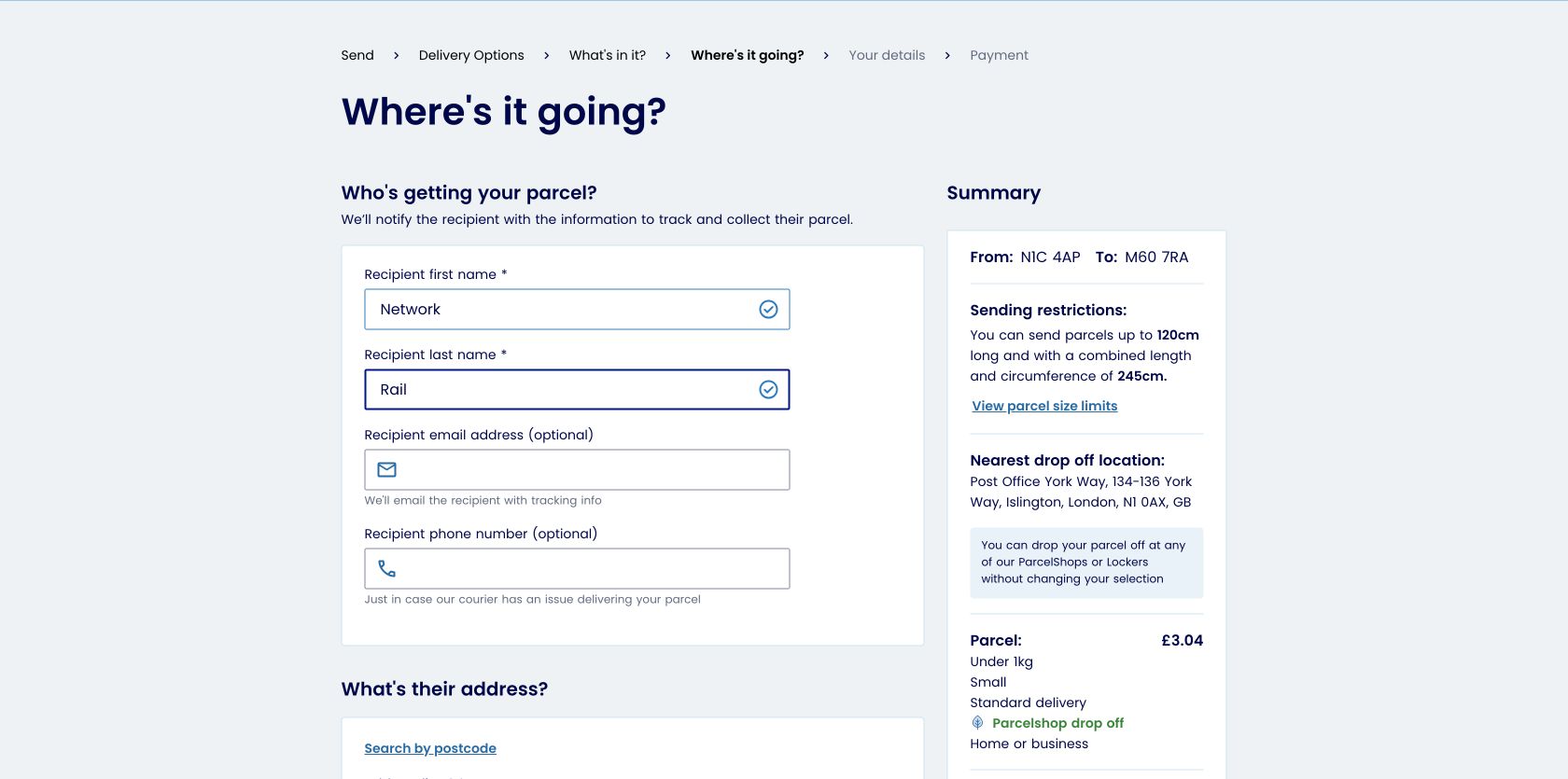
Evri also offered postcode lookup, populated a public business address and preserved the £3.04 summary, parcel size, delivery type, £20 cover and nearest drop-off point beside the form. The progress sequence—Send, Delivery Options, What’s in it?, Where’s it going?, Your details, Payment—made the remaining work visible.
Round edge / Royal Mail
Evri’s persistent summary was stronger, but Royal Mail’s warning respected optional contact data and described the real consequence.
Evri’s contents form recovered clearly
Submitting Evri’s empty contents step produced a top-level Error message and specific “This is a required field” messages for contents and value. After “Books” and £20 were entered, the errors cleared and the journey continued with the free £20 cover intact. An optional signature cost 60p and started unselected.
Royal Mail’s most useful recovery behaviour appeared in the contact warning rather than a failed form. It allowed progress while making the lost tracking notification explicit. Neither journey sent data or created an account during the recovery tests.
Round edge / Evri
The error summary, inline messages and successful correction formed the clearer conventional recovery path.
Royal Mail honoured its no-registration promise
Royal Mail reached a £3.65 payment page after the Royal Mail Shop drop-off choice. It offered card, PayPal and Google Pay, kept Confirm and Pay disabled until the required billing details were complete and presented an optional next-day upgrade for £1. We stopped without choosing or entering a payment method.
Evri changed course at the equivalent commitment point. Its Your details form ended with “Add to basket”; selecting it opened “Login and continue with your payment” with only Sign in and Create an account. There was no guest action. Because creating credentials is consequential, the test stopped there.
Round winner / Royal Mail
Royal Mail let a first-time sender inspect the complete service and payment boundary without creating credentials.
Evri loaded faster; both send pages moved too much
These 75th-percentile Chrome UX Report results cover the exact Royal Mail item-start URL and Evri send URL from 27 August to 23 September 2026. They do not measure the address, account or payment screens above. Evri’s loading was strong, but its layout instability was poor on both device groups. Royal Mail missed the good range on all three phone metrics.
Mobile PageSpeed checks on 25 September scored Royal Mail 69 for accessibility and 100 for best practices; Evri scored 99 and 77. Royal Mail’s automated failures included unnamed controls and links, colour contrast, an unlabelled field, restricted zoom, positive tabindex and small targets. Evri’s accessibility run found a heading-order issue. Automated checks are diagnostic leads and do not establish WCAG conformance.
All ten Nielsen usability heuristics
Keep route, parcel and total visible.
Evri’s persistent summary did this best; Royal Mail’s staged progress also made sequence clear.
Start with recognisable parcel formats.
Royal Mail’s size tiles translated centimetre limits into familiar letters and parcels.
Let optional contact data remain optional.
Royal Mail warned about lost notifications and still allowed progress.
Do not label an account gate as Add to basket.
Evri’s button described one action and delivered another.
Keep Confirm and Pay disabled until complete.
Royal Mail prevented an accidental transaction at the boundary.
Repeat the chosen service beside forms.
Evri preserved weight, size, delivery, drop-off, cover and total across steps.
Support guest sending.
Royal Mail allowed it; Evri required registration only after the work had been completed.
Keep upgrades subordinate.
Royal Mail’s £1 next-day choice remained secondary to the selected £3.65 service.
Connect summaries to fields.
Evri supplied a visible summary and inline required messages on the contents step.
Explain cover and delivery terms at selection.
Both exposed the core service information before sender details.
What we would change first
Allow guest payment or disclose the account rule at the quote.
What
Provide Continue as guest; if registration is essential, state it before address entry.
Where
The service quote and the transition from Your details to payment.
Why
The current dialog changes the commitment after the sender has completed the task.
Measure
Origin-step completion, account-dialog exits and progression to payment.
Repair control names, labels and zoom support.
What
Name basket and navigation controls, associate form labels, remove positive tabindex and allow user scaling.
Where
The public send template beginning at parcel size.
Why
The mobile accessibility score was 69 and the failures affect keyboard and screen-reader use.
Measure
Automated regressions, keyboard completion and task testing with assistive-technology users.
Reserve space for late content.
What
Stabilise information banners and feature-link cards before they render.
Where
The exact public send page and shared shell.
Why
Real-user CLS was 0.44 on phone and 0.57 on desktop.
Measure
p75 CLS, mis-clicks and quote-form starts.
Improve loading, interaction and stability together.
What
Profile the shared template, long tasks and late layout changes instead of optimising one isolated score.
Where
The item-start page and components reused through checkout.
Why
Phone LCP, INP and CLS all missed the good range.
Measure
Template-level p75 vitals beside quote completion and progression to payment.
What this public comparison cannot see
Evri’s account gate prevented inspection of its basket and payment screens. We did not hand over a physical parcel, test labels or QR codes, track a delivery, make a claim, contact support or complete payment. Delivery estimates and prices can vary by service and promotion.
We cannot say which journey converts better or which service delivers more reliably. With GA4, Search Console and Microsoft Clarity connected, UX Robot could quantify quote starts, service changes, form errors, account-gate exits and progression to payment.