Independent public comparison
We asked Premier Inn and Travelodge to book a flexible, fully refundable double room near London Waterloo for two adults. We are not affiliated with either company. This records the public journeys on 27 September 2026; rates and availability can change.
The London Waterloo hotel test
Book one standard double room for two adults from 18 to 19 October 2026, using the flexible fully refundable rate.
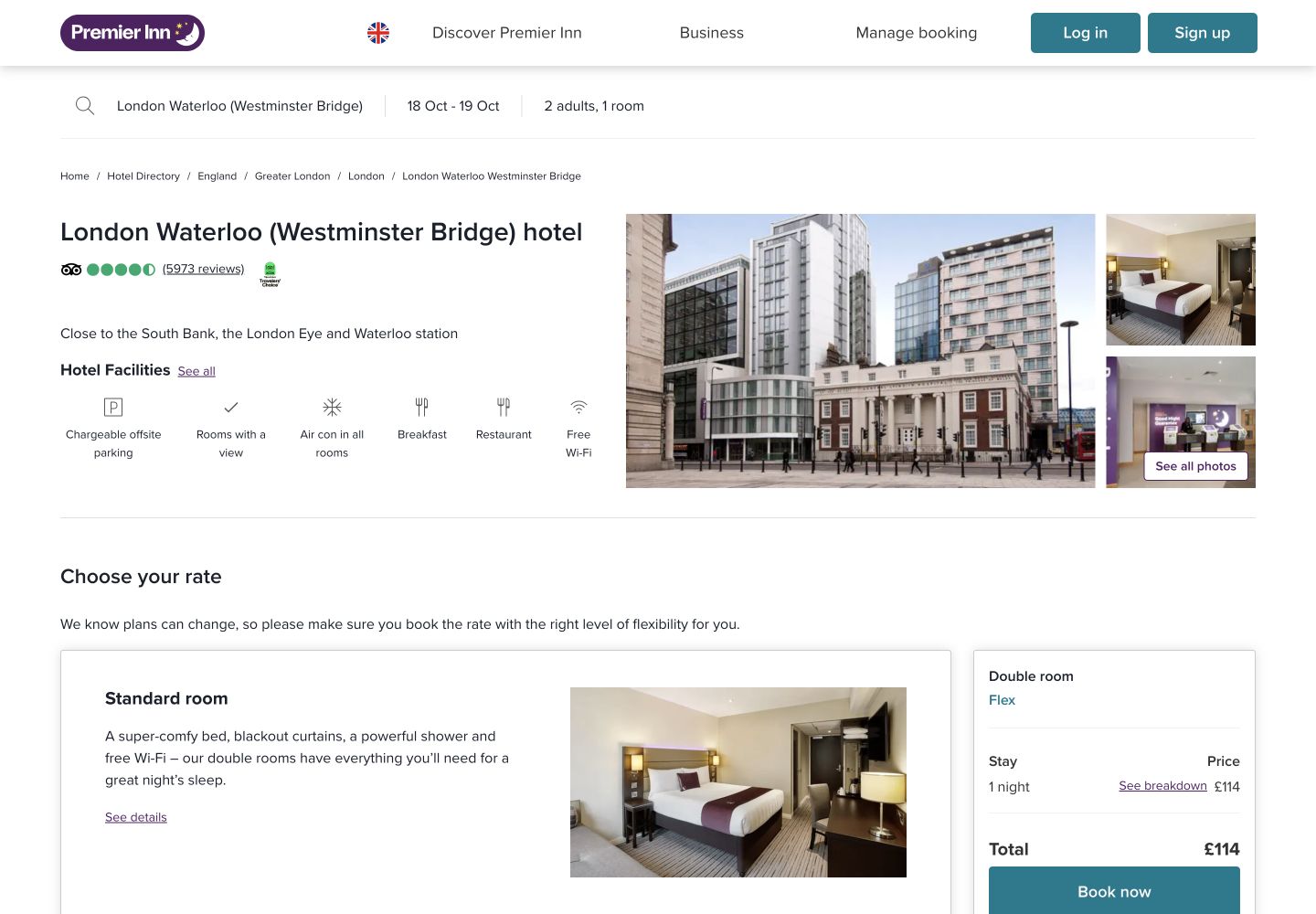
London Waterloo (Westminster Bridge), Flex rate at £114 for one night.
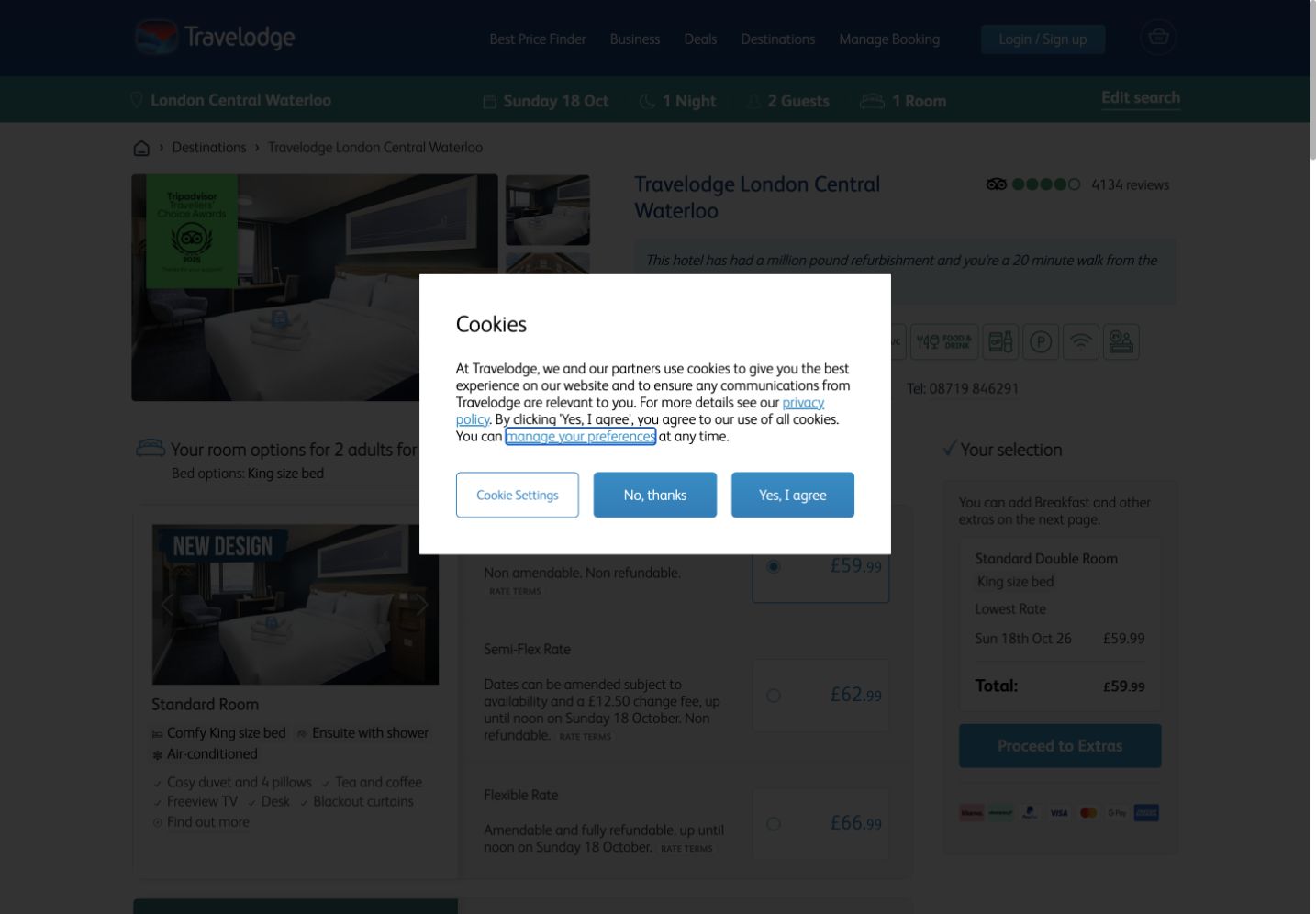
London Central Waterloo, Flexible rate at £66.99 for one night.
United Kingdom, unsigned-in desktop Chrome session, prices in pounds.
The empty guest-details submission before payment. No booking, identity or payment data was submitted.
Standard double room and the closest publicly offered flexible, fully refundable rate at each hotel.
The 30-second result
Travelodge delivered the same broad flexibility for £47.01 less. Premier Inn explained the rate ladder more calmly.
Travelodge wins this booking journey on value. Its £66.99 Flexible rate was amendable and fully refundable until noon on arrival day, while Premier Inn’s £114 Flex rate allowed cancellation until 1pm. Both kept optional extras unselected and reached guest details without forcing an account. Premier Inn’s three-rate comparison was easier to read, but Travelodge exposed more payment choices at checkout. The win comes with a serious technical caveat: Travelodge’s tested public hotel page had poor phone loading, unstable layout and a 68 mobile accessibility score.
Premier Inn made the rate ladder easier to understand
Premier Inn offered Standard at £95, Semi-Flex at £105 and Flex at £114. Each step paired the price with its payment and cancellation consequence: Standard was paid now and non-refundable, Semi-Flex was paid now and refundable up to three days before arrival, and Flex could be paid now or on arrival.
Travelodge offered a £59.99 Lowest Rate, £62.99 Semi-Flex and £66.99 Flexible rate for the standard room. A SuperRoom ranged from £81.99 to £91.99. The hierarchy was denser, but the £7 jump from Lowest to Flexible was modest and the selected total stayed visible beside the cards.
Travelodge’s flexible rate was cheaper and nearly as forgiving
Travelodge allowed free amendment and a full refund until noon on 18 October. Premier Inn allowed a full refund until 1pm that day and also offered payment on arrival. Premier Inn therefore held a one-hour and payment-timing advantage; Travelodge saved £47.01 on the observed stay. The two hotels and products are not identical, but the commitment customers were comparing was clear.
Round winner / Travelodge
The flexible standard room was materially cheaper while retaining arrival-day cancellation.
Neither preselected extras; Travelodge exposed more of the final payment context
Premier Inn offered unlimited breakfast at £14.99 per person, continental breakfast at £12.99, a £29.99 meal deal, £6 room Wi-Fi and £20 early check-in. None was selected, and the £114 room total remained intact. The separate price for Wi-Fi sat awkwardly beside the hotel page’s general “Free Wi-Fi” facility message and needed more explanation.
Travelodge’s extras modal offered breakfast at £12.50 per person, dinner at £15.99, £20 early check-in, £15 late checkout, a £20 pet charge and Premium Wi-Fi from £3.50. Skipping all six preserved the £66.99 total. The checkout then showed Apple Pay, cards, Google Pay, PayPal, Klarna, Clearpay and PayPal Pay Later before any payment was attempted.
Both named missing fields; neither moved focus well
Premier Inn’s empty Continue attempt produced specific messages for required guest and address fields, but focus stayed on Continue rather than moving to the first error. Travelodge identified first name, last name, email, contact number, address and the required confirmation, yet focus fell back to the page body. Clear messages are only half the recovery contract: keyboard and screen-reader users also need predictable focus and announcement.
Travelodge’s value win did not extend to its public page runtime
These p75 phone Chrome UX Report records cover the exact public hotel pages from 29 August to 25 September 2026. They do not measure the dynamic guest or payment steps above. Neither page met all three good thresholds; Travelodge’s 4.11-second LCP is the clearest loading priority, while both need interaction and layout work.
The configured mobile PageSpeed runs scored Premier Inn 88 for accessibility and 77 for best practices, and Travelodge 68 and 46. Premier Inn’s automated findings included heading order, missing image alternatives, unnamed links and small touch targets. Travelodge’s included unnamed inputs, buttons and links, ARIA structure, contrast, headings, image alternatives, list structure, disabled zoom and label/name mismatches. These are diagnostic leads, not proof of WCAG conformance.
All ten Nielsen usability heuristics
Keep stay and total visible.
Both preserved dates, guests and room; each also kept the selected total through extras.
Lead with cancellation deadlines.
Both translated rate names into a specific arrival-day commitment.
Let extras remain optional.
Neither preselected breakfast, food, Wi-Fi or arrival-time products.
Reconcile Wi-Fi messages.
Premier Inn’s facility and paid room-Wi-Fi wording need one clear explanation.
Show commitment before Book.
Both exposed refund consequences before guest details.
Keep rate terms beside prices.
Premier Inn’s three-card ladder was the clearest comparison.
Support preferred payment methods.
Travelodge exposed more payment choices at the boundary.
Keep consent out of the rate decision.
Travelodge’s cookie modal covered the first useful comparison view.
Move focus to the first invalid field.
Both provided messages without an efficient focus handoff.
Explain every paid facility.
Wi-Fi, parking, breakfast and check-in terms should remain available at selection.
What we would change first
Fix the public page’s loading and accessibility debt.
What
Prioritise the LCP resource, reserve media dimensions and repair the named control, label, ARIA, contrast and zoom defects.
Where
The London Central Waterloo page and shared hotel components.
Why
Exact-page LCP was 4.11 seconds and mobile accessibility scored 68.
Measure
p75 LCP and CLS, automated regressions and successful keyboard room selection.
Focus and announce the first error.
What
Add a linked error summary, focus it or the first invalid control, and announce changes.
Where
The guest and address forms before payment.
Why
Both displayed useful messages but left focus on the action or body.
Measure
Repeat submits, recovery time and assisted task completion.
Make Wi-Fi entitlement unambiguous.
What
State what the included service provides and what the £6 upgrade adds.
Where
The hotel facilities, rate summary and extras step.
Why
The observed journey showed both “Free Wi-Fi” and a paid room option.
Measure
Wi-Fi help opens, upgrade reversals and support contacts.
Keep the refundable choice anchored.
What
Persist price, deadline, pay timing and selected extras in a compact summary.
Where
Rate cards, extras and guest details.
Why
The commitment difference matters more than the branded rate name.
Measure
Rate switches, term opens, reversals and booking progression.
What this public comparison cannot see
The hotels, rooms and loyalty propositions differ. We did not enter identity or payment details, reserve a room, stay at either hotel or test amendment and cancellation after booking. Prices and extras can change at any time.
We cannot say which journey converts better or which stay is better. GA4 could measure rate comparison, extra acceptance and payment progression, Search Console could show the location and flexibility needs that start each journey, and Microsoft Clarity could reveal form recovery before completed flexible bookings.