Independent public comparison
We compared public prepaid eSIM journeys from Telstra and Optus on 29 September 2026. We are not affiliated with either provider. Both pages contained dated offers, and Optus advertised a price change from 30 September; this article records what the journeys showed during the test.
The 28-day prepaid eSIM test
As a price-conscious mobile customer, I want a 28-day prepaid eSIM with at least 25GB so that I can get connected without a contract.
Compare the introductory and ongoing data, the recurring recharge price and eSIM activation requirements; stop before identity, account or payment.
The $54 plan offered a $40 eSIM activation and next six recharges, 75GB for three recharges, then 35GB.
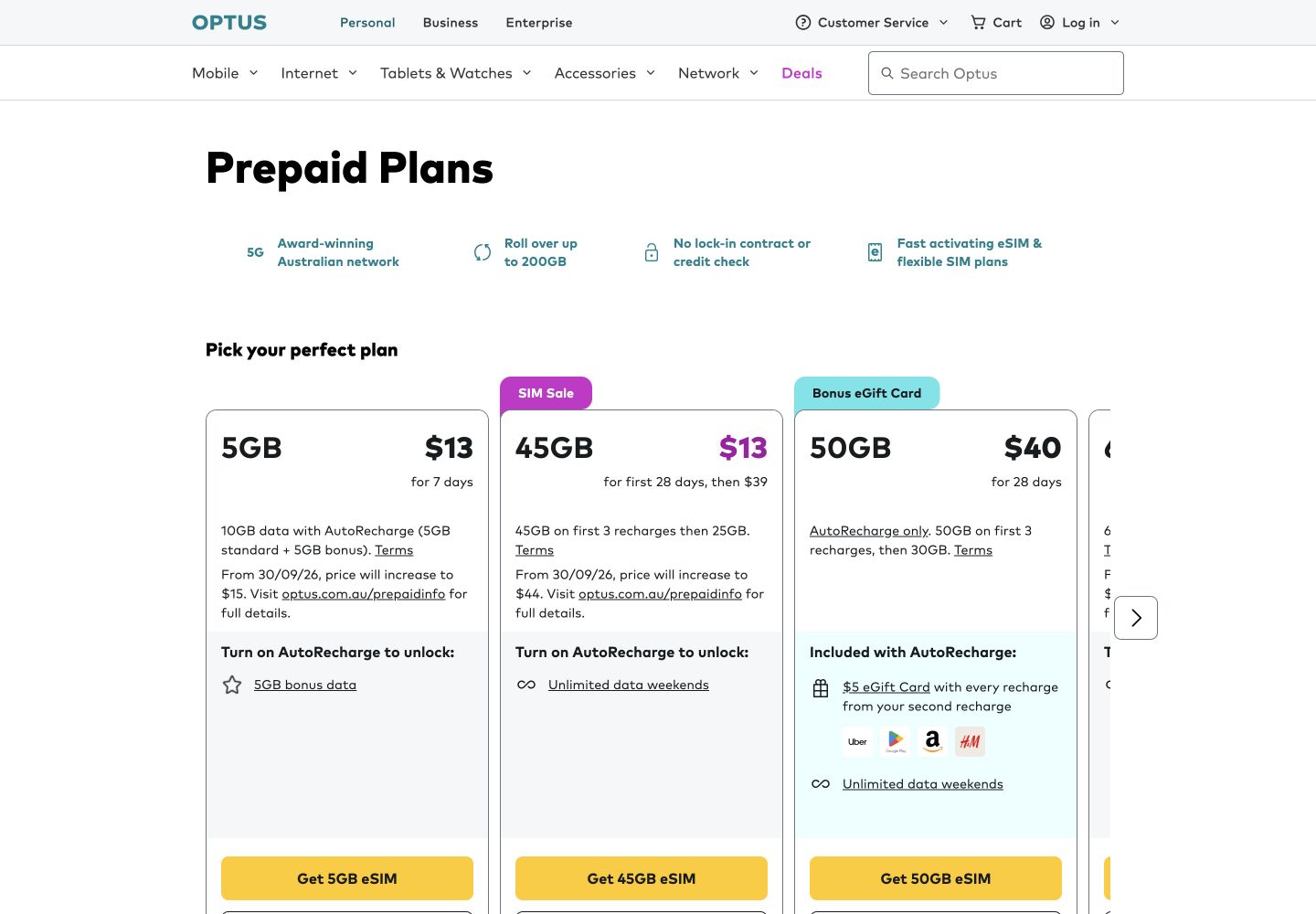
The selected plan showed $13 first recharge, then $39, 45GB for three recharges, then 25GB; its recurring price was due to rise to $44 the next day.
Australia, unsigned-in desktop Chrome at 1440 × 1000, prices in Australian dollars.
Follow each eSIM route to its pre-activation boundary, test the available action and stop before submitting ID, creating an account or paying.
The 30-second result
Telstra wins the activation journey by explaining the eSIM hand-off and identity requirements before commitment. Optus makes plan trade-offs easier to scan, then stalls at Get started.
Both selected plans meet the ongoing 25GB requirement, but the promotional headlines need careful reading. Telstra separates its temporary $40 eSIM offer from the regular $54 plan and tells the user how compatibility, QR-code setup and ID will work. Optus presents competing plans in a stronger comparison grid and discloses the imminent $44 recurring price, yet the valid activation action disabled itself without navigation or an error in this test. That failure is part of the observed user experience—not an external access block.
Optus makes the promotional-to-ongoing trade-off easier to compare
Optus places multiple prepaid choices in one card row. The selected 45GB eSIM was $13 for the first 28 days and then $39, with 45GB for the first three recharges and 25GB after that. The same card warned that the recurring price would rise to $44 from 30 September 2026. A neighbouring $40 AutoRecharge-only plan offered 50GB for three recharges and then 30GB, plus a recurring eGift-card offer.
Telstra’s $44 plan dropped from 50GB for the first three recharges to 20GB, so it did not meet the ongoing requirement. The next qualifying plan was the $54 option: 75GB for three recharges and 35GB thereafter. Its eSIM-only offer reduced activation and the next six recharges to $40, with the offer ending 5 October and the bonus data requiring activation by 2 November. Telstra communicates the terms, but finding the true long-term fit takes more cross-reading than Optus’s card row.
Round winner / Optus
Its cards make introductory data, ongoing data and adjacent alternatives directly comparable, even though the same-day deadline creates urgency.
Telstra makes the activation boundary predictable
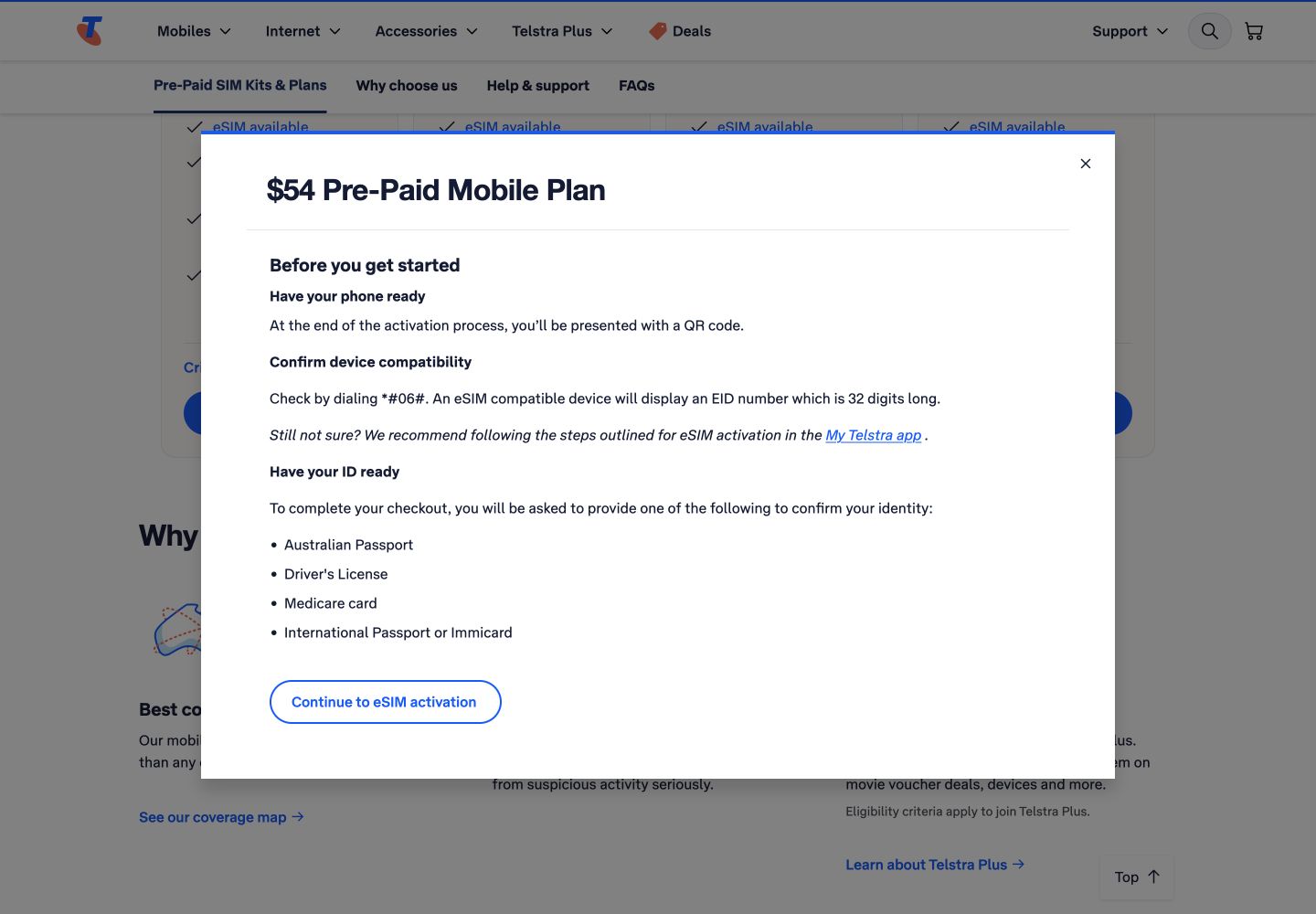
Choosing Telstra eSIM opens a focused preparation screen before the hand-off. It explains that activation will end with a QR code, provides a device-compatibility check using the EID, and names the accepted identity documents: Australian passport, driver’s licence, Medicare card, international passport or ImmiCard. This is the information a cautious user needs before starting an identity-bound flow.
Optus also lists a card, valid ID, compatible 4G or 5G device and the My Optus app, and reminds users keeping a number to have the old SIM in the device. The requirement copy is useful. The problem appears at the action: clicking Get started changed the button to a disabled state, but after 3.5 seconds the page had not navigated and displayed no progress or error.
Optus turns a valid action into an unexplained wait
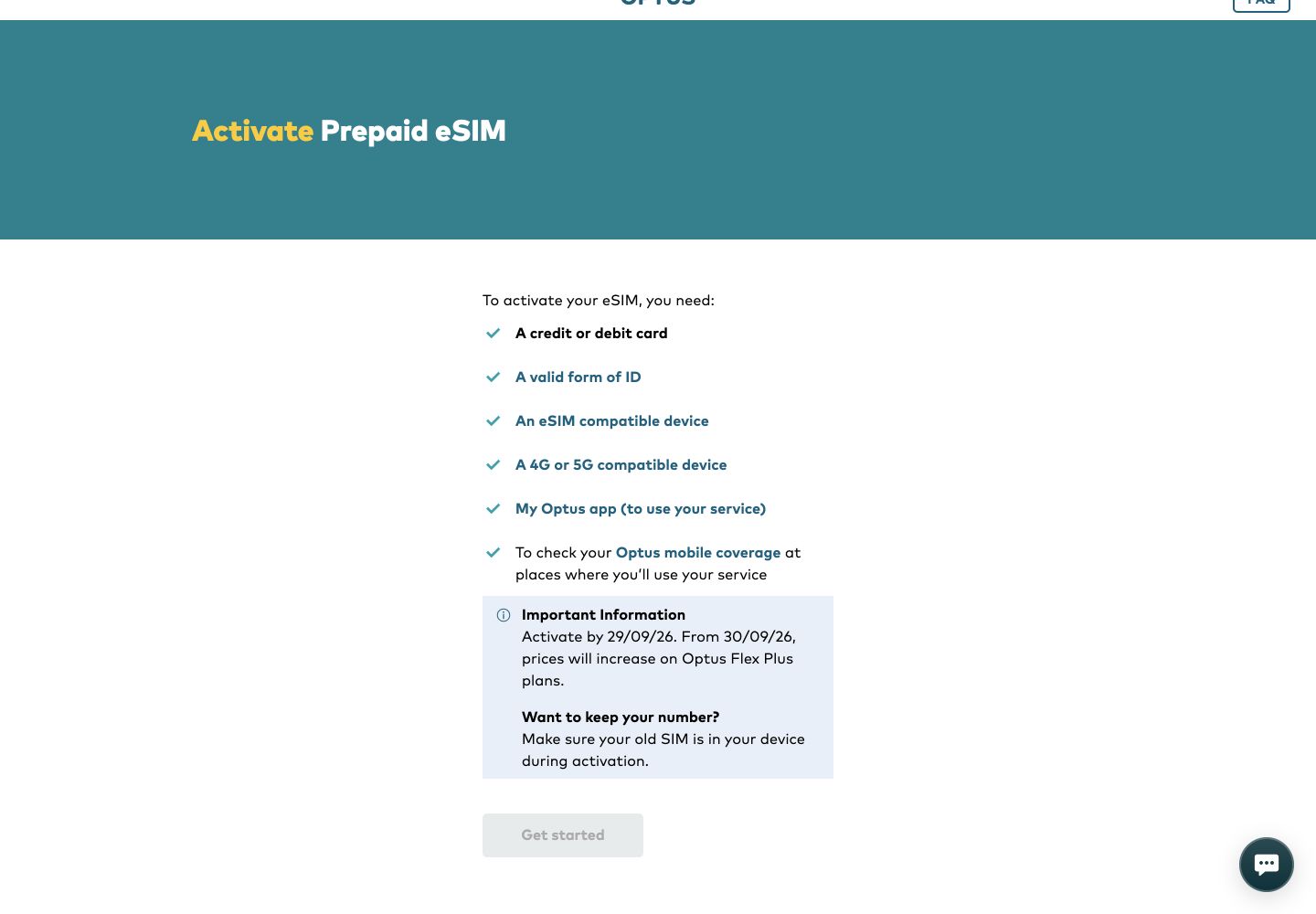
A disabled button can prevent duplicate submission, but it must be paired with a progress label, busy state and recoverable timeout. Without those signals, the user cannot tell whether activation has begun, whether another prerequisite is missing or whether it is safe to retry. Going back preserved access to the plan journey, so this remained a usable UX failure rather than a bot, location or authentication block.
Keyboard checks found a visible multi-ring focus treatment on Telstra’s My Telstra app link and a visible native outline on Optus’s “Get 45GB SIM” control. That is useful evidence about the tested controls, not a whole-site accessibility claim.
Optus is faster in the field but produced a severe late shift in one clean trace
These are p75 phone Chrome UX Report results for the exact public plan URLs from 31 August to 27 September 2026. They represent all qualifying visits to those URLs, not only this eSIM path. Both load their largest content quickly, while interaction responsiveness needs improvement; Telstra also needs better field layout stability.
Clean desktop traces told a more volatile story. Telstra recorded 3.75s LCP and 0.00 CLS. Optus recorded 6.13s LCP and 0.615 CLS, with the main shift cluster arriving around 6.7 seconds. An unsized Aboriginal artwork image in the footer was identified in the moving region. Because Optus’s field CLS is 0.04, this single lab run is a reproducible diagnostic—not evidence that most users see a poor shift.
Configured PageSpeed checks scored Telstra 95 for accessibility and 96 for best practices, versus Optus at 100 and 77. Telstra’s findings included a select without a label and visible-label/accessibility-name mismatch. Optus’s performance diagnostics included layout-shift elements and unsized images. Automated scores indicate targets for inspection and do not establish WCAG conformance.
All ten Nielsen usability heuristics
Say what happens after Get started.
Telstra previews the hand-off; Optus leaves a valid click in an unexplained disabled state.
Lead with the ongoing monthly reality.
Both must help users distinguish a promotional recharge from what they will normally pay and receive.
Keep a safe route back to plan comparison.
Both let the user return before identity or payment.
Use one structure for promotional terms.
Price, recharge count, bonus data and deadline should appear in a predictable order.
Check compatibility before identity capture.
Telstra’s EID instruction reduces the chance of starting on an incompatible phone.
Keep introductory and ongoing allowances together.
Optus’s card row best supports side-by-side recognition.
Support fast eSIM without hiding the prerequisites.
Both promise digital activation and expose the main preparation needs.
Prevent late footer content from moving the page.
Optus’s lab shift distracts from an otherwise scannable plan layout.
Turn a stalled action into a retryable state.
Show progress, timeout copy and a safe retry that cannot duplicate an activation.
Name accepted ID before hand-off.
Telstra’s specific document list is more useful than a generic “valid ID” requirement.
What we would change first
Make Get started observable and recoverable.
What
Replace the silent disabled state with progress text, a programmatic busy state, timeout feedback and an idempotent retry.
Where
The prepaid eSIM activation hand-off.
Why
A valid click produced no destination or error in the tested journey.
Measure
Hand-off latency, timeout rate, repeat clicks and completed activations.
Give ongoing price and data equal visual weight.
What
Add a standard “first recharges / after promotion” pair to every plan card.
Where
The prepaid plan comparison before SIM type selection.
Why
The cheaper $44 plan fails this user’s ongoing 25GB need despite its stronger introductory allowance.
Measure
Plan changes, term expansion, recharge retention and price-related support contacts.
Size the footer artwork before it loads.
What
Add intrinsic dimensions or an aspect ratio and reserve the final footer region.
Where
The Aboriginal artwork image and its late-loading container on the plans page.
Why
One clean run produced a 0.615 shift cluster tied to that region.
Measure
Lab shift nodes, exact-page p75 CLS and accidental clicks during late load.
Profile the controls users touch first.
What
Instrument plan selection, carousel controls and eSIM hand-offs; reduce long tasks around those actions.
Where
The exact prepaid plan pages, prioritising phone sessions.
Why
Both exact URLs have p75 INP above the 200ms good threshold.
Measure
Component INP, long tasks, plan-selection latency and activation progression.
What this public comparison cannot see
We stopped before submitting identity, creating an account, transferring a number or paying. We did not activate either service or assess coverage, speeds, congestion, app setup, support or later recharge behaviour. Prices, data bonuses and deadlines were time-sensitive snapshots.
Public testing cannot show which plan produces more successful activations or satisfied customers. Product analytics should connect term expansion, plan changes, hand-off errors, identity completion and activation with recharge retention and support outcomes.