Independent public comparison
We compared the public information and unsigned-in joining starts for AustralianSuper and Rest. We are not affiliated with either fund. This is a UX review, not financial advice or a recommendation to choose a fund. Fees, performance and product terms can change; read the current PDS and TMD before making a decision.
The first-super-account test
As a new employee choosing my first super fund, I want to understand its fees and default investment before joining so that my employer contributions enter an account I understand.
Review public fees and the default investment, begin the super joining flow, test empty and malformed-email recovery, then stop before submitting personal information.
Public admin fee of $1 a week plus 0.10% pa of the balance, capped at $350 pa; the join start names Balanced as the default option.
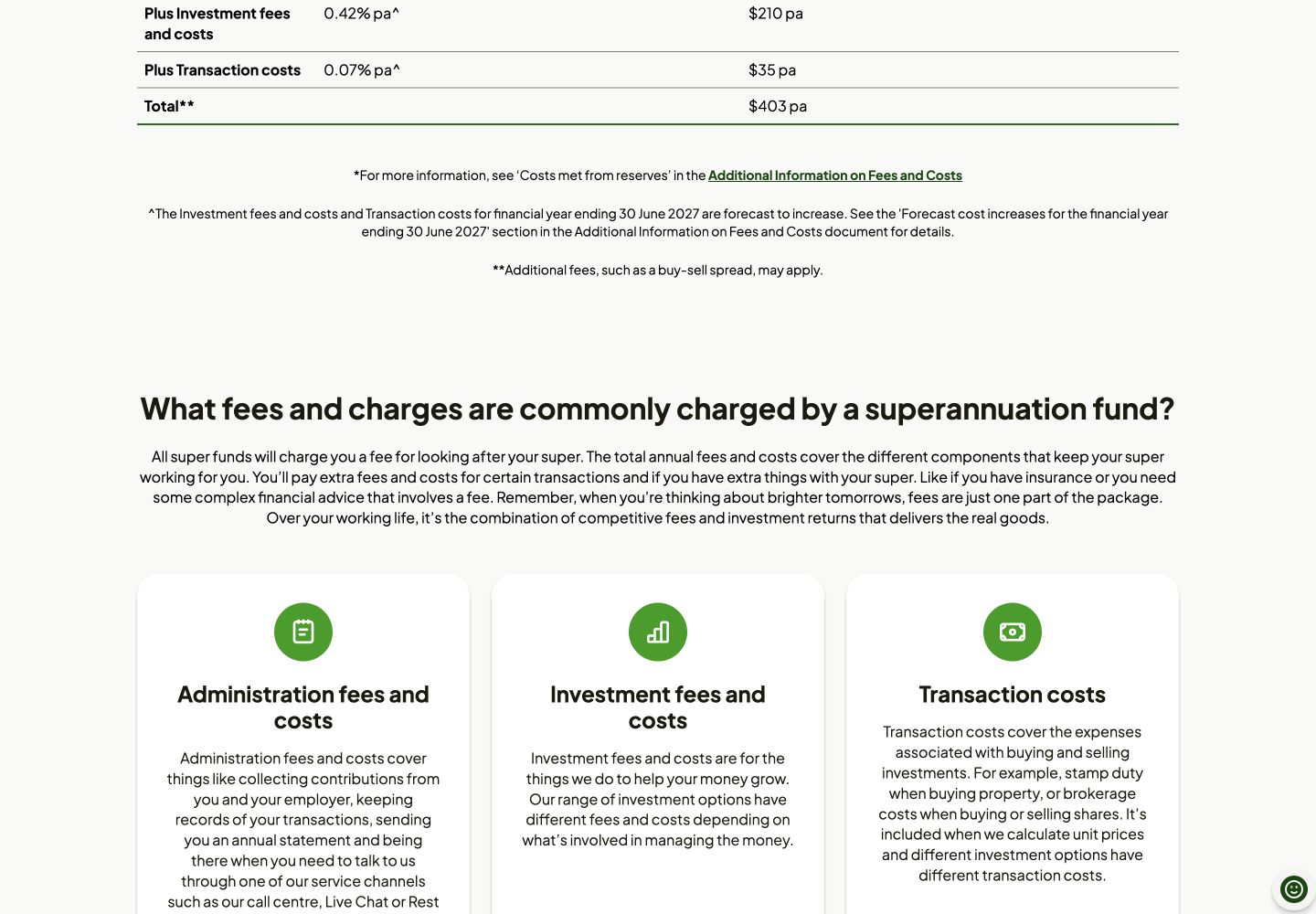
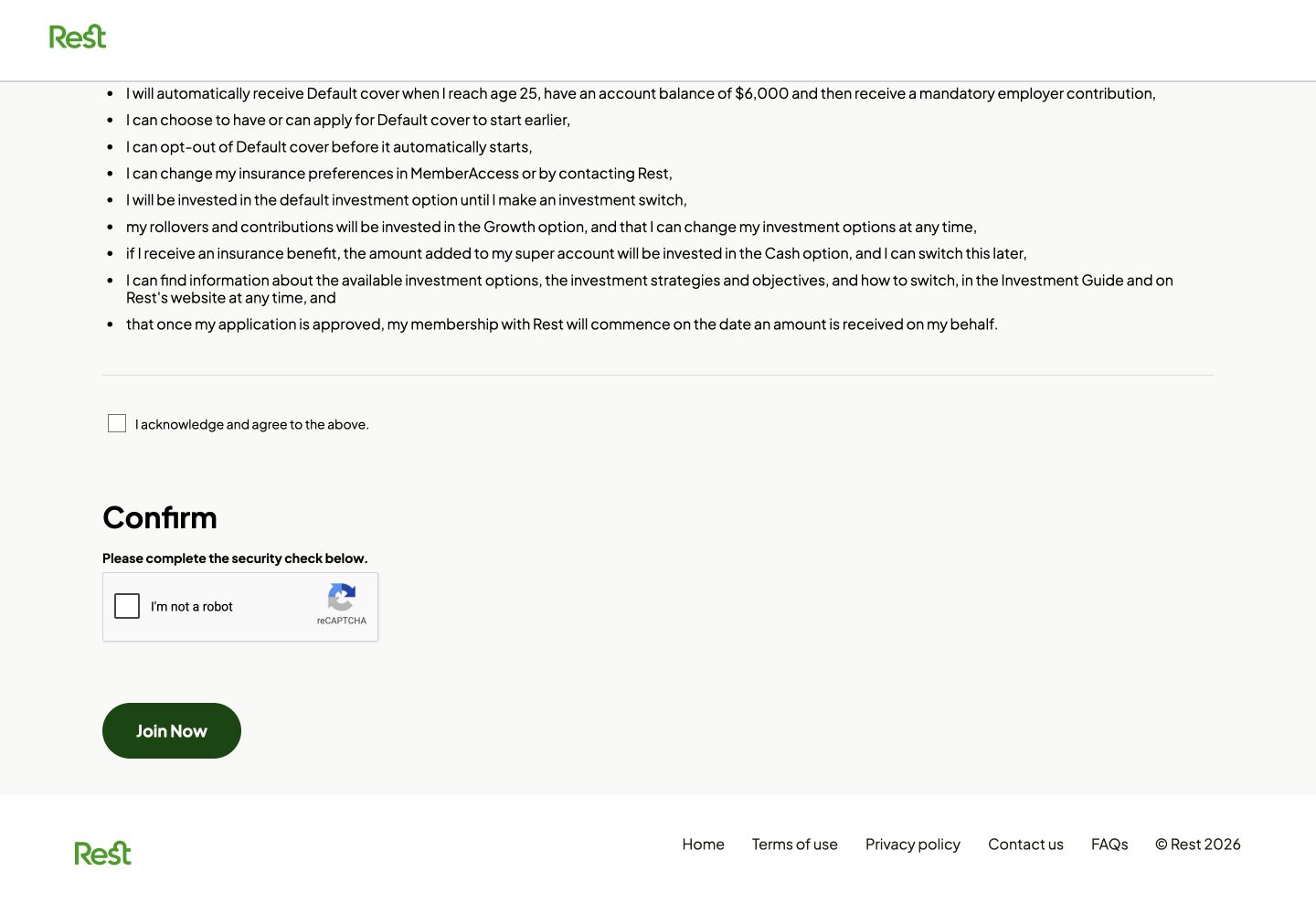
A separate fee page gives a $403 pa example for a $50,000 Growth balance; the application later says contributions default to Growth.
Australia, unsigned-in desktop Chrome at 1440 × 1000, current public pages observed on 28 September 2026.
Submit required fields empty, inspect focus and messages, enter and correct a malformed email, then stop. No application, account or personal data was submitted.
The 30-second result
AustralianSuper gives the prospective member the clearer pre-join explanation. Rest makes the important facts discoverable, but too late and across too many surfaces.
AustralianSuper wins this information journey. Its marketing page gives the admin-fee formula, and its join start explains that no investment choice means the default Balanced option before asking only for an email and privacy acknowledgement. Rest has a useful fee table and clearly identifies Growth as the default, but the “Join Rest” page does not surface either fact: fees require a product-page detour, while the default appears deep in a long personal-details application. Both forms provide specific, recoverable errors.
AustralianSuper connects the proposition to the default choice
AustralianSuper’s public “How to join” page states an administration fee of $1 a week plus 0.10% pa of the account balance, capped at $350 pa. It also names Balanced as its flagship option and provides a PDS and TMD route before the application. On the join start, the fund repeats the consequence of doing nothing: the account will be invested in the default Balanced option. That is the right information at the right commitment point.

Rest’s dedicated fee page is stronger once found. For a $50,000 balance in Growth it itemises $78 pa plus $50 pa of balance-based administration charges, $30 pa met from reserves, $210 pa of investment fees and costs, and $35 pa of transaction costs—a $403 pa example, before possible additional fees. This is not directly comparable with AustralianSuper’s admin-fee statement because Rest’s example includes investment and transaction costs.
Round winner / AustralianSuper
It links the default investment to the joining decision instead of asking the visitor to assemble the story across pages.
Rest’s join page promotes confidence signals before product facts
The public “Join Rest” page leads with “anyone can join”, awards, app features and a direct Join call to action. Fees and the default investment are absent from that decision surface. The visitor can navigate through Super, Super Products and Rest Super to reach “Competitive fees”, then another link to the actual table. That route is possible, but it asks a new employee to know which facts to seek and where fund information normally lives.

The external application begins immediately with title, name, gender, date of birth, contact details and address. Only much later, after links to fee and investment documents, does the confirmation text say that contributions and rollovers will be invested in Growth until the member switches. The disclosure is accurate and visible before final submission, but it appears after the form has asked for substantial personal information.
Both recover correctly; AustralianSuper asks for less before value is clear
AustralianSuper’s first step asks for an email and agreement to the privacy collection statement. An empty Get Started attempt produced “Please enter your email address” and “Please review and agree”, with focus on the email field. Entering “bad” changed the message to “Please check your email address”; correcting it cleared that message without advancing.

Rest’s empty Join Now attempt exposed specific messages beside all required controls and moved focus to the first Title selector. A malformed email produced “Please enter a valid email address”, and the message cleared after correction. That is good recovery behaviour, but the one-page form reveals a large wall of required errors at once. A staged approach would reduce the recovery burden and bring product understanding before identity data.
AustralianSuper has the stronger exact-page phone record
These are p75 phone Chrome UX Report results for the exact public join URLs from 30 August to 26 September 2026. AustralianSuper passes LCP and CLS but not INP. Rest misses all three good thresholds, with slower largest-content rendering and greater layout movement. These field measurements describe the full exact URLs across real Chrome visits; they do not prove which component caused a metric.
The configured mobile PageSpeed runs scored AustralianSuper 95 for accessibility and 73 for best practices, versus Rest at 85 and 69. AustralianSuper’s findings concerned focusable content in an aria-hidden region and the absence of a main landmark. Rest’s included contrast, heading order, unlabelled form controls, disabled zoom and a skip-link failure. Automated findings identify risks; they do not establish WCAG conformance.
All ten Nielsen usability heuristics
State the default before data entry.
AustralianSuper does this; Rest waits until the confirmation area.
Use worked annual examples.
Rest’s $50,000 example translates percentages into a recognisable yearly cost.
Explain switchability with the default.
Both say the investment choice can be changed later.
Keep product facts consistent across marketing and application.
Joining should not change from a promotional story to legal disclosure without a bridge.
Validate a short start before collecting identity data.
AustralianSuper’s email gate prevents a much larger correction loop.
Repeat fees and default at the join start.
Rest currently relies on the visitor remembering earlier pages or documents.
Support save-and-resume early.
AustralianSuper promises an application ID valid for 30 days before starting.
Prioritise decision facts over award volume.
Awards can reassure after fee, default and insurance consequences are clear.
Preserve specific messages and first-error focus.
Both corrected the tested email problem without losing state.
Keep PDS detail available without making it the only explanation.
Plain-language summaries should link to—not be replaced by—formal documents.
What we would change first
Put the fee example and default Growth option before Join.
What
Add a plain-language product facts panel with links to the full fee page, PDS and investment guide.
Where
The primary Join Rest page and top of the external application.
Why
The observed journey required detours for fees and a long scroll for the default.
Measure
Fee-link use, join starts, pre-submit exits and informed-comprehension checks.
Stage personal details before the confirmation wall.
What
Split the application into progress-labelled sections and show only errors for the current step.
Where
Personal, contact, address, TFN and acknowledgement sections.
Why
An empty submission currently reveals many errors across one long page.
Measure
Validation loops, time per step, save-and-resume use and completed applications.
Investigate the exact join page’s long interaction delay.
What
Trace email, consent and Get Started interactions under phone CPU conditions.
Where
The member-join start and shared form components.
Why
The exact-page p75 INP is 463ms despite good loading and stability.
Measure
p75 INP, interaction traces, start success and repeated-click rate.
Fix semantic failures and track them with completion.
What
Repair hidden-focus, landmarks, labels, contrast, zoom and skip-link behaviour, then retest by keyboard and screen reader.
Where
Join pages and shared navigation/form templates.
Why
Automated findings affect understanding and recovery in a consequential financial task.
Measure
Zero component regressions, successful assistive-technology completion and p75 Core Web Vitals.
What this public comparison cannot see
We did not submit personal details, accept product terms, solve Rest’s reCAPTCHA or create an account. We did not assess insurance suitability, investment suitability, long-term net returns, service quality or which product is financially appropriate. The displayed fees and performance statements remain subject to each fund’s current disclosures.
Public testing cannot show application conversion or comprehension. Analytics could connect product-information views, document opens, form starts, validation loops, save-and-resume and completed memberships; moderated research would be needed to learn whether first-time members understand the fee and default-investment consequences.