Independent public comparison
We asked Boots and Superdrug to sell us the same CeraVe Hydrating Cleanser 236ml as a guest in the United Kingdom. We are not affiliated with either retailer. This records the public journeys on 28 September 2026; prices, offers and delivery charges can change.
The CeraVe cleanser test
Buy CeraVe Hydrating Cleanser 236ml, add one to the basket and reach the guest-checkout entry.
£9.37, reduced from £12.50; basket total £13.32 including £3.95 standard delivery.
£9.38, reduced from £12.49; basket total £9.38 with shipping deferred to the next step.
United Kingdom, unsigned-in desktop Chrome at 1440 × 1000, prices in pounds sterling.
Guest-checkout entry before submitting personal details or payment. No account, order or payment was submitted.
Where the form loaded safely, continue empty, inspect messages and focus, then correct First name.
The 30-second result
Boots wins by showing the delivered total before checkout. Superdrug has the better tested form recovery.
The products differed by one penny, so cost transparency decided this comparison. Boots showed £3.95 standard delivery and a £13.32 basket total before the guest handoff. Superdrug kept its total at £9.38 and postponed shipping until the next step. Superdrug then delivered specific inline validation and recovered when First name was corrected. Boots’ next page was blocked by a local client-side browser condition, so we do not score its later form.
Both pages identify the product; Boots gives more fulfilment detail
Boots showed the 236ml size at £9.37, a £3.13 saving against £12.50, a 4.6 rating from 2,576 reviews and collection and standard-delivery thresholds. Ingredients, suitability and offers were available on the same page. That is a strong recognition-first product state: the buyer can verify the exact bottle before acting.
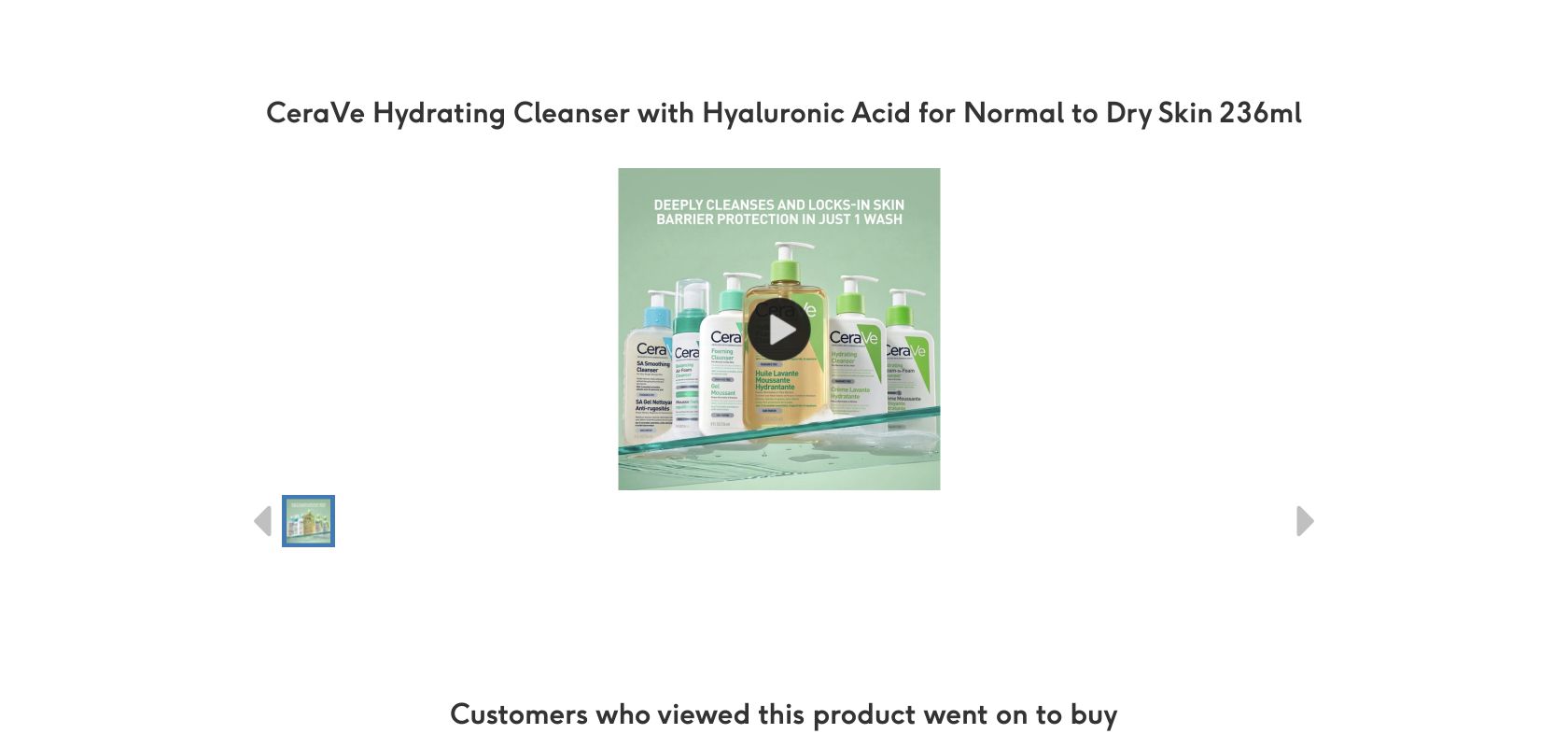
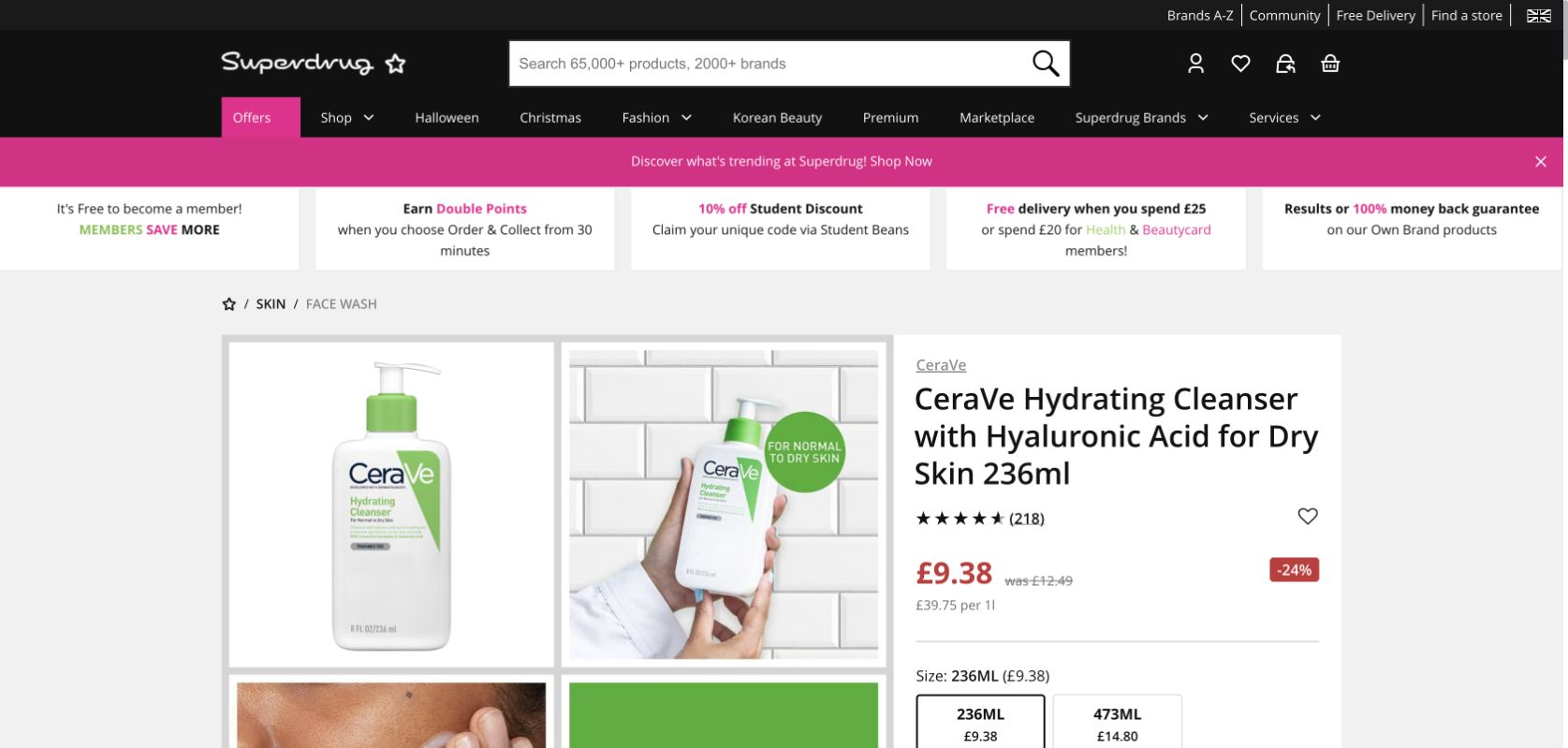
Superdrug showed the same size at £9.38, reduced from £12.49, with a 4.6 rating from 218 reviews and two offer messages. Its page was clear enough to confirm the match, although the Add to basket response took several seconds before the basket state updated.
Boots answers “what will this cost?” one step sooner
Boots’ basket flyout retained the £9.37 item and added £3.95 standard delivery for a visible £13.32 total. It also showed free-delivery thresholds and collection pricing. Recommendations, account prompts, voucher controls and points added density, but the number needed for the next decision was present.
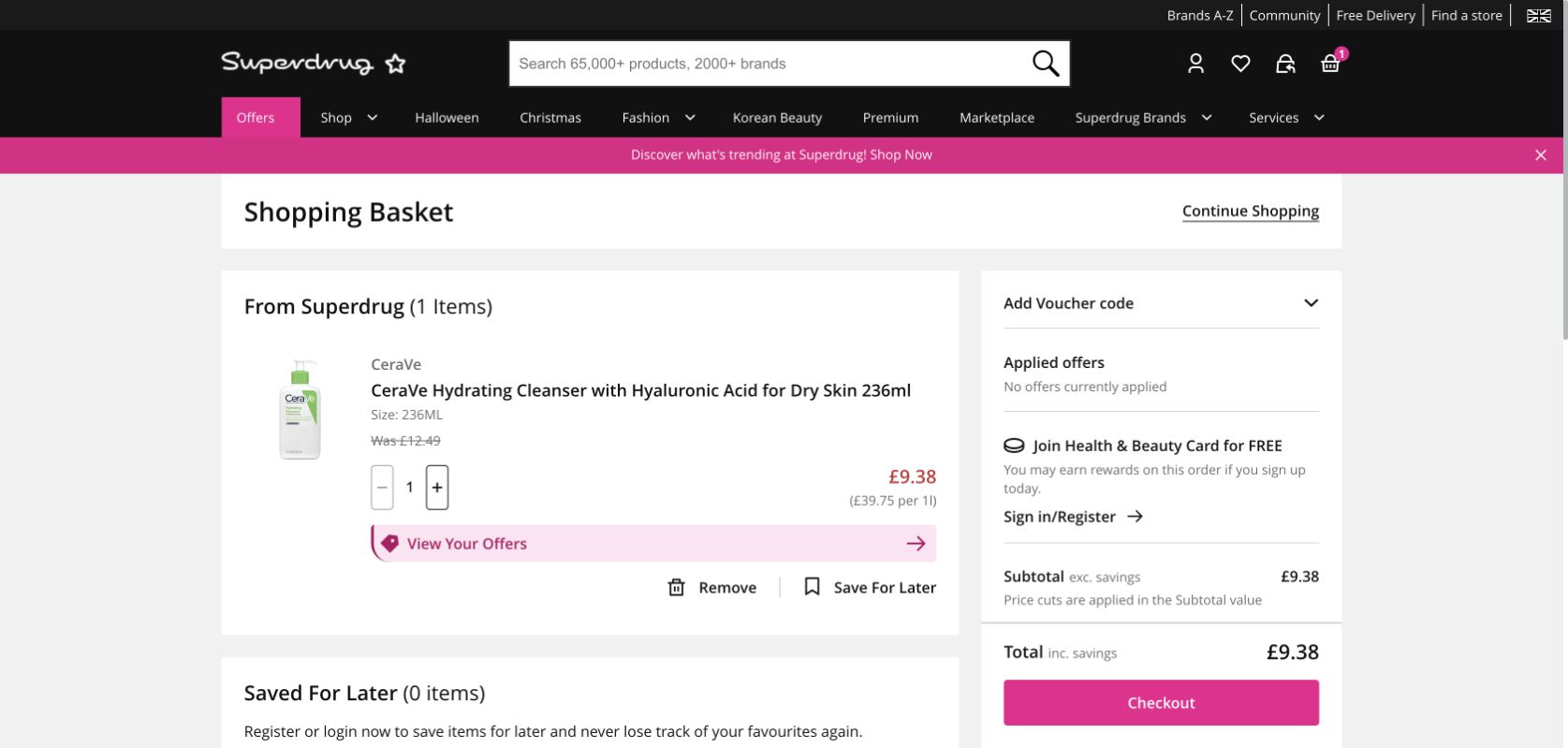
Superdrug’s basket retained the £9.38 item but labelled shipping as calculated in the next step. That makes the apparent one-penny product difference less useful: the customer still cannot compare the amount that will leave their account. Financing and promotion controls compete with that unresolved cost.
Round winner / Boots
It shows the standard delivered total before asking the customer to begin checkout.
Superdrug’s guest form recovers well, but its copy needs polish
Boots made registered and guest routes explicit. Selecting guest was the right safe action, but the following document was stopped by Chrome with ERR_BLOCKED_BY_CLIENT. Because that condition can be caused by the local browser environment, it is a testing limitation, not a Boots defect.
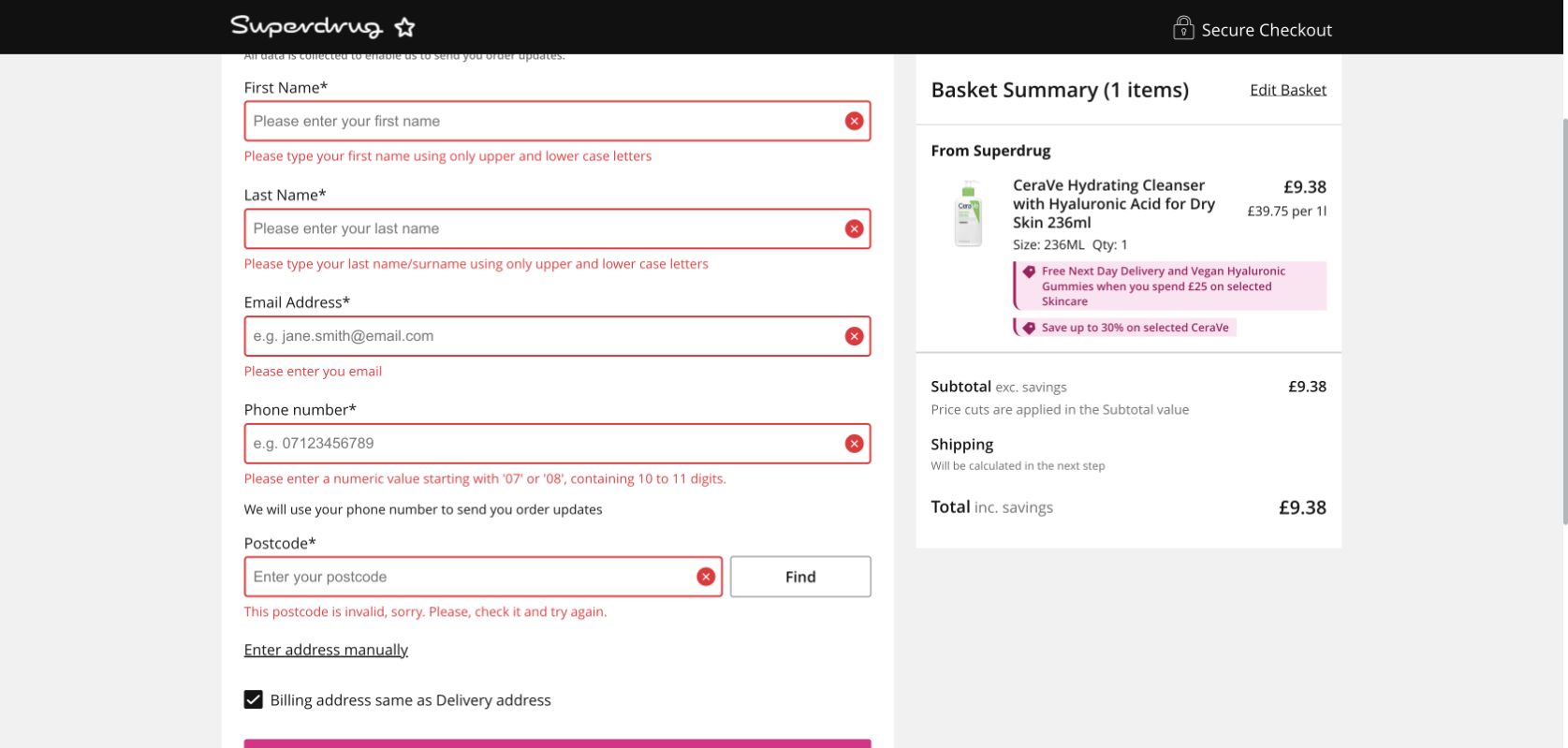
Superdrug reached delivery details without an account. An empty Continue attempt produced specific rules for name, email, phone and postcode and moved focus into the error sequence. Correcting First name to “UX” cleared its message and displayed a success marker. The form therefore passed the tested recovery loop. The message “Please enter you email” is a small but visible copy defect in a trust-sensitive step.
Real phone users see slow, unstable and delayed interactions
These p75 phone Chrome UX Report results cover qualifying pages across each public origin from 30 August to 26 September 2026. They are not measurements of these exact product or checkout pages and cannot prove which component caused a metric. Both origins miss the good loading and interaction thresholds; Boots’ 0.34 CLS is poor, while Superdrug’s 495ms INP sits just inside the needs-improvement band.
The configured mobile PageSpeed runs scored Boots 77 for accessibility and 77 for best practices, compared with 97 and 96 for Superdrug. Boots’ exact product page exposed unnamed controls and links, prohibited ARIA, low contrast, an untitled frame, skipped headings, malformed lists, disabled zoom and a positive tabindex. Superdrug’s repeat run found low contrast and visible-label/accessibility-name mismatches. Automated checks identify risks; they do not establish WCAG conformance.
All ten Nielsen usability heuristics
Confirm Add to basket immediately.
Superdrug eventually updated the basket, but the wait lacked a strong progress state.
Show the delivered amount.
Boots turns item price and standard delivery into one recognisable total.
Keep guest checkout prominent.
Both offered a route that did not require account creation.
Use polished, grammatical errors.
Superdrug’s “enter you email” weakens confidence during checkout.
Explain phone and postcode formats before submission.
The rules appeared only after the empty attempt.
Repeat product, quantity and delivery together.
The basket should remain the authoritative purchase summary.
Offer account benefits without interrupting guests.
Login, loyalty and voucher controls should not obscure the primary route.
Reduce basket competition.
Recommendations and finance are secondary to cost and checkout.
Keep the summary connected to fields.
Superdrug’s corrected first name cleared successfully and focus moved predictably.
Explain delivery thresholds at the point of choice.
Boots did this earlier; Superdrug deferred the actual shipping amount.
What we would change first
Estimate delivery before checkout.
What
Use location or a lightweight postcode prompt to show the likely charge and earliest option.
Where
The basket totals panel.
Why
The displayed £9.38 excludes a material part of the transaction.
Measure
Delivery lookups, checkout starts, exits after shipping disclosure and completed orders.
Repair the product template’s control semantics.
What
Name controls and frames, correct ARIA and list structure, restore zoom, fix heading order and remove positive tabindex.
Where
The exact CeraVe product template and shared commerce components.
Why
The automated score was 77 and several failures affect navigation and operation.
Measure
Zero component regressions plus keyboard and screen-reader add-to-basket completion.
Reduce work around basket updates.
What
Profile product option changes, basket drawers and third-party scripts; defer work that is not needed to confirm the item.
Where
Product and basket templates.
Why
Origin-level p75 INP was 437ms for Boots and 495ms for Superdrug.
Measure
p75 INP alongside add-to-basket acknowledgement and basket-to-checkout progression.
Polish validation copy and expose formats sooner.
What
Correct the email message and put phone and postcode guidance beside the fields.
Where
Delivery details.
Why
The recovery mechanism works, but preventable copy errors reduce confidence.
Measure
Repeat validation, time to valid field and guest completion.
What this public comparison cannot see
We stopped before submitting delivery details or payment. Boots’ guest handoff was blocked by a client-side browser condition, so its later form was not scored and no claim is made about its address or payment experience. The origin-level field data describes qualifying pages across each site, not these exact screens.
Public testing cannot show which retailer converts better. GA4 could connect product views, add-to-basket acknowledgement, delivery-price disclosure, validation recovery and completed orders; Search Console could show the cleanser and delivery intentions that start the journey; Microsoft Clarity could reveal hesitation around basket totals and guest details.